Home
Class 11
PHYSICS
A rod of length L and uniform cross-sect...

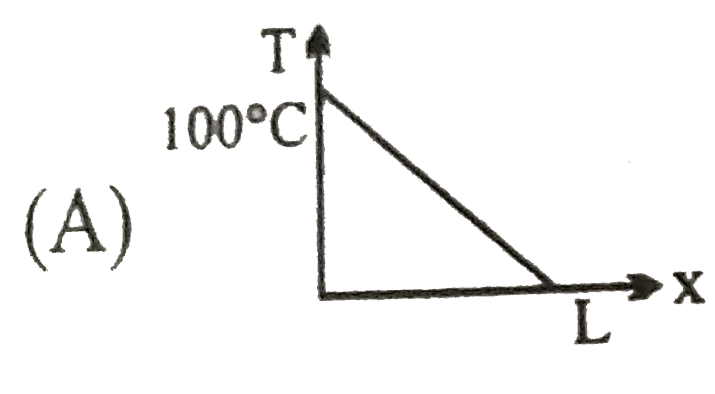
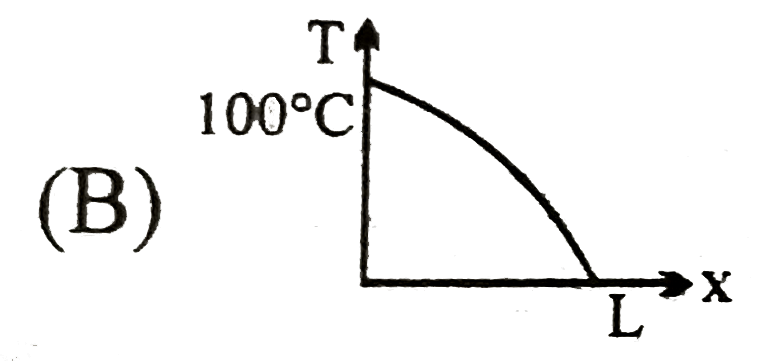
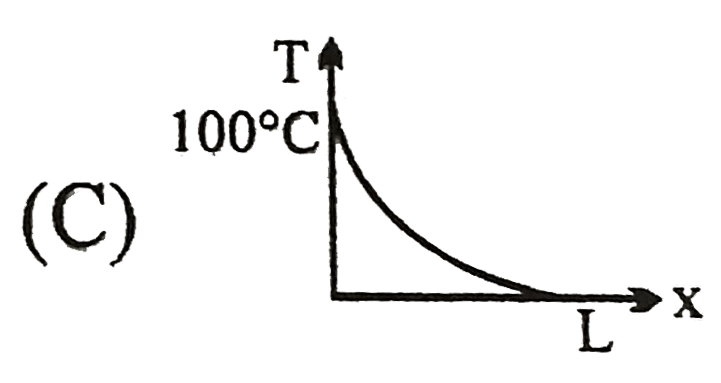
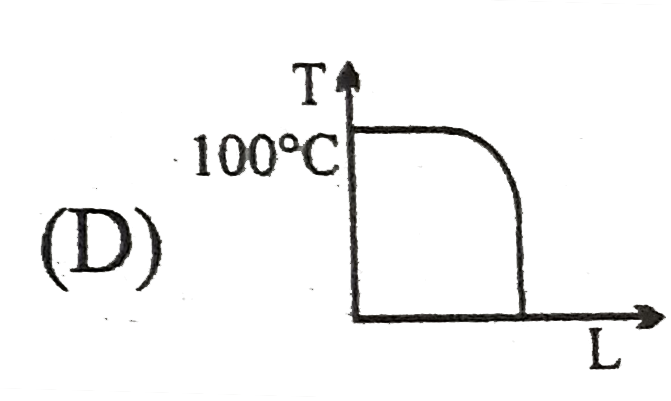
A rod of length `L` and uniform cross-sectional area has varying thermal conductivity which changes linearly from `2K` at end `A` to `K` at the other end `B`. The ends `A` and `B` of the rod are maintained at constant temperture `100^(@)C` and `0^(@)C`, respectively. At steady state, the graph of temperture : `T=T(x)` where `x=` distance from end `A` will be

A

B

C

D

Text Solution

AI Generated Solution

To solve the problem, we need to analyze the heat transfer through a rod with varying thermal conductivity. Here’s a step-by-step breakdown of the solution: ### Step 1: Understand the Problem We have a rod of length `L` with thermal conductivity that varies linearly from `2K` at one end (A) to `K` at the other end (B). The temperatures at the ends are maintained at `100°C` (at A) and `0°C` (at B). We need to find the temperature distribution `T(x)` along the length of the rod. ### Step 2: Define the Thermal Conductivity as a Function of Position Since the thermal conductivity changes linearly, we can express it as: \[ K(x) = K_A + \left( \frac{K_B - K_A}{L} \right) x \] ...
Promotional Banner

Similar Questions

Explore conceptually related problems

Two ends of a conducting rod of varying cross-section are maintained at 200^(@)C and 0^(@)C respectively. In steady state:

The ends of a rod of uniform thermal conductivity are maintained at different (constant) temperatures. Afer the steady state is achieved:

A rod of length l and cross-section area A has a variable thermal conductivity given by K = alpha T, where alpha is a positive constant and T is temperature in kelvin. Two ends of the rod are maintained at temperature T_(1) and T_(2) (T_(1)gtT_(2)) . Heat current flowing through the rod will be

In a steady state of thermal conduction, temperature of the ends A and B of a 20 cm long rod are 100^(@)C and 0^(@)C respectively. What will be the temperature of the rod at a point at a distance of 6 cm from the end A of the rod

A rod of length l and cross sectional area A has a variable conductivity given by K=alphaT , where alpha is a positive constant T is temperatures in Kelvin. Two ends of the rod are maintained at temperatures T_1 and T_2(T_1gtT_2) . Heat current flowing through the rod will be

The temperature of hot and cold end of a 20 cm long rod in thermal steady state are at 100^(@)C and 20^(@)C respectively. Temperature at the centre of the rod is

Four identical rods AB, CD, CF and DE are joined as shown in figure. The length, cross-sectional area and thermal conductivity of each rod are l, A and K respectively. The ends A, E and F are maintained at temperature T_(1) , T_(2) and T_(3) respectively. Assuming no loss of heat to the atmospere, find the temperature at B.

Two identical rods AB and CD, each of length L are connected as shown in figure-4.22. Their cross-sectional area is A and their thermal conductivity is k. Ends A, C and D are maintained at temperatures T_(1),T_(2) and T_(3) respectively. Neglecting heat loss to the surroundings, find the temperature at B.

The temperature of the two ends A and B of a rod of length 25cm and circular cross section are 100^(@)C and 0^(@)C respectively In the steady state, find the temperature at a point 10cm from the end B (ifnore loss of heat from curved surface of the body) ?
