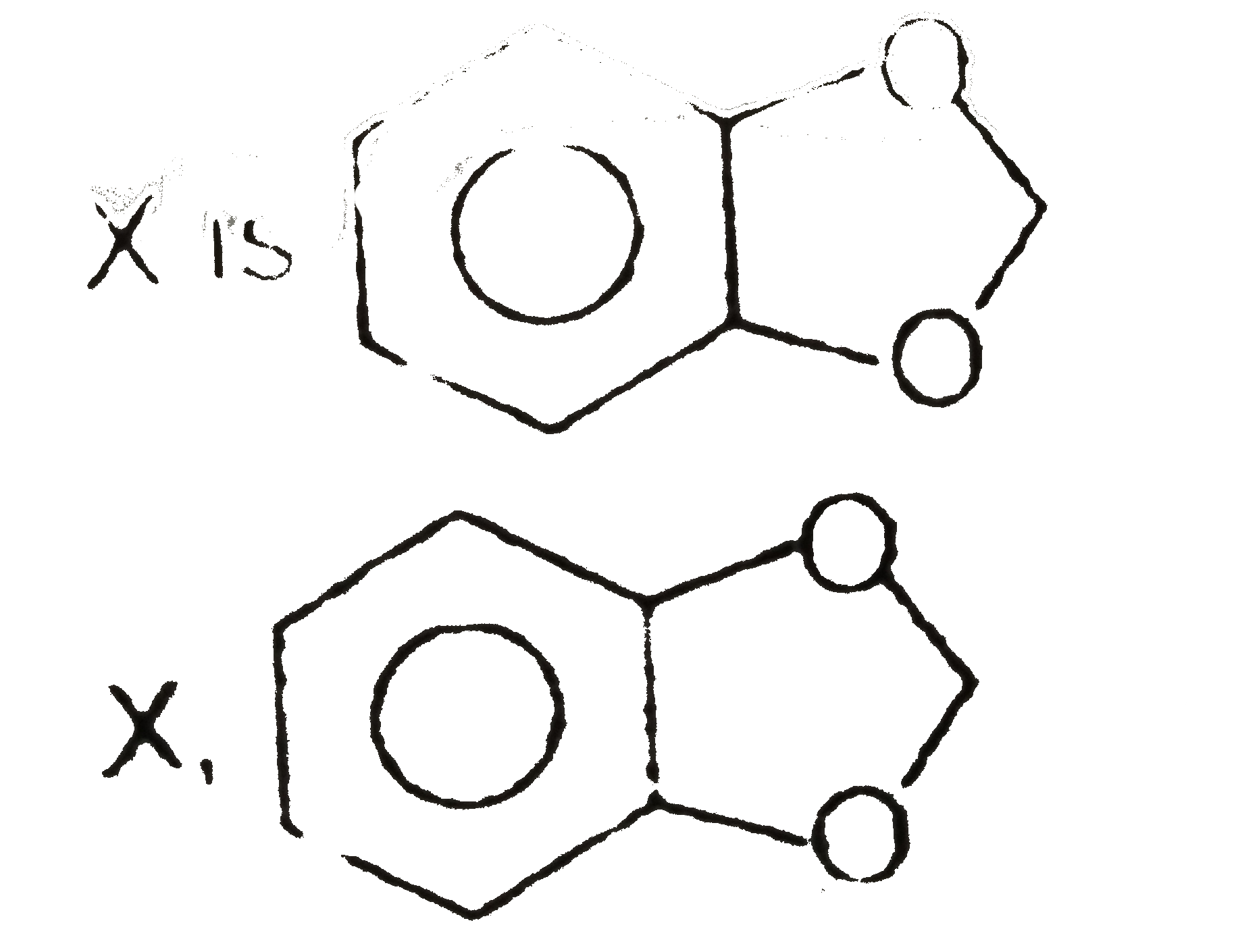
An organic compound (X) has molecular formula `C_(7)H_(6)O_(2)` and it does not effervesces with `NaHCO_(3).` A on treatment with excess of `HBr(aq)` gives `Y(C_(6)H_(6)O_(2))` and `CH_(2)Br_(2)`. Y forms a violet coloured solution with `FeCl_(3)`. If X treated with `Br_(2)Fe,` how many different monobrominaiton product would result?
Text Solution
Verified by Experts
The correct Answer is:
2
`X` is
Topper's Solved these Questions
TEST PAPERS
RESONANCE|Exercise PART - III CHEMISTRY SEC - 1|12 Videos
TEST PAPERS
RESONANCE|Exercise PART - III CHEMISTRY SEC - 2|18 Videos
SURFACE CHEMISTRY
RESONANCE|Exercise Section - 5|1 Videos
TEST SERIES
RESONANCE|Exercise CHEMISTRY|50 Videos
Similar Questions
Explore conceptually related problems
An organic compound (X) has molecular formula C_(7)H_(6)O_(2) and it does not effervesces with NaH A on treatment with excess of HBr(aq) gives Y(C_(6)H_(6)O_(2)) and CH_(2)Br_(2) . Y forms a violet coloured solution with FeCl_(3) . If X treated with Br_(2)Fe, how many different monobrominaiton product would result?
Compound having molecular formula C_(3)H_(6)O_(2) is:-
An organic compound (A) with molecular formula C_(7)H_(8)O dissolves in NaOH and gives characteristic colour with FeCI_(3) . On treatement with Br_(3) , it gives a tribromo product C_(7)H_(5)Br_(3) . The compound is:
An optically active compound 'X' has molecular formula C_(4)H_(8)O_(3) . It evolves CO_(2) with NaHCO_(3) . 'X' reacts with LiAIH_(4) to give an achiral compound 'X' is: