Home
Class 12
PHYSICS
A negative charge Q is distributed unifo...

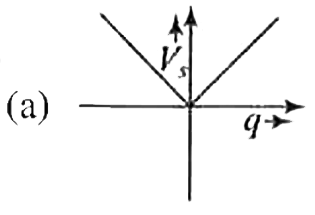
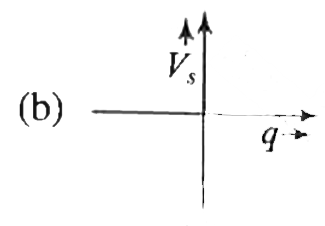
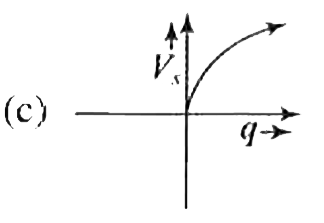
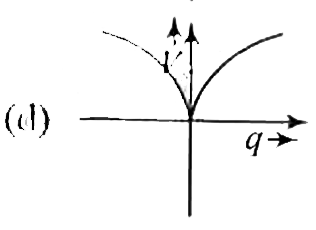
A negative charge `Q` is distributed uniformly in volume of a sphere is radius R and a point charge particle (may be negative or positive) is present on the surface of this sphere then variation of escape velocity `(v_(s))` of charge 'q' as a function of 'q' will be [neglect gravitational interaction].

A

B

C

D

Text Solution

AI Generated Solution

The correct Answer is:

To solve the problem of finding the variation of escape velocity \( v_s \) of a charge \( q \) as a function of \( q \) when a negative charge \( Q \) is uniformly distributed in a sphere of radius \( R \), we can follow these steps: ### Step 1: Understanding the System We have a uniformly distributed negative charge \( Q \) within a sphere of radius \( R \). A point charge \( q \) is located on the surface of this sphere. We need to determine how the escape velocity \( v_s \) of the charge \( q \) varies with \( q \). ### Step 2: Use Energy Conservation The principle of conservation of mechanical energy states that the total mechanical energy at the initial point (when the charge is at the surface) must equal the total mechanical energy at the point of escape (where the potential energy is zero). The equation can be written as: \[ \text{Initial Kinetic Energy} + \text{Initial Potential Energy} = \text{Final Kinetic Energy} + \text{Final Potential Energy} \] ### Step 3: Write the Energy Equation Initially, when the charge \( q \) is at the surface of the sphere, its kinetic energy is \( \frac{1}{2} m v_s^2 \) and the potential energy due to the charge \( Q \) is given by: \[ U_i = -\frac{k Q q}{R} \] where \( k \) is Coulomb's constant. At the point of escape, the kinetic energy is \( 0 \) and the potential energy is also \( 0 \). Thus, we can write: \[ \frac{1}{2} m v_s^2 - \frac{k Q q}{R} = 0 \] ### Step 4: Rearranging the Equation Rearranging the equation gives us: \[ \frac{1}{2} m v_s^2 = \frac{k Q q}{R} \] Multiplying both sides by \( 2 \) leads to: \[ m v_s^2 = \frac{2 k Q q}{R} \] ### Step 5: Solve for Escape Velocity \( v_s \) Now, we can solve for the escape velocity \( v_s \): \[ v_s^2 = \frac{2 k Q q}{m R} \] Taking the square root gives: \[ v_s = \sqrt{\frac{2 k Q q}{m R}} \] ### Step 6: Analyze the Relationship From the equation \( v_s = \sqrt{\frac{2 k Q q}{m R}} \), we can see that \( v_s \) is proportional to the square root of \( q \): \[ v_s \propto \sqrt{q} \] ### Conclusion Thus, the variation of escape velocity \( v_s \) as a function of charge \( q \) is given by: \[ v_s \propto \sqrt{q} \]
Promotional Banner

Topper's Solved these Questions

  • ELECTRIC POTENTIAL

    CENGAGE PHYSICS|Exercise DPP 3.5|14 Videos
  • ELECTRIC POTENTIAL

    CENGAGE PHYSICS|Exercise DPP 3.3|20 Videos
  • ELECTRIC FLUX AND GAUSS LAW

    CENGAGE PHYSICS|Exercise MCQ s|38 Videos
  • ELECTRICAL MEASURING INSTRUMENTS

    CENGAGE PHYSICS|Exercise M.C.Q|2 Videos

Similar Questions

Explore conceptually related problems

A charge q is distributed uniformly on the surface of a sold sphere of radius R. It covered by a concentric hollow conduction sphere of radius 2R . Find the charges inner and outer surface of hollow sphere if it is earthed.

A charge Q is uniformly distributed inside a non- conducting sphere of radius R . Find the electric potential energy stored in the system.

A charge q_0 is distributed uniformly on a ring of radius R. A sphere of equal radius R constructed with its centre on the circumference of the ring. Find the electric flux through the surface of the sphere.

A charge q is uniformly distributed over the volume of a shpere of radius R . Assuming the permittively to be equal to unity throughout, find the potential (a) at the centre of the sphere, (b) inside the sphere as a function of the distance r from its centre.

Charge Q is distributed on two concentric spheres of radius r and R resp. if charge density of both spheres is same then electric potential at centre will be

Flux passing through the shaded surface of a sphere when a point charge q is placed at the center is (radius of the sphere is R)

If charge q is induced on outer surface of sphere of radius R, then intensity at a point P at a distance S from its centre is

A sphere is constructed around a positive point charge q. The work done in moving a unit positive charge on this sphere is numerically equal to
