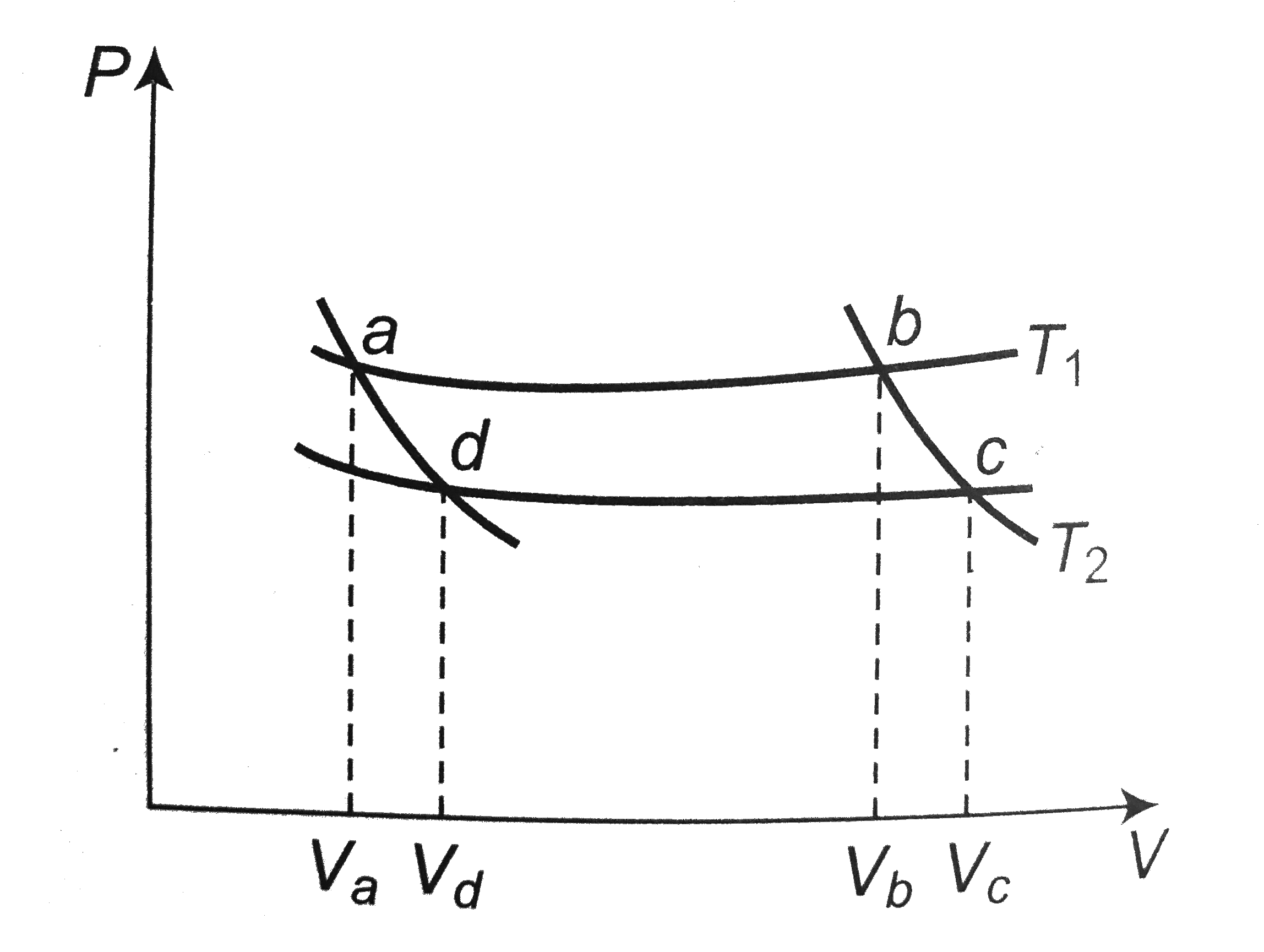
In the following P–V diagram of an ideal gas, two adiabates cut two isotherms at T_1 and T_2 The value of V_B // V_C is :
Two curves are given at temperatures T_(1) and T_(2) in an isothermal process, then-
Two different adiabatic curves for the same gas intersect two isothermals at T_(1), and T_(2) as shown in P-V diagram, (figure). How does the ratio (V_(a)//V_(d)) compare with the ratio (V_(b)//V_(c)) ?
In the P - V diagram, the point B and C correspond to temperatures T _(1) and T_(2) respectively. State relationship between T_(1) and T_(2).
The voltage V and current I v graphs for a conductor at two different temperatures T_(1) and T_(2) are shown in the figure. The relation between T_(1) and T_(2) is
The current (I) and voltage (V) graphs for a given metallic wire at two different temperature (T_(1)) and (T_(2)) are shown in fig. It is concluded that