

Home
Class 11
PHYSICS
A horizontal force F is applied to a hom...

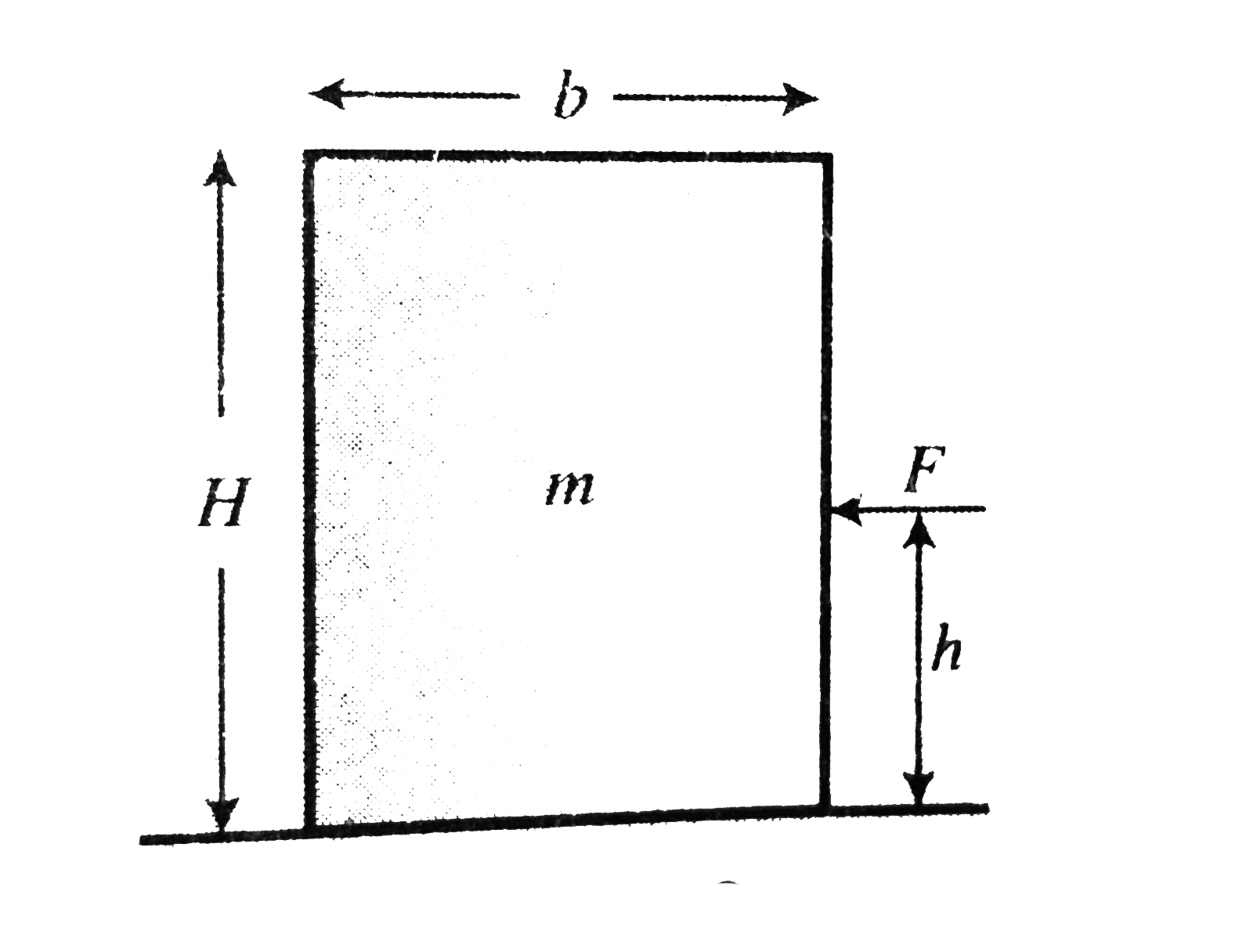
A horizontal force `F` is applied to a homogeneous rectangular block of mass `m`, width `b` and height `H`. The block moves with constant velocity, the coefficient of friction is `mu_(k)`.
a. What is the greater height `h` at which the force `F` can be applied so that the block will slide without tipping over ?

b. Through which point on the bottom face of the block will the resultant of the friction and normal forces act if `h=H//2?`
c. If the block is at rest and coefficient of static friction is `mu_(s)` what are the various criteria for which sliding or tipping occurs?

Promotional Banner

Topper's Solved these Questions

  • RIGID BODY MOTION

    ANURAG MISHRA|Exercise SCQ_TYPE|83 Videos
  • RIGID BODY MOTION

    ANURAG MISHRA|Exercise MCQ_TYPE|41 Videos
  • IMPULSE AND MOMENTUM

    ANURAG MISHRA|Exercise matching|3 Videos
  • UNIT AND DIMENSIONS

    ANURAG MISHRA|Exercise Matching Type Problem|4 Videos

Similar Questions

Explore conceptually related problems

in the above questions ,F is applied at h/2 The disance x is the horizontal disance between a point on the bottom face of the block at which resultant of friction and normal force act C.G of the block find x-

A homogenous block of mass m, width b and height h is resting on a rough horizontal surface A horizontal force F is applied to it , which makes it to move with a constant velocity . The coefficient of friction between block and surface is mu Find the greatest height at which force F may be applied to slide the block with out tipping over

A block of mass m rests on a horizontal floor for which coefficient of friction is mu . Find the magnitude and the direction of force that should be applied to just move the block so that the applied force is minimum.

A tall block of mass M=50kg and base width b=1 m and height h=3 m is kept on rough inclined surface with coefficient of friction mu=0.8 as shown in figure. The angle of inclination with the horizontal is 37^@ . Determine whether the block slides down or topples over.

A horizontal force F is applied at the top of an equilateral triangular block having mass m . The minimum coefficient of friction required to topple the block before translation will be

Consider the situation shown in the figure . The coefficient of friction between the blocks is mu . Find the minimum and the maximum force F that can be applied so that two blocks move together.

In given diagram what is the minimum value of a horizontal external force F on block A so that block B will slide on ground is .

A block of mass m is lying on horizontal surface of coefficient of friction mu. A force is applied to the block at an angle theta with the horizontal. The block will move with a minimum force F if

A block of mass m rests on a bracket of mass M. The coefficients of friction between block and bracket are mu_(s) and mu_(k) . The bracket rests on a frictionless surface. What is the maximum force F that can be applied if the block is not to slide on the bracket?