

Home
Class 11
PHYSICS
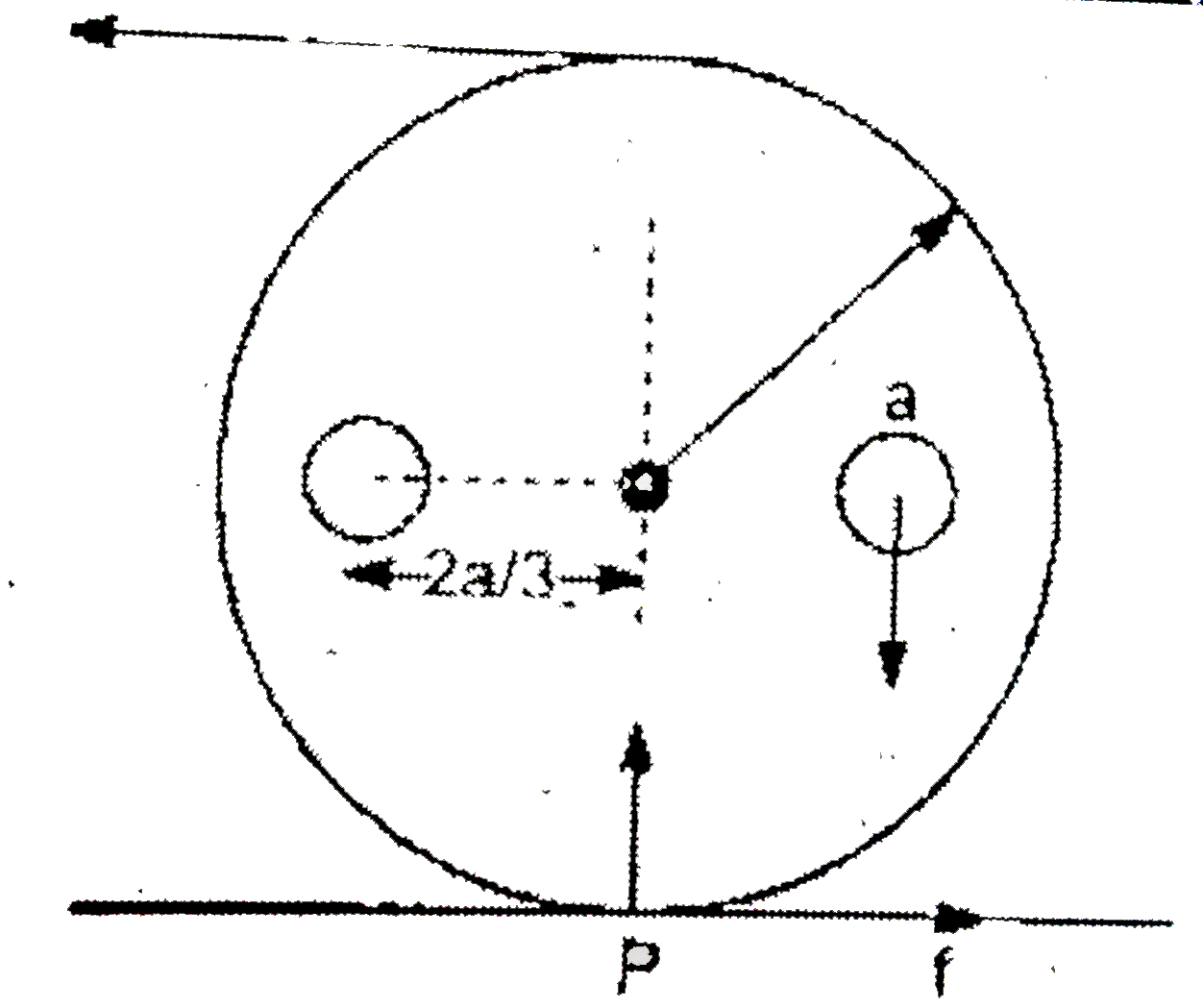
Fig shows a uniform cylinder of radius a...

Fig shows a uniform cylinder of radius a weight `75N`. After on off axis cylindrical hole was drilled through it as shown, it weighed `60N`. The axes of the two cylinders are parallel. Assuming the cyliner does not slip on the table, determine what the tension `T` in the cord must be to keep it from moving.

Promotional Banner

Topper's Solved these Questions

  • RIGID BODY MOTION

    ANURAG MISHRA|Exercise SCQ_TYPE|83 Videos
  • RIGID BODY MOTION

    ANURAG MISHRA|Exercise MCQ_TYPE|41 Videos
  • IMPULSE AND MOMENTUM

    ANURAG MISHRA|Exercise matching|3 Videos
  • UNIT AND DIMENSIONS

    ANURAG MISHRA|Exercise Matching Type Problem|4 Videos

Similar Questions

Explore conceptually related problems

A uniform cylinder of radius R originally had weight of 80N. It weigths 65N, after an off axis cylinderical hoole at (2R)/(3) was drilled through n. The axis of the two cylinders are parallel and at same height A force T is applied to the top of the cylinder horizontally to keep the cylinder at rest about the axis of the original cylinder passing through O. The value of force should be

Let's assume that the Tower of Pisa is a uniform hollow cylinder of radius R = 9.8 m and height h=60 m. The center of Mass is located at height h//2 , along the cylinder's central axis. In Fig. 11-18a, the cylinder is upright. In Fig. 11-18b, it leans rightward (loward the tower's southern wall) by theta= 5.5 , which shifts the com by a distance d. Let's assume that the ground exerts only two forces on the tower. A normal force vecF_(NL)= 0 acts on the left (northern) wall, and a normal force we acts on the right (southern) wall. By what percent does the magnitude Far increase because of the leaning?

Two uniform solid cylinders, each of mass m = 10 kg and radius r = 150 mm, are connected by a rough belt as shown. If the system is released from rest, determine the velocity of the centre of cylinder A after it has moved through 1.2 m & the tension in the portion of the belt connecting the two cylinders.

Figure shows two cylinders of raddi r_1 and r_2 having moments of inertia I_1 and I_2 about their respective axes. Initially the cylinders rotate about their axes with angular speed omega_1 and omega_2 as shown in the figure. The cylinders are moved closer to touch each other keeping the axes parallel. The cylinders first slipover each other at the contact but the slipping finally ceases due to the friction between them. Find the angular speeds of the sylinders after the slipping ceases.

A transparent thin film of uniform thickness and refractive index n_(1) =1.4 is coated on the convex spherical surface of radius R at one end of a long solid glass cylinder of refractive index n_(2) =1.5 , as shown in the figure. Rays of light parallel to the axis of the cylinder traversing through the film from air to glass get focused at distance f_(1) from the film, while rays of light traversing from glass to air get focused at distance f_(2) from the film, Then

A cylindrical container of height 3L and cross sectional area A is fitted with a smooth movable piston of negligible weight. It contains an ideal diatomic gas. Under normal atmospheric pressure P_(0) the piston stays in equilibrium at a height L above the base of the container. The gas chamber is provided with a heater and a copper coil through which a cold liquid can be circulated to extract heat from the gas. Volume occupied by the heater and the liquid coil is negligible. Following set of operations are performed to take the gas through a cyclic process. (1) Heater is switched on. At the same time a tap above the cylinder is opened. Water fills slowly in the container above the piston and it is observed that the piston does not move. Water is allowed to fill the container so that the height of water column becomes L. Now the tap is closed. (2) The heater is kept on and the piston slowly moves up. Heater is switched off at the time water is at brink of overflowing. (3) Now the cold liquid is allowed to pass through the coil. The liquid extracts heat from the gas. Water is removed from the container so as to keep the position of piston fixed. Entire water is removed and the gas is brought back to atmospheric pressure. (4) The circulation of cold liquid is continued and the piston slowly falls down to the original height L above the base of the container. Circulation of liquid is stopped. Assume that the container is made of adiabatic wall and density of water is rho . Force on piston due to impact of falling water may be neglected. (a) Draw the entire cycle on a P–V graph. (b) Find the amount of heat supplied by the heater and the amount of heat extracted by the cold liquid from the gas during the complete cycle.

Two uniform cylinders, each of mass m = 10 kg and radius r = 150 mm, are connected by a rough belt as shown. If the system is released from rest, determine the velocity of the centre of cylinder A after it has moved through 1.2 m &

Figure shows (only cross section) a wooden cylinder C with a mass m of 0.25 kg ,a radius R and a length l perpenducular to the plane of paper of 0.1 meter with N=10 where N is number of turns of wire loop contains the axis of the cylinder the least current through the loop is P/2A that will prevent the cylinder from moving down a plane whose surface is inclined at angle theta to the horizontal, in the presence of a vertical field of magnetic induction 0.5 weber//meter^(2) , if the planer of the windings is parallel to the inclinded plane?(bottom most point of cylinder does not slip)then find value of P .