

Home
Class 11
PHYSICS
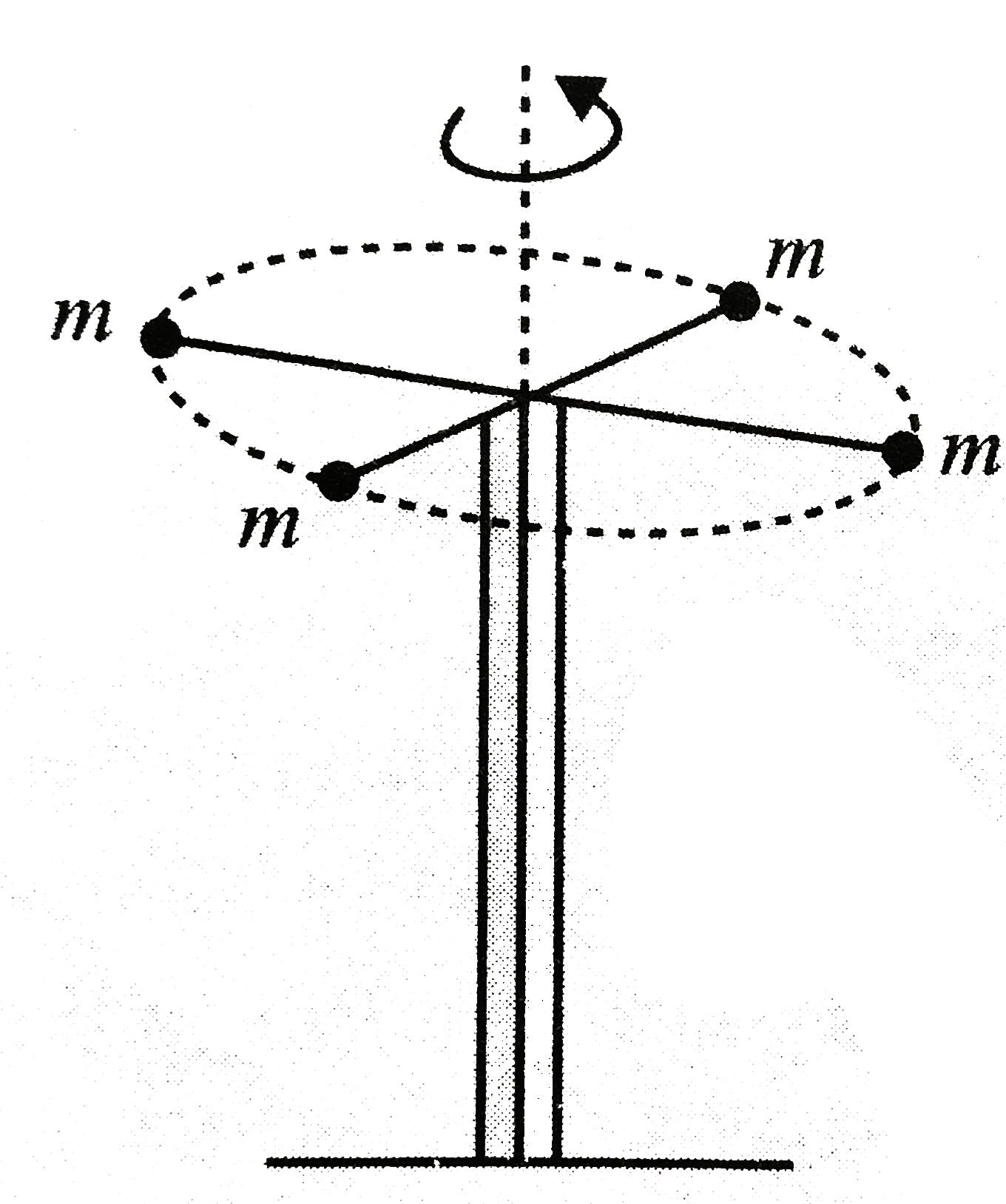
The device shown in Fig. rotates on the ...

The device shown in Fig. rotates on the vertical axle as shown. The frame has negligible mass as compared to the four masses each of mass `m`. Initial angular velocity of the system is `omega_(0)`. Due to an internal mechanism the spokes in the frame lengthen so that the radii of the masses become `2a`. Initially, it was a. What will be the new angular velocity of the system?

Promotional Banner

Topper's Solved these Questions

  • RIGID BODY MOTION

    ANURAG MISHRA|Exercise SCQ_TYPE|83 Videos
  • RIGID BODY MOTION

    ANURAG MISHRA|Exercise MCQ_TYPE|41 Videos
  • IMPULSE AND MOMENTUM

    ANURAG MISHRA|Exercise matching|3 Videos
  • UNIT AND DIMENSIONS

    ANURAG MISHRA|Exercise Matching Type Problem|4 Videos

Similar Questions

Explore conceptually related problems

Initial angular velocity of a circular disc of mass M is omega_(1) . Then two small spheres of mass m are attached gently to two diametrically opposite points on the edge of the disc. What is the final angular velocity of the disc -

Initial angular velocity of a circualr disc of mass M is omega_1. The tow sphere of mass ma re attached gently to diametrically opposite points ont eh edge of the disc. What is the final angular velocity on the disc?

In the figure, a ball of mass m is tied with two strings of equal as shown. If the rod is rotated with angular velocity omega_(1) when

A circular disc of mass M and radius R is rotating with angular velocity omega . If two small spheres each of mass m are gently attached to two diametrically opposite points on the edge of the disc, then the new angular velocity of the disc will be

If 2 kg mass is rotating on a circular path of radius 0.8 m with angular velocity of 44 rad/sec. If radius of the parth becomes 1 m, then what will be the value of angular velocity?

A disc of mass M and radius r is rotating with an angular velocity omega . If gently, two masses m each are placed at a distance r//2 on either side of the axis of rotation, what will be the new angular velocity ?

A smooth uniform rod of length L and mass M has two identical beads of negligible size each of mass m which can slide freely along the rod. Initially the two beada are at the centre of the rod and the system is rotating with an angular velocity omega_0 about an axis perpenducular to the rod and passing through the midpoint of the rod. There are no external forces. When the beads reach the ends of the rod, the angular velocity of the system is ......