

Home
Class 11
PHYSICS
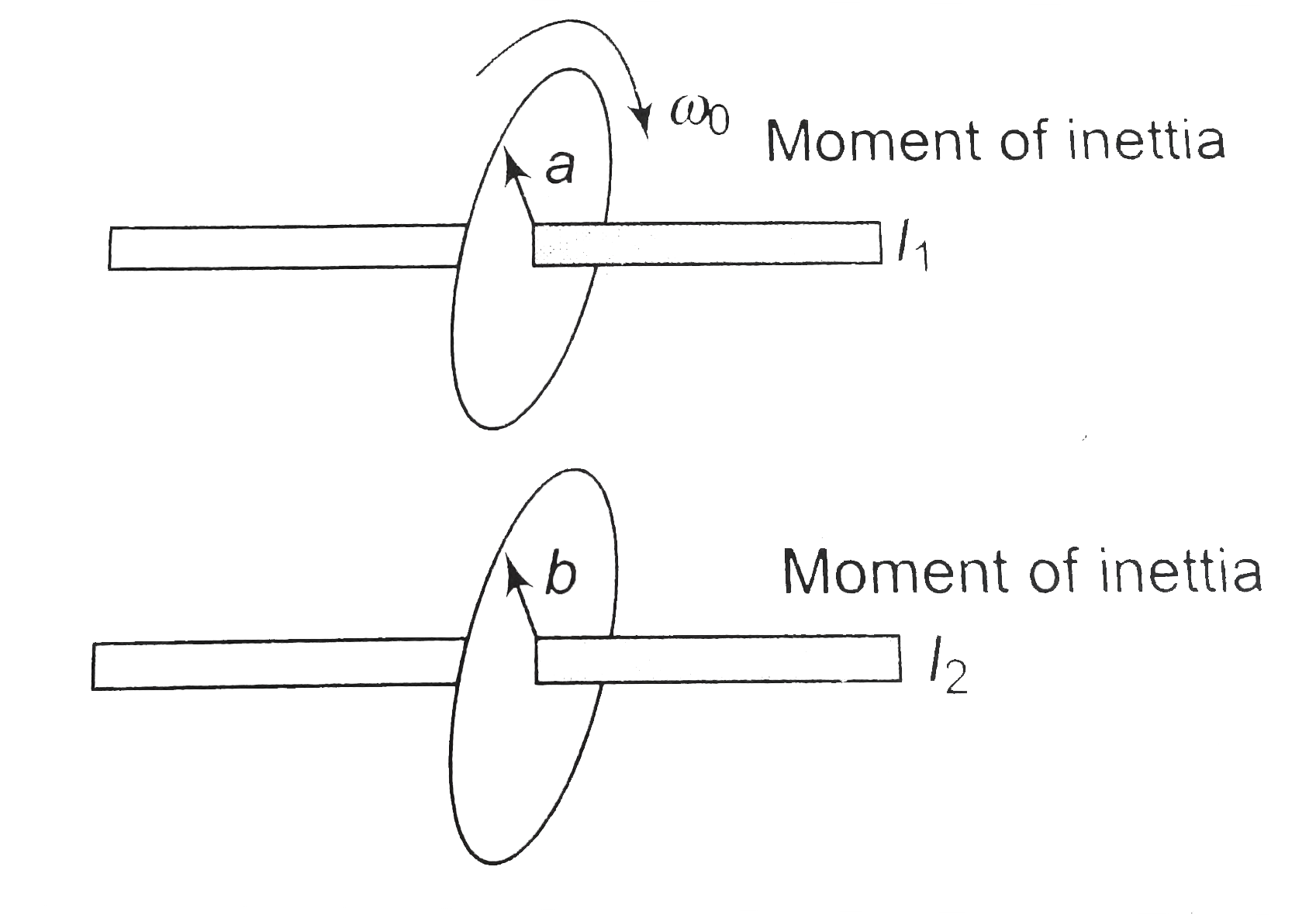
The two uniform discs rotate separately ...

The two uniform discs rotate separately on parallel axles. The upper disc (radius `a` and momentum of inertia `I_1`) is given an angular velocity `omega_0` and the lower disc of (radius `b` and momentum of inertia `I_2`) is at rest. Now the two discs are moved together so that their rims touch. Final angular velocity of the upper disc is.
.

Promotional Banner

Topper's Solved these Questions

  • RIGID BODY MOTION

    ANURAG MISHRA|Exercise SCQ_TYPE|83 Videos
  • RIGID BODY MOTION

    ANURAG MISHRA|Exercise MCQ_TYPE|41 Videos
  • IMPULSE AND MOMENTUM

    ANURAG MISHRA|Exercise matching|3 Videos
  • UNIT AND DIMENSIONS

    ANURAG MISHRA|Exercise Matching Type Problem|4 Videos

Similar Questions

Explore conceptually related problems

A disc of moment of inertia I_(1) is rotating freely with angular speed omega_(1) when another non-rotating disc of moment of inertia I_(2) is dropped on it. The two discs then rotate as one unit. Find the final angular speed.

A disc rotates with angular velocity omega and kinetic energy E . Then its angular momentum

Initial angular velocity of a circualr disc of mass M is omega_1. The tow sphere of mass ma re attached gently to diametrically opposite points ont eh edge of the disc. What is the final angular velocity on the disc?

A disc of moment of inertia 3 kg m^(2) is acted upon by a constant torque of 60 Nm, if the disc is at rest, then the time after which the angular velocity of the disc is 90 rad/s, will be

A round disc of moment of inertia I_2 about its axis perpendicular to its plane and passing through its centre is placed over another disc of moment of inertia I_1 rotating with an angular velocity omega about the same axis. The final angular velocity of the combination of discs is.

Initial angular velocity of a circular disc of mass M is omega_(1) . Then two small spheres of mass m are attached gently to two diametrically opposite points on the edge of the disc. What is the final angular velocity of the disc -

A uniform disc of mass M and radius R is rotating in a horizontal plane about an axis perpendicular to its plane with an angular velocity omega . Another disc of mass M/3 and radius R/2 is placed gently on the first disc coaxial. Then final angular velocity of the system is

A uniform circular disc of radius R is rotating about its own axis with moment of inertia I at an angular velocity omega if a denser particle of mass m is gently attached to the rim of disc than its angular velocity is

A child with mass m is standing at the edge of a disc with moment of inertia I , radius R m and initial angular velocity omega . See figure given below. The chlid jumps off the edge of the disc with tangential velocity v with respect to the ground. The new angular velocity of the disc is. .