

Home
Class 12
PHYSICS
Consider the situation shown in figure-6...

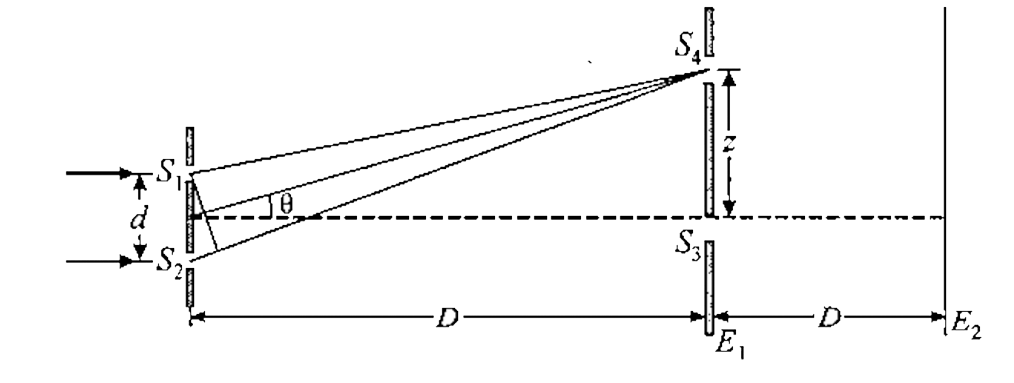
Consider the situation shown in figure-6.35. The two slits `S_(1)` and `S_(2)` placed symmetrically around the central line are illuminated by a monochromatic light of wavelength `lambda`. The separation between the slits is d. The light transmitted by the slits falls on a screen `E_(1)` placed at a distance D from the slits. The slit `S_(3)` is at the central line and the slit `S_(4)` is at a distance z from `S_(3)`. Another screen `E_(2)` is placed a further distance D away from `E_(1)`. Find the ratio of the maximum to minimum intensity observed on `E_(2)` if z is equal is : `(a) (lambdaD)/(2d) " "(b) (lambdaD)/(d)" " (c )(lambdaD)/(4d)`

Promotional Banner

Topper's Solved these Questions

  • WAVE OPTICS

    PHYSICS GALAXY - ASHISH ARORA|Exercise Practice Exercise 6.1|1 Videos
  • WAVE OPTICS

    PHYSICS GALAXY - ASHISH ARORA|Exercise Practice Exercise|25 Videos
  • THERMODYNAMICS LAWS & SPECIFIC HEATS OF GASES

    PHYSICS GALAXY - ASHISH ARORA|Exercise Practice Exercise 3.4|11 Videos
  • WAVES

    PHYSICS GALAXY - ASHISH ARORA|Exercise Unsolved Numerical Problems for Preparation of NSE, INPhO & IPhO|135 Videos

Similar Questions

Explore conceptually related problems

Consider the situation shown in fig. The two slits S_(1) and S_(2) placed symmetrically around the central line are illuminated by monochromatic light of wavelength lambda . The separation between the slit is d. The ligth transmitted by the slits falls on a screen S_(0) placed at a distance D form the slits. The slit S_(3) is at the central line and the slit S_(4) is at a distance z from S_(3) Another screen S_(c) is placed a further distance D away from S_(c) Find the ratio of the maximum to minimum intensity observed on S_(c) If z = (lambda D)/(4 d)

Consider the situation shown in fig. The two slits S_(1) and S_(2) placed symmetrically around the central line are illuminated by monochromatic light of wavelength lambda . The separation between the slit is d. The ligth transmitted by the slits falls on a screen S_(0) placed at a distance D form the slits. The slit S_(3) is at the central line and the slit S_(4) is at a distance z from S_(3) Another screen S_(c) is placed a further distance D away from S_(c) Find the ratio of the maximum to minimum intensity observed on S_(c) If z = (lambda D)/(2 d)

Consider the situation shown in fig. The two slits S_(1) and S_(2) placed symmetrically around the central line are illuminated by monochromatic light of wavelength lambda . The separation between the slit is d. The ligth transmitted by the slits falls on a screen S_(0) placed at a distance D form the slits. The slit S_(3) is at the central line and the slit S_(4) is at a distance z from S_(3) Another screen S_(c) is placed a further distance D away from S_(c) Find the ratio of the maximum to minimum intensity observed on S_(c) If z = (lambda D)/(d)

In the set up shown in figure, the two slits S_1 and S_2 are not equidistant from the slit S. The central fringe at O is then

Light d of wavelength 5000Å is incident normally on a slite. The first minimum of the distance of 5 mm from the central maximum on a screen placed at a distance of 2 m from the slit. The width of slit is

In a double slit experiment, the distance between the slits is d. The screen is at a distance D from the slits. If a bright fringe is formed opposite to one of the slits, its order is

For a parallel beam of monochromatic light of wavelength 'lambda' diffraction is produced by a single slit whose width 'a' is of the order of the wavelength of the light. If 'D' is the distance of the screen from the slit, the width of the central maxima will be

For a parallel beam of monochromatic light of wavelength 'lambda' differaction is produced by a single slit whose width 'a' is of the order as wavelength of the light. If 'D' is the distance of the screen from the slit, the width of the central maxima will be

Young’s double slit experiment is performed with light of wavelength 550 nm . The separation between the slits is 1.10 mm and screen is placed at distance of 1 m . What is the distance between the consecutive bright or dark fringes

PHYSICS GALAXY - ASHISH ARORA-WAVE OPTICS-Unsolved Numerical Problems
  1. Consider the situation shown in figure-6.35. The two slits S(1) and S(...

    Text Solution

    |

  2. A prism having angle A^(@) (which is very small) is placed in front of...

    Text Solution

    |

  3. A thin glass plate of thickness t and refractive index mu is inserted ...

    Text Solution

    |

  4. A double slit arrangement produces fringes for light lambda=5890Å whic...

    Text Solution

    |

  5. Two coherent narrow slits emitting light of wavelength lambda in the s...

    Text Solution

    |

  6. In Young's double-slit experiment, the slit are 0.5 mm apart and the i...

    Text Solution

    |

  7. Light of wavelength 520nm passing through a double slit,produced inter...

    Text Solution

    |

  8. The distance between two slits in a YDSE apparatus is 3mm. The distanc...

    Text Solution

    |

  9. One radio transmitter A operating 60.0MHzis 10.0from another similar t...

    Text Solution

    |

  10. The central fringe of the interference pattern produced by the light o...

    Text Solution

    |

  11. A broad sources of light of wavelength 680nm illuminated normally two ...

    Text Solution

    |

  12. Two microwave coherent point sources emitting waves of wavelenths lamb...

    Text Solution

    |

  13. In a YDSE two thin transparent sheet are used in front of the slits S(...

    Text Solution

    |

  14. In a two slit experiment with monochromatic light fringes are obtained...

    Text Solution

    |

  15. A source S is kept directly behind the slit S(1) in a double slit appa...

    Text Solution

    |

  16. In a YDSE a parallel beam of light of wavelength 6000Å is incident on ...

    Text Solution

    |

  17. A plastic film with index of refraction 1.80 is put on the surface of ...

    Text Solution

    |

  18. Two coherent monochromatic sources A and B emit light of wavelength la...

    Text Solution

    |

  19. A beam of light consisting of two wavelength, 6500 Å and 5200 Å is use...

    Text Solution

    |

  20. In an experiment using Fresnel biprism, fringes of width 0.185 xx 10^(...

    Text Solution

    |

  21. Two identical monochromaticlight sources A & B intensity 10^(-15)W//m^...

    Text Solution

    |