Home
Class 12
PHYSICS
A narrow monochromatic beam of light of ...

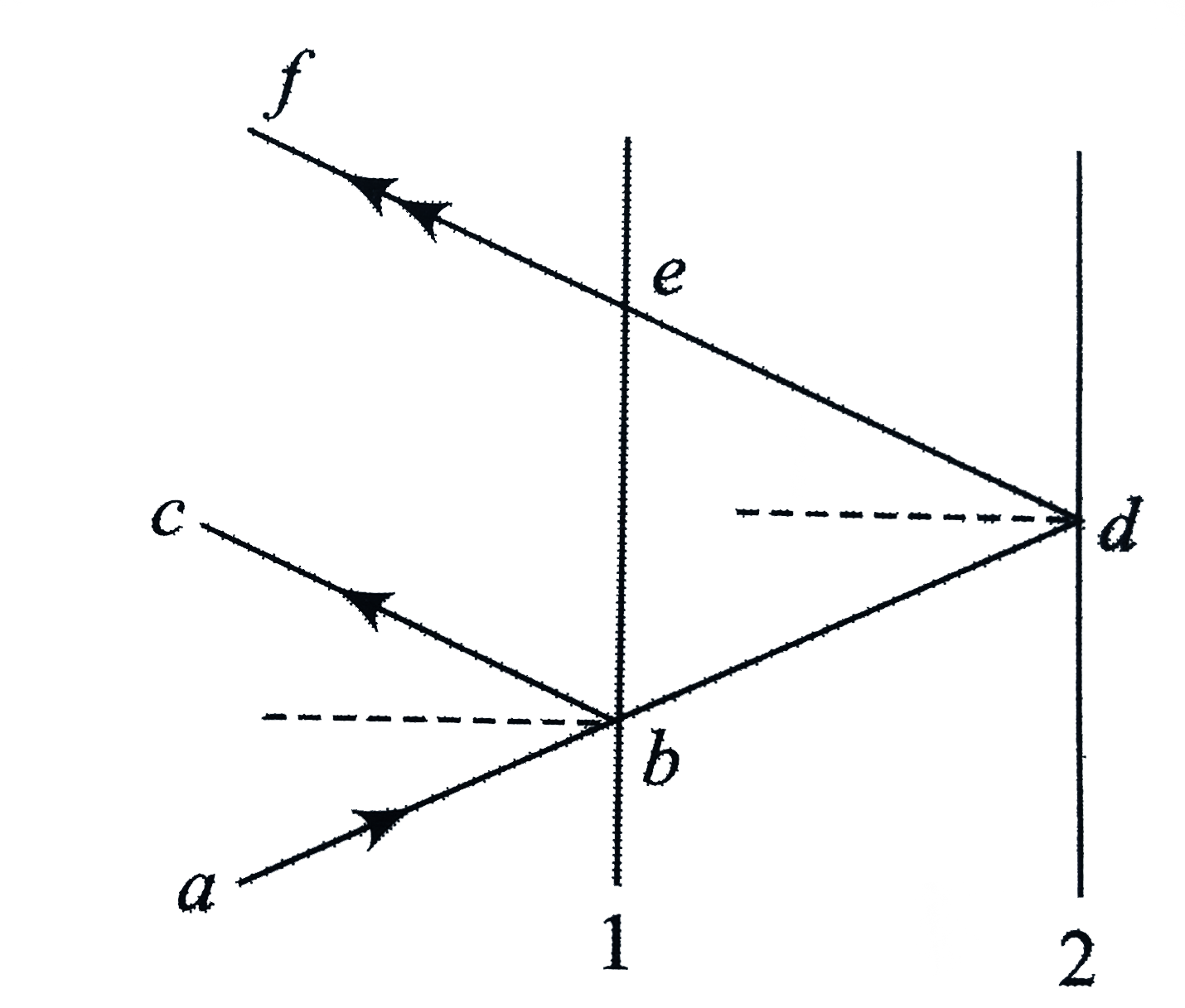
A narrow monochromatic beam of light of intensity 1 is incident on a glass plate as shown in figure Another identical glass plate is kept close to the first one and parallel to it. Each glass plate reflects `25%` of the light incident on it and transmits intensities in the interference pattern formed by two beams obtained after one reflection at each plate.

Text Solution

Verified by Experts

The correct Answer is:

`[49 : 1]`
Promotional Banner

Topper's Solved these Questions

  • WAVE OPTICS

    PHYSICS GALAXY - ASHISH ARORA|Exercise Advance MCQs with One or More Options Correct|27 Videos
  • THERMODYNAMICS LAWS & SPECIFIC HEATS OF GASES

    PHYSICS GALAXY - ASHISH ARORA|Exercise Practice Exercise 3.4|11 Videos
  • WAVES

    PHYSICS GALAXY - ASHISH ARORA|Exercise Unsolved Numerical Problems for Preparation of NSE, INPhO & IPhO|135 Videos

Similar Questions

Explore conceptually related problems

A narrow monochromatic beam of light of intensity I is incident on a galss plate as shown in figure. Another identical glass plate is kept close to the first one & parallel to it. Each glass plate reflects 25% of the light incident on it % transmits the remaining find the ratio of the minimum & the maximum intensities in the interference pattern formed by the two beams obtained after one reflection at each plate.

A narrow monochromatic beam of light of intensity I is incident on a glass plate. Another identical glass plate is kept close to the first one and parallel to it. Each plate reflects 25% of the incident light and transmits the remaining. Calculate the ratio of minimum and maximum intensity in the interference pattern fromed by two beams obtained after reflection from each plate.

A ray light of intensity I is incident on a parallel glass-slab at a point A as shown in figure it undergoes partial reflection and refraction. At each reflection 20% of incident energy is refracted rays AB and A'B' undergo interference find the ratio I_(max)//I_(min)

A ray of light intensity I is incident on a parallel glass-slab at a point A as shown in figure. It undergoes partial reflection and refraction. At each reflection 25% of incident energy is reflected. The rays AB and A^(')B^(') undergo interference. The ratio I_(max)//I_(min) is

Two thin glass plates are placed parallel to each other such that distance between them is very small. Each glass plate reflects 25% of incident energy and transmits remaining 75% Light beam is incident on this system. Consider the interference of two light beams obtained after one reflection from each glass plate. Calculate ratio of the maximum to minimum intensity.

A parallel beam of light of intensity I is incident on a glass plate. 25% of light is reflected in any reflection by upper surface and 50% of light is reflected by any reflection from lower surface. Rest is refracted The ratio of maximum to minimum intensity in interference region of reflected rays is

A ray of light of intensity I is incident on a parallel glass slab at a point A as show. It undergoes partial reflection and refraction. At each reflaction 25% of incident energy is reflected. The rays AB and A'B' undergo interference. The ratio I_(max)//I_(min) is

A ray of unpolarised light is incident on a glass plate of refractive index 1.54 at polarising angle, then angle of refraction is :

A ray of light in incident on a glass plate at an angle of 60^@ . What is the refractive index of glass if the reflected and refracted rays are perpendicular to each other?

PHYSICS GALAXY - ASHISH ARORA-WAVE OPTICS-Unsolved Numerical Problems
  1. The central fringe of the interference pattern produced by the light o...

    Text Solution

    |

  2. A broad sources of light of wavelength 680nm illuminated normally two ...

    Text Solution

    |

  3. Two microwave coherent point sources emitting waves of wavelenths lamb...

    Text Solution

    |

  4. In a YDSE two thin transparent sheet are used in front of the slits S(...

    Text Solution

    |

  5. In a two slit experiment with monochromatic light fringes are obtained...

    Text Solution

    |

  6. A source S is kept directly behind the slit S(1) in a double slit appa...

    Text Solution

    |

  7. In a YDSE a parallel beam of light of wavelength 6000Å is incident on ...

    Text Solution

    |

  8. A plastic film with index of refraction 1.80 is put on the surface of ...

    Text Solution

    |

  9. Two coherent monochromatic sources A and B emit light of wavelength la...

    Text Solution

    |

  10. A beam of light consisting of two wavelength, 6500 Å and 5200 Å is use...

    Text Solution

    |

  11. In an experiment using Fresnel biprism, fringes of width 0.185 xx 10^(...

    Text Solution

    |

  12. Two identical monochromaticlight sources A & B intensity 10^(-15)W//m^...

    Text Solution

    |

  13. Two fine slits are placed very close to each other and they are illumi...

    Text Solution

    |

  14. Biprism fringes are produced with the help of sodium light (lambda=589...

    Text Solution

    |

  15. A glass plate 1.2 xx 10^(-6)m thick is placed in the path of one of th...

    Text Solution

    |

  16. A narrow monochromatic beam of light of intensity 1 is incident on a g...

    Text Solution

    |

  17. A plane light wave of wavelength lambda = 700nm falls normally on the ...

    Text Solution

    |

  18. In a biprism experiment, the angular width of fringes was theta=2'. Ca...

    Text Solution

    |

  19. In a biprism experiment, calculate the intensity of lights on the scre...

    Text Solution

    |

  20. Two parallel beams of light P and Q are incident normally on a prism a...

    Text Solution

    |
