

Home
Class 11
PHYSICS
A block speed of mass m and a pan of equ...

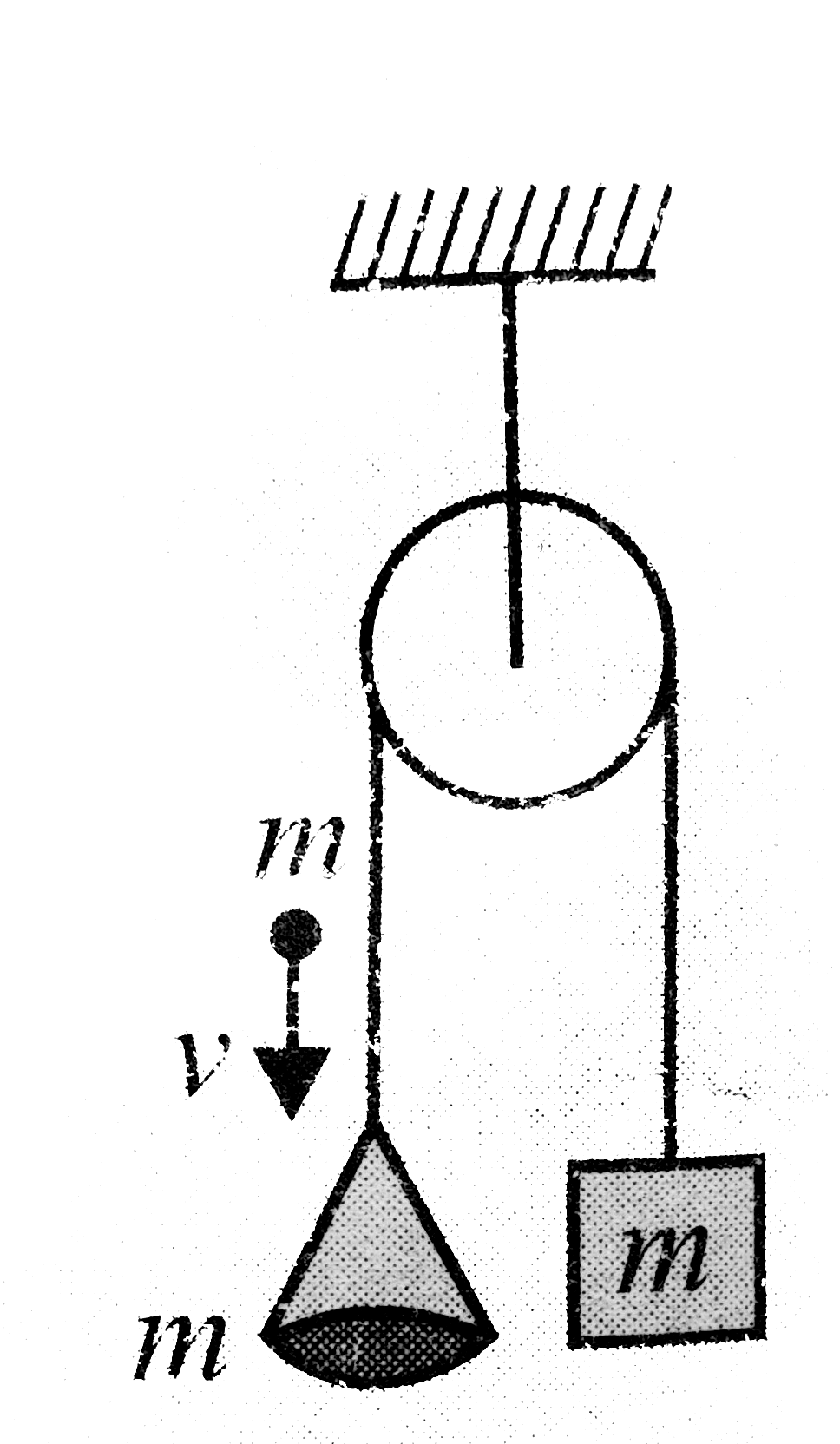
A block speed of mass `m` and a pan of equal mass are connected by a string going over a smooth light pulley. Initially, the system is at rest, then a particle of mass `m` falls on the pan ad sticks to it. If the particle strikes the pan with a speed `v`, find the speed with which the system moves just after the collision.

Promotional Banner

Topper's Solved these Questions

  • IMPULSE AND MOMENTUM

    ANURAG MISHRA|Exercise Example|50 Videos
  • IMPULSE AND MOMENTUM

    ANURAG MISHRA|Exercise Level 1|110 Videos
  • FORCE ANALYSIS

    ANURAG MISHRA|Exercise Matching type|13 Videos
  • RIGID BODY MOTION

    ANURAG MISHRA|Exercise MATCH THE COLUMN|12 Videos

Similar Questions

Explore conceptually related problems

A block of mass m and alpha pan of equla mass are connected by a string going over a smooth light pulley as shwon in figure. Initially the systemis at rest when a particle of mass m falls on the pan and sticks to it. If the particle strikes thepan witha speed v find the speed with which the system moves just after the collision.

Two masses m and M(gt m) are joined by a light string passing over a smooth light pulley. The centre of mass of the system moves with an acceleration

Two bodies of masses m_1 and m_2 are connected by a light string going over a smooth lilght pulley at the end of an incline. The mass_1 lies on the incline m_2 hangs vertically. The system is t rest. Find the angle of the incline and the fore exerted by the incline on the body of mass m_1.

A particle of mass m moving with velocity v strikes a stationary particle of mass 2 m and sticks to it. The speed of the system will be.

A particle of mass 2m moving with velocity v strikes a stationary particle of mass 3m and sticks to it . The speed of the system will be

A particle of mass 2m moving with velocity v strikes a stationary particle of mass 3m and sticks to it. The speed of the system will be

A particle of mass m, collides with another stationary particle of mass M. If the particle m stops just after collision, then the coefficient of restitution for collision is equal to

A pan of mass m = 1.5 kg and a block of mass M = 3 kg are connected to each other by a light inextensible string, passing over a light pulley as shown in Fig. Initially, the block is resting on a horizontal floor. A ball of mass m_0 = 0.5 kg collides with the pan at a speed v_0= 20 m//s . Consider this instant of collision as t = 0 . Assume collision to be perfectly inelastic. Now, Fig. answer the following questions based on the above information. Find the velocity of pan + ball system at t = 2.6 s . Assume that the block comes to rest instantaneously after striking the floor.

A pan of mass m = 1.5 kg and a block of mass M = 3 kg are connected to each other by a light inextensible string, passing over a light pulley as shown in Fig. Initially, the block is resting on a horizontal floor. A ball of mass m_0 = 0.5 kg collides with the pan at a speed v_0= 20 m//s . Consider this instant of collision as t = 0 . Assume collision to be perfectly inelastic. Now, Fig. answer the following questions based on the above information. Find the time t at which the block strikes the floor for the first time

A pan of mass m = 1.5 kg and a block of mass M = 3 kg are connected to each other by a light inextensible string, passing over a light pulley as shown in Fig. Initially, the block is resting on a horizontal floor. A ball of mass m_0 = 0.5 kg collides with the pan at a speed v_0= 20 m//s . Consider this instant of collision as t = 0 . Assume collision to be perfectly inelastic. Now, Fig. answer the following questions based on the above information. . Find the maximum height reached by the block alter the second jerk.