

Home
Class 11
PHYSICS
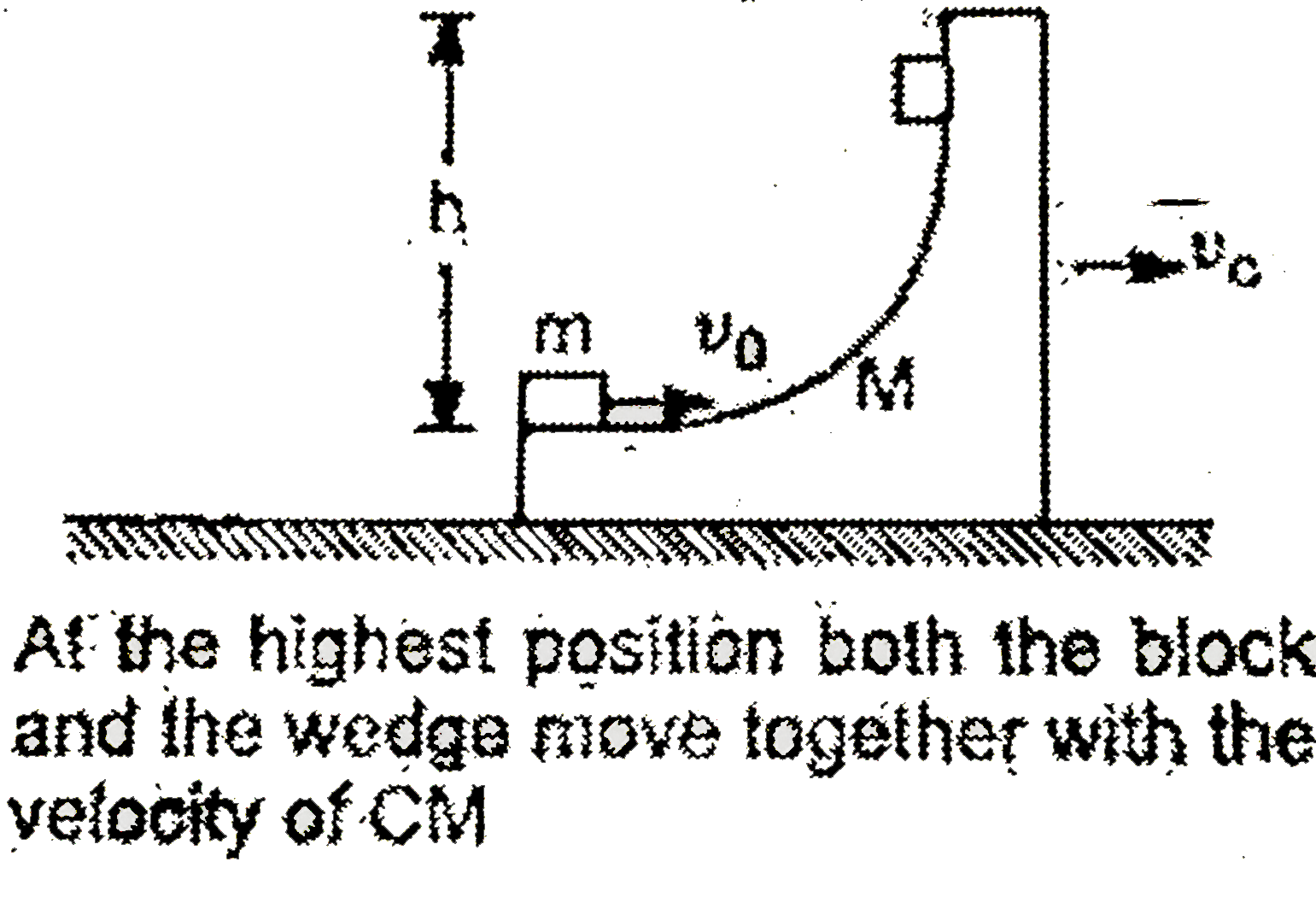
In the fig 4 .25 shown, if all the surfa...

In the fig 4 .25 shown, if all the surfaces are smooth , then determine the maximum height h attained by the block on the wedge, assuming it to be very large .

Promotional Banner

Topper's Solved these Questions

  • IMPULSE AND MOMENTUM

    ANURAG MISHRA|Exercise Example|50 Videos
  • IMPULSE AND MOMENTUM

    ANURAG MISHRA|Exercise Level 1|110 Videos
  • FORCE ANALYSIS

    ANURAG MISHRA|Exercise Matching type|13 Videos
  • RIGID BODY MOTION

    ANURAG MISHRA|Exercise MATCH THE COLUMN|12 Videos

Similar Questions

Explore conceptually related problems

In the figure shown, a cylinder A is initially rolling with velocity v on the horizontal surface of the wedge B (of same mass as A ). All surfaces are smooth and B has no initial velocity. Then maximum height reached by cylinder on the wedge will be. .

All the surfaces are smooth as shown in figure. The acceleration of mass m relative to wedge is :

All surfaces are smooth Find the horizontal displacements of the block and the wedge when the block slides down from top to bottom .

All surfaces are smooth in the adjoining figure. Find F such that block remains stationary with respect to wedge.

Assuming all the surfaces to be smooth, find the acceleration of the triangular block of mass M when the block of mass m slides on it.

A rocket is launched upward from the earth surface whose velocity time graph shown in figure. Then maximum height attained by the rocket is :-

All surfaces shown in figure are smooth. Wedges of mass 'M' is free to move. Block of mass 'm' is given a horizontal velocity v_0 as shown. Find the maximum height 'h' attained by 'm' (over the wedges or outside it).