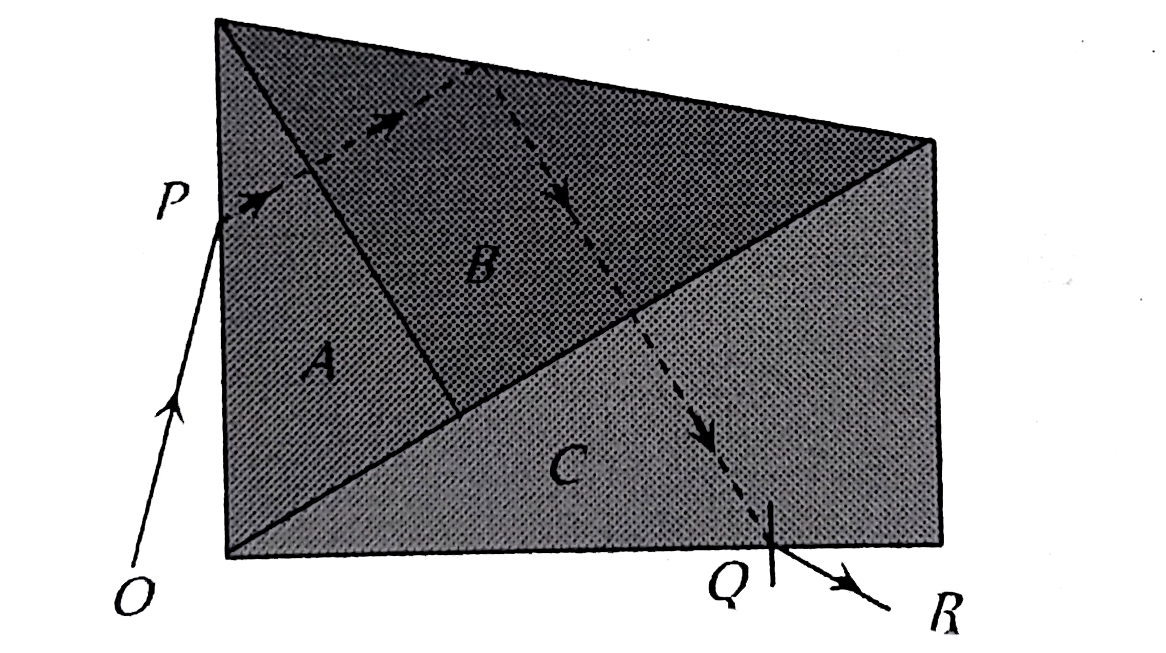
A
B
C
D
Text Solution
Verified by Experts
The correct Answer is:



Topper's Solved these Questions
Similar Questions
Explore conceptually related problems
CENGAGE PHYSICS-RAY OPTICS-DPP 1.5
- A ray of light is incident on the hypotenuse of a right-angled prism a...
Text Solution
|
- The refractive indices of the material of the prism and liquid are 1.5...
Text Solution
|
- A prism having an apex angle of 4^@ and refractive index of 1.50 is lo...
Text Solution
|
- A light ray is incident by grazing one of the face of a prism and afte...
Text Solution
|
- The light ray is incidence at angle of 60^(@) on a prism of angle 45^(...
Text Solution
|
- A light ray is incident upon a prism in minimum deviation position and...
Text Solution
|
- A ray of monochromatic light is incident on one refracting face of a p...
Text Solution
|
- Three glass prisms A , B and C of same refractive index are placed in ...
Text Solution
|
- The refractive index of a material of a prism of angles 45^(@)-45^(@)-...
Text Solution
|
- Angle of prism is A and its one surface is silvered. Light rays fallin...
Text Solution
|
- A ray of light incident normally on an isosceles right angled prism t...
Text Solution
|
- When a ray of light is incident normally on one refracting surface of ...
Text Solution
|
- Read the paragraph and the figure carefully and answer the questions. ...
Text Solution
|
- Read the paragraph and the figure carefully and answer the questions. ...
Text Solution
|
- Read the paragraph and the figure carefully and answer the questions. ...
Text Solution
|