Home
Class 12
PHYSICS
A pair of parallel horizontal conducting...

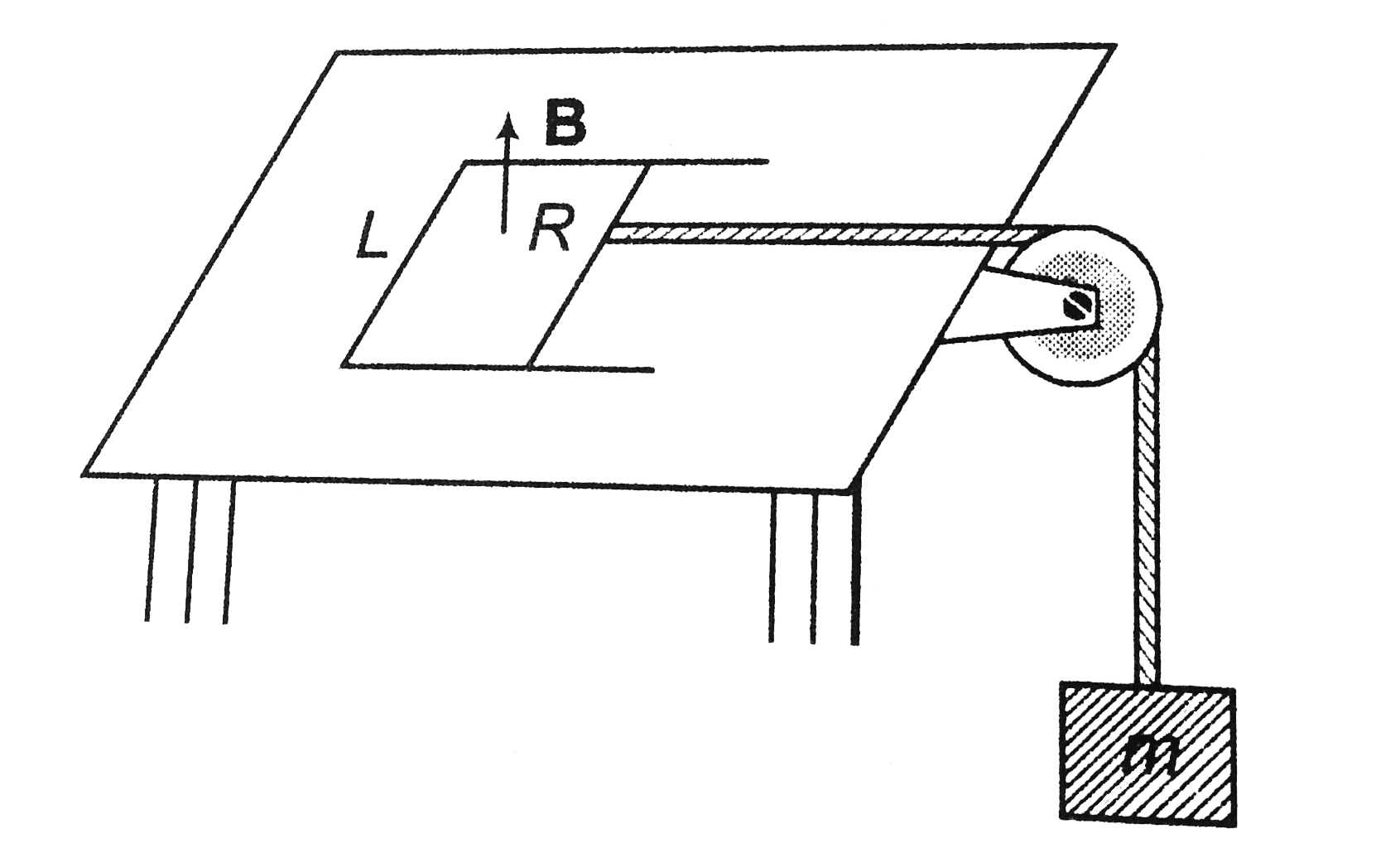
A pair of parallel horizontal conducting rails of negligible resistance shorted at one end is fixed on a table. The distance between the rails is `L`. A conducting massless rod of resistance `R` can slide on the rails frictionlessly. The rod is tied to a massless string which passes over a pulley fixed to the edge of the table. A mass `m` tied to the other end of the string hangs vertically. A constant magnetic field `B` exists perpendicular to the table. If the system is released from rest, calculate

a. the terminal velocity achieved by the rod and
b. The acceleration of the mass of the instant when the velocity of the rod is half the terminal velocity.

Text Solution

Verified by Experts

The correct Answer is:

`[V_(T)=(mgR)/(B^(2)L^(2)),` (b) `(g)/(2)`]
Promotional Banner

Topper's Solved these Questions

  • MAGNETIC EFFECTS OF CURRENT AND MAGNETISM

    PHYSICS GALAXY - ASHISH ARORA|Exercise Advance MCQ|29 Videos
  • Kinetic Theory of Gases and Gas Laws

    PHYSICS GALAXY - ASHISH ARORA|Exercise Unsolved Numerical Problems for Preparation of NSEP, INPhO & IPhO|64 Videos
  • NUCLEAR PHYSICS AND RADIOACTIVITY

    PHYSICS GALAXY - ASHISH ARORA|Exercise Concptual MCQs|48 Videos

Similar Questions

Explore conceptually related problems

A pair of parallel horizontal conducting rails of negligible resistance shorted at one end is fixed on a table. The distance between the rails is L. A conducting massless rod of resistance R can slide on the rails frictionlessly. The rod is tied to a massless string which passes over a pulley fixed to the edge of the table, A mass m, tied to the other end of the string hanges vertically. A constant magnetic field B exists perpendicular to the table. If the system is released from rest, calculate. (i) the terminal velocity achieved by the rod, and the acceleration of the mass at the instant when the velocity of the rod is half the terminal velocity.

A block of mass m_(1) rests on a horizontal table. A string tied to the block is passed on a frictionless pulley fixed at the end of the table and to the other end of string is hung another block of mass m_(2) . The acceleration of the system is

A pair of long, smooth, parallel, horizontal, conducting rails are joined to a cell at one end. There are no external electric or magnetic fields. A metal rod is placed on the rails. The rod will

Two bodies of masses 4 kg and 6 kg are tied to the ends of a massless string. The string passes over a frictionless pulley. The acceleration of the system is :

A smooth ring of mass m can slide on a fixed horizontal rod. A string tied to the ring pases over a fixed pulley B and carries a block C of mass 2m as shown below. As the ring starts sliding

A resistance R is connected between the two ends of the parallel smooth conducting rails.A conducting rod lies on these fixed horizontal rails and a uniform constant magnetic field B exists perpendicular to the plane of the rails as shown in the figure.If the rod is given a velocity v and released as shown in figure, it will stop after some time, which option are correct:

A metallic rod of length 'l' is tied to a string of length 2l and made to rotate with angular speed w on a horizontal table with one end of the string fixed. If there is a vertical magnetic field 'B' in the region, the e.m.f. Induced across the ends of the rod is

Two vertical conducting rails separted by distance 1.0m are placed parallel to z -axis as shown in figure. At z=0 , a capacitor of 0.15 F is connected between the rails and a metal rod of mass 100g placed across the rails slides down along the rails. if a constant magnetic fields of 2.0 T exists perpendicular to the plane of the rails, what is the acceleration of the rod?

A copper rod of mass m slides under gravity on two smooth parallel rails l distance apart set at an angle theta to the horizontal. At the bottom, the rails are joined by a resistance R . There is a uniform magnetic field perpendicular to the plane of the rails. the terminal valocity of the rod is

PHYSICS GALAXY - ASHISH ARORA-MAGNETIC EFFECTS OF CURRENT AND MAGNETISM-U.N.P
  1. A charge of 1 coul. is placed at one end of a non-conducting rod of le...

    Text Solution

    |

  2. A long horizontal wire P carries of 50 A. It is rigidly fixed. Another...

    Text Solution

    |

  3. A pair of parallel horizontal conducting rails of negligible resistanc...

    Text Solution

    |

  4. Three infinitely long thin wires, each carrying current i in the same ...

    Text Solution

    |

  5. The region between x=o and x = L is filled with uniform, steady magn...

    Text Solution

    |

  6. Two straight parallel conductors are 50cm apart and carry oppositively...

    Text Solution

    |

  7. In the Bohr model of the hydrogen atom, the electron circuulates aroun...

    Text Solution

    |

  8. A coil carrying a current 10mA is placed in a uniform magnetic field s...

    Text Solution

    |

  9. A current I = 5.0 A A flows along a thin wire shaped as shwon in F...

    Text Solution

    |

  10. In an electromagnetic pump designed for transferring molten metals...

    Text Solution

    |

  11. A current I flows in a long thin walled cylinder of radius R. What ...

    Text Solution

    |

  12. At the moment t = 0 on electron leaves one plate of a parallel-plate ...

    Text Solution

    |

  13. A non-relativistic proton beam passes without deviation through a regi...

    Text Solution

    |

  14. A proton accelarted by a potential differnce V gets into the unifrom...

    Text Solution

    |

  15. A charged particle moves along a circle of radius r = 100 mm in a u...

    Text Solution

    |

  16. A non-relativistic charge q of mass m originates at a point A lying on...

    Text Solution

    |

  17. A non-relativistic charged particle files through the electric field o...

    Text Solution

    |

  18. Uniform electric and magnetic fields with strength E and induction B, ...

    Text Solution

    |

  19. A narrow beam of identical ions with specific charge q/m, possessing d...

    Text Solution

    |

  20. A beam of non-relativistic charged particles moves without deviation t...

    Text Solution

    |
