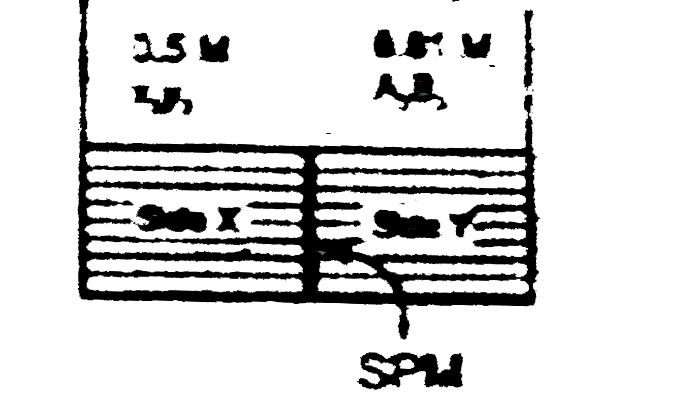
`X_(3)Y_(2)(i=5)` when reacted with `A_(2)B_(3)(i=5` in aqueous solution gives brown colour. These are separated by a semipermeable membrane `AB` as shown. Due to oxmosis there is `:`
A
brown colour formation in side X
B
brown colour formation in side Y
C
formation in both of the sides X and Y
D
no brown colour formation
Text Solution
Verified by Experts
The correct Answer is:
d
Topper's Solved these Questions
DILUTE SOLUTION
NARENDRA AWASTHI|Exercise Level 1 (Q.62 To Q.91)|1 Videos
FeCI_(3) on reaction with K_(4)[Fe(CN)_(6)] in aqueous solution gives blue colour. These are separated by a semipermeable membrane AB as shown. Due to osmosis there is:
FeCl_(3) on reaction with K_(4)[Fe(CN)_(6)] in aqueous solution gives blue colour. These are separated by a semi-permeable membrane AB as shown. Due to osmosis, there is
When SO_2 is passed through an aqueous solution of I_2 , it becomes colourless . This is due to
When silver nitrate is reacted with excess of I_(2) in aqueous solution then which of the following compounds are formed ?
When phenol is allowed to react with Br_(2) in (i) CS_(2) solution and (ii) in aqueous solution, the resulting compounds are
When a copper wire is placed I a solution of AgNO_3 , the solution acquires blue colour. This due to the formation of .
A_(2)+2B_(2)rarrA_(2)B_(4) (3)/(2)A_(2)+2B_(2)rarrA_(3)B_(4) Two substance A_(2) & B_(2) react in the above manner when A_(2) is limited it gives A_(2)B_(4) in excess gives A_(3)B_(4^(.) A_(2)B_(4) can be converted to A_(3)B_(4) when reacted with A_(2) . Using this information calculate the composition of the final mixture when the mentioned amount of A % B are taken :c (a) 4 mole A_(2) & 4 mole B_(2) (b) (1)/(2) moles A_(2) & 2 moles B_(2) (c ) 1.25 moles A_(2) & 2 moles B_(2)
Concentrated HNO_(3) reacts with I_(2) to give :
NARENDRA AWASTHI-DILUTE SOLUTION-Level 3 - Match The Column