Home
Class 11
PHYSICS
Two particles A and B of mass 1 kg and 2...

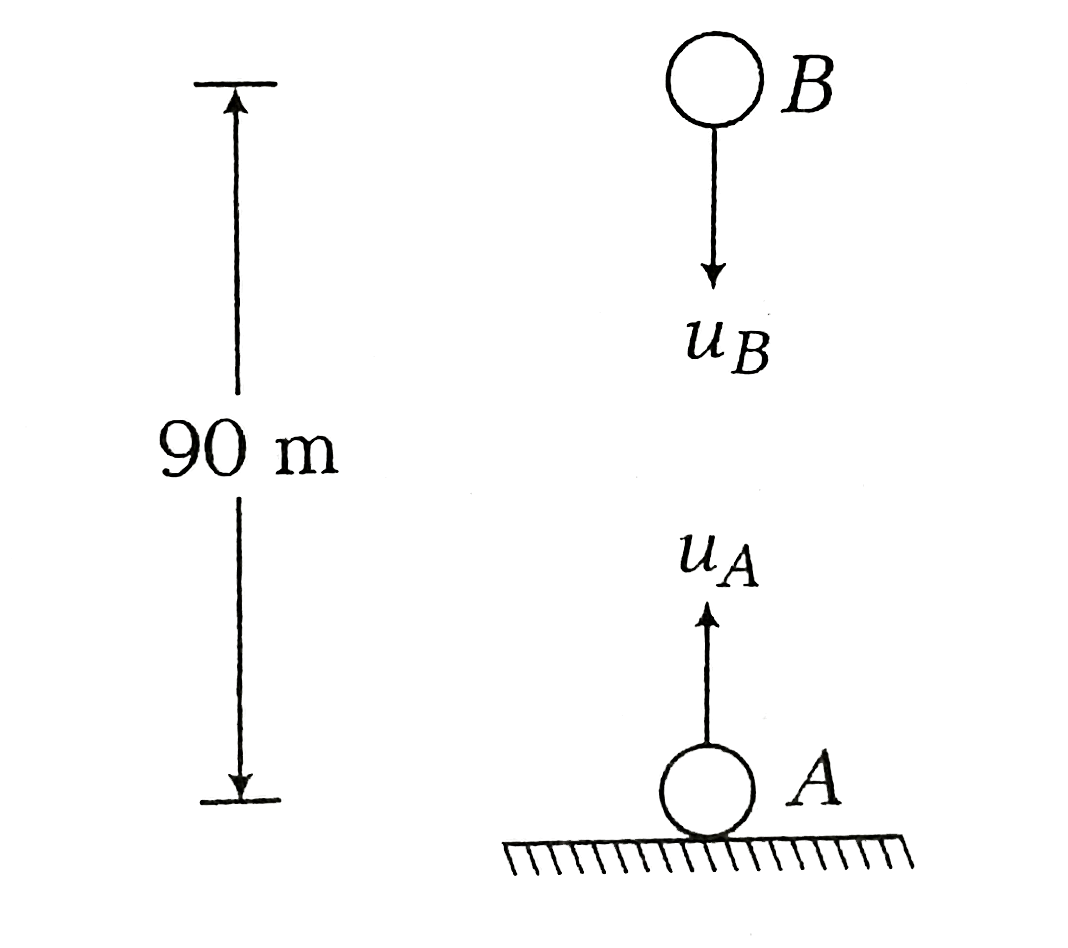
Two particles A and B of mass 1 kg and 2 kg respectively are projected in the direction shown in figure with speeds `u_(A) = 200 ms^(-1)` and `u_(B) = 50 ms^(-1)`. Initially they were 90 m apart. Find the maximum height attained by the center of mass of the particles. Assume acceleration due to gravity to be constant. (Take, `g=10 ms^(-2)`.

Text Solution

Verified by Experts

Using, `m_(A)r_(A) = m_(B)r_(B)` or `1(r_(A)) = 2(r_(B))`
or `r_(A) = 2r_(B)`..................(i)
and `r_(A) + r_(B)` = 90 m ..........................(ii)
Solving thest two equations, we get
`r_(A)`=60 m and `r_(B)` =30 m
i.e., CM is at height 60 m from the ground at time t=0.
Further, `a_(CM)` = `(m_(A)a_(A) + m_(B)a_(B))/(m_(A) + m_(B))`= g = `10 ms^(-1)` (downwards)
as `a_(A)` = `a_(B`) = g (downwards)
`u_(CM)` = `(m_(A)u_(A) + m_(B)u_(B))/(m_(A) + m_(B)`
`(1(200) - 2(50))/(1+2) = 100/3 ms^(-1)` (upwards)
Let h be the height attained by CM beyond 60m. Using
`v_(CM)^(2) = v_(CM)^(2) + 2a_(CM^(h)`
or `0=(100/3)^(2) -(2)(10(h)`
or `h=(100)^(2)/180= 55.55m`
Therefore, maximum height attained by the center of mass is H=60 + 55.55 = 115.55m
Promotional Banner

Topper's Solved these Questions

  • CENTRE OF MASS

    DC PANDEY|Exercise Check points|50 Videos
  • CENTRE OF MASS

    DC PANDEY|Exercise Taking it together|73 Videos
  • CALORIMETRY AND HEAT TRANSFER

    DC PANDEY|Exercise Medical entrance s gallery|38 Videos
  • CENTRE OF MASS, IMPULSE AND MOMENTUM

    DC PANDEY|Exercise Comprehension type questions|15 Videos

Similar Questions

Explore conceptually related problems

Two particles A and B of masses 1kg and 2kg respectively are projected in the directions shown in figure with speeds u_A=200m//s and u_B=50m//s . Initially they were 90m apart. They collide in mid air and stick with each other. Find the maximum height attained by the centre of mass of the particles. Assume acceleration due to gravity to be constant. (g=10m//s^2)

Two particles A and B masses 1 kg and 2 kg respectivelty are projected in the same vertical line as shown in figure with speeds u_(A) = 200 m//s and u_(B) = 85m//s respectively. Initially they were 90 m apart. Find the maximum height attained by the centre of mass of the system of particles A and B, from the initial position of centre of mass of the system. Assume that none of these particles collides with the ground in that duration Take g = 10 m//s^(2)

Two particles P and Q have mass 1 kg and 2 kg respectively. They are projected along a vertical line with velocity u_(p) = 20 m/s and u_(Q) = 5 m/s when separation between them was 60 m. P was projected vertically up while Q was projected vertically down. Calculate the maximum height attained by the centre of mass of the system of two particles, measured from the initial position of P. Assume that the particles do not collide and that the ground is far below their point of projection [g = 10 m//s^(2)]

The acceleration due to gravity on a planet of mass 10^(25) Kg and radius 2580 Km in ms^(-2) is

Two particles of same mass are project simultaneously with same speed 20ms^(-1) from the top of a tower of height 30m. One is projected vertically upwards and other projected horizontally.The maximum height attained by centre of mass from the ground will be (g=10ms^(-2))

The maximum height attained by a ball projected with speed 20 ms^(-1) at an angle 45^(@) with the horizontal is [take g = 10 ms^(-2) ]

Two particles A and B of mass 3kg and 2kg moving with speed 10m//s and 5m//s as shown in figure. Kinetic energy of particle A when particle B has the maximum momentum

A ball is projected vertically upward with a speed of 50 m//s. Find (a) the maximum height, (b) the time to reach the maximum height, (c) the speed at half the maximum height. Take g=10 ms^2.

If unit of mass is taken as 1 kg of time as 1 minute and that acceleration due to gravity is taken as 9.81 ms^(-2) , what is the unit of energy ?

DC PANDEY-CENTRE OF MASS-Medical entrances gallery
  1. Two particles A and B of mass 1 kg and 2 kg respectively are projected...

    Text Solution

    |

  2. A rod of weight w is supported by two parallel knife edges A and B an...

    Text Solution

    |

  3. Two particles of masses m(1),m(2) move with initial velocities u(1) an...

    Text Solution

    |

  4. The figure shows a smooth curved track terminating in a smooth horizon...

    Text Solution

    |

  5. A block having mass m collides with an another stationary block having...

    Text Solution

    |

  6. A smooth curved surface of height 10 m is ended horizontally. A spring...

    Text Solution

    |

  7. A frog sits on the end of a long board of length L = 5 m. The board re...

    Text Solution

    |

  8. A particle of mass m, collides with another stationary particle of mas...

    Text Solution

    |

  9. A body from height h is dropped, if the coefficient of restitution is ...

    Text Solution

    |

  10. Three particles of masses 0.50 kg, 1.0 kg and are placed at the corner...

    Text Solution

    |

  11. A large number of particles are placed around the origin, each at a di...

    Text Solution

    |

  12. A circular disc rolls on a horizontal floor without slipping and the c...

    Text Solution

    |

  13. The linear momentum of a particle varies with time t as p= a +bt + ct^...

    Text Solution

    |

  14. A body of mass (4m) is laying in xy-plane at rest. It suddenly explode...

    Text Solution

    |

  15. The position of center of mass of a system of particles does not depen...

    Text Solution

    |

  16. A bullet is fired from the gun. The gun recoils, the kinetic energy of...

    Text Solution

    |

  17. An explosion blows a rock into three parts. Two parts go off at right ...

    Text Solution

    |

  18. The linear momentum is conserved in

    Text Solution

    |

  19. Three particles , each of mass m, are placed at the vertices of a righ...

    Text Solution

    |

  20. A ball of mass 'm' moving with a horizontal velocity 'v' strikes the b...

    Text Solution

    |

  21. In an inelastic collision

    Text Solution

    |
