Home
Class 11
PHYSICS
A block of mass 5 kg moves from left to ...

A block of mass 5 kg moves from left to right with a velocity of `2ms^(-1)` and collides with another block of mass 3 kg moving along the same line in the opposite direction with velocity `4 ms^(-1)`.
(i) If the collision is perfectly elastic, determine velocities of both the blocks after their collision.
(ii) If coefficient of restitution is 0.6, determine velocities of both the blocks after their collision.

Text Solution

Verified by Experts
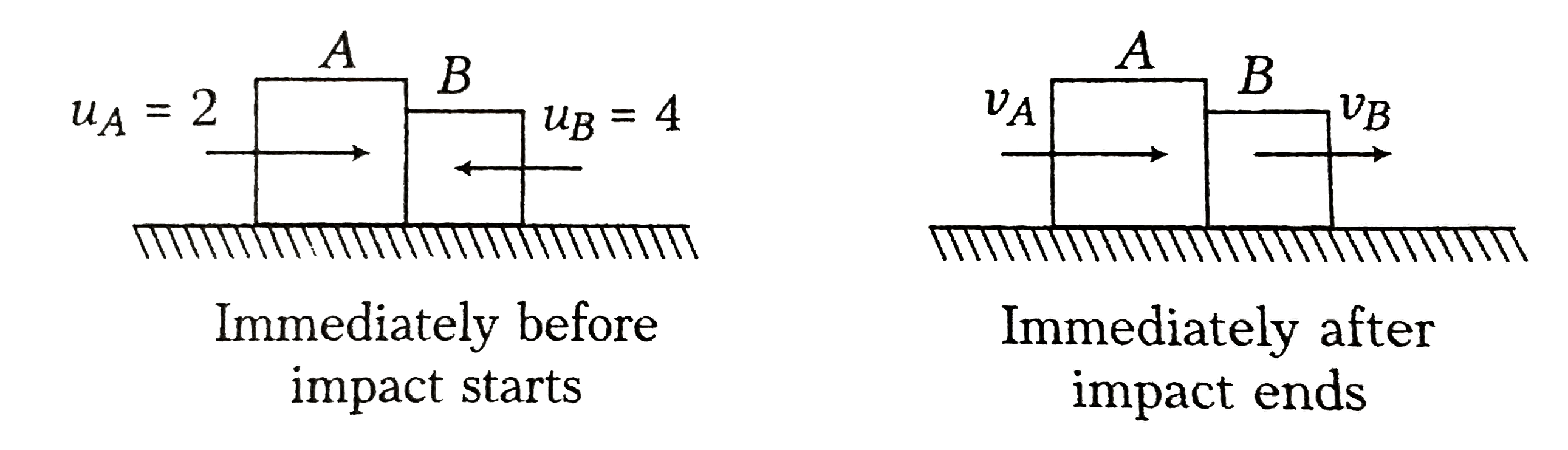
Denoting the first block by A and the second block by B velocities immediately before and after the impact are shown in the figure.

Applying principle of conservation of momentum, we have
`rArr (m_(B)v_(B) + m_(A)v_(A) = m_(A)u_(A) + m_(B)u_(B))`
`3v_(B) +5v_(A) = 5xx2+3xx(-4)`
`3v_(B) + 5v_(A) = -2`.............(i)
Applying equation of coefficient of resolution, we have
`v_(A) - v_(B) = e(u_(A) - u_(B))`
`rArr v_(B) - v_(A) = e[2-(-4)]`
`v_(B) - v_(A) = 6e` ...................(ii)
(i) For perfectly elastic impact e=1. Using this value in Eq. (ii), we have
`v_(B)-v_(A) = 6`..................(iii)
Now , from Eqs. (i) and (iii), we obtain
`v_(A) = -2.5 ms^(-1)` and `v_(B) = 3.5 ms^(-1)`
(ii) For value e = 0.6, Eq. (ii) is modified ias
`v_(B) - v_(A) = 3.6` ..................(iv)
Now from Eqs. (i) and (iv), we obtain
`v_(A) = -1.6 ms^(-1)` and `v_(B) = 2ms^(-1)`
Block A reverse back with speed `1.6 ms^(-1)` and B also move in opposite direction to its original direction with speed `2 ms^(-1)`
Promotional Banner

Topper's Solved these Questions

  • CENTRE OF MASS

    DC PANDEY|Exercise Check points|50 Videos
  • CENTRE OF MASS

    DC PANDEY|Exercise Taking it together|73 Videos
  • CALORIMETRY AND HEAT TRANSFER

    DC PANDEY|Exercise Medical entrance s gallery|38 Videos
  • CENTRE OF MASS, IMPULSE AND MOMENTUM

    DC PANDEY|Exercise Comprehension type questions|15 Videos

Similar Questions

Explore conceptually related problems

A block of mas m moving at a velocity upsilon collides head on with another block of mass 2m at rest. If the coefficient of restitution is 1/2, find the velocities of te blocks after the collision.

A ball of mass M moving with a velocity v collides perfectly inelastically with another ball of same mass but moving with a velocity v in the opposite direction. After collision

A body of mass 1 kg moving with velocity 5 m/s collides with another body of mass 2 kg moving with velocity 1.5 m/s in opposite direction. If the coefficient of restitution is 0.8, their velocities aftter collision respectively are

A body of mass 4kg moving with a speed of 3 ms^(-1) collides head on with a body of mass 3 kg moving in the opposite direction at a speed of 2 ms^(-1) . The first body stops after the collision. The final velocity of the second body is

A ball of mass 10 kg is moving with a velocity of 10 m / s . It strikes another ball of mass 5 kg which is moving in the same direction with a velocity of 4 m / s . If the collision is elastic, their velocities after the collision will be, respectively

A body of mass 3 kg moving with a velocity of 4 m//s towards left collides head on with a body of mass 4 kg moving in opposite direction with a velocity of 3 m//s . After collision the two bodies stick together and move with a common velocity which is

A body of mass 2kg moving with a velocity of 3m/sec towards left collides head-on with a body of mass 3kg moving in opposite direction with a velocity 2m/sec. After collision the two bodies stick together and move with a common velocity which is :

A body of mass 2 kg moving with a velocity 3 m//sec collides with a body of mass 1 kg moving with a velocity of 4 m//sec in opposite direction. If the collision is head-on perfect inelastic, then

A block of mass 1 kg moving with a speed of 4 ms^(-1) , collides with another block of mass 2 kg which is at rest. The lighter block comes to rest after collision. The loss in KE of the system is

A ball of mass m moving with velocity v collides elastically with another ball of identical mass coming from the opposite direction with velocity 2v. Their velocities after collisions are-

DC PANDEY-CENTRE OF MASS-Medical entrances gallery
  1. A block of mass 5 kg moves from left to right with a velocity of 2ms^(...

    Text Solution

    |

  2. A rod of weight w is supported by two parallel knife edges A and B an...

    Text Solution

    |

  3. Two particles of masses m(1),m(2) move with initial velocities u(1) an...

    Text Solution

    |

  4. The figure shows a smooth curved track terminating in a smooth horizon...

    Text Solution

    |

  5. A block having mass m collides with an another stationary block having...

    Text Solution

    |

  6. A smooth curved surface of height 10 m is ended horizontally. A spring...

    Text Solution

    |

  7. A frog sits on the end of a long board of length L = 5 m. The board re...

    Text Solution

    |

  8. A particle of mass m, collides with another stationary particle of mas...

    Text Solution

    |

  9. A body from height h is dropped, if the coefficient of restitution is ...

    Text Solution

    |

  10. Three particles of masses 0.50 kg, 1.0 kg and are placed at the corner...

    Text Solution

    |

  11. A large number of particles are placed around the origin, each at a di...

    Text Solution

    |

  12. A circular disc rolls on a horizontal floor without slipping and the c...

    Text Solution

    |

  13. The linear momentum of a particle varies with time t as p= a +bt + ct^...

    Text Solution

    |

  14. A body of mass (4m) is laying in xy-plane at rest. It suddenly explode...

    Text Solution

    |

  15. The position of center of mass of a system of particles does not depen...

    Text Solution

    |

  16. A bullet is fired from the gun. The gun recoils, the kinetic energy of...

    Text Solution

    |

  17. An explosion blows a rock into three parts. Two parts go off at right ...

    Text Solution

    |

  18. The linear momentum is conserved in

    Text Solution

    |

  19. Three particles , each of mass m, are placed at the vertices of a righ...

    Text Solution

    |

  20. A ball of mass 'm' moving with a horizontal velocity 'v' strikes the b...

    Text Solution

    |

  21. In an inelastic collision

    Text Solution

    |

