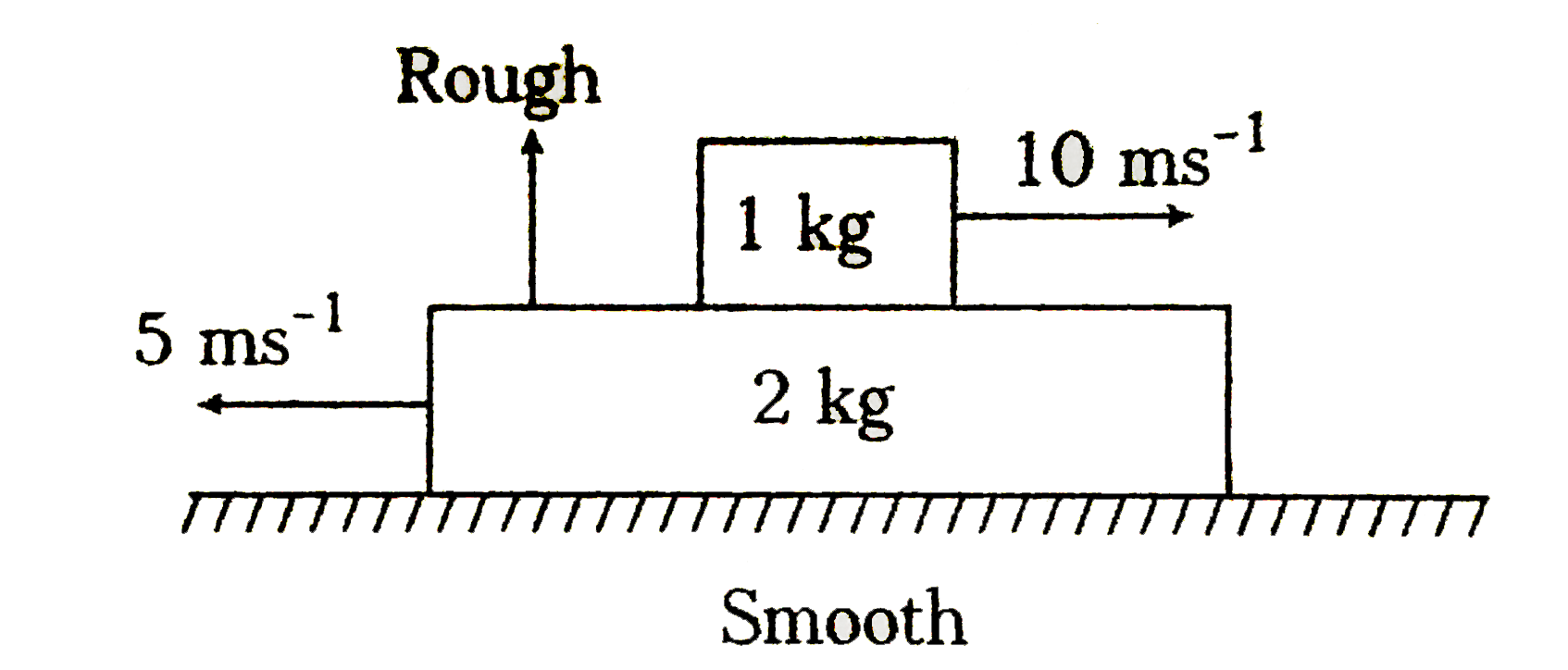
 `{:("Column1","Column2"),("A Velocity of center of mass","P Keep on changing all the time"),("B Momentum of center of mass","Q First decreases then become zero"),("C Momentum of 1kg block","R Zero"),("D Kinetic energy of 2kg block","S Constant"):}`
Text Solution
Verified by Experts
The correct Answer is:



Topper's Solved these Questions
CENTRE OF MASS
DC PANDEY|Exercise Medical entrances gallery|27 VideosCENTRE OF MASS
DC PANDEY|Exercise Assertion and reason|21 VideosCALORIMETRY AND HEAT TRANSFER
DC PANDEY|Exercise Medical entrance s gallery|38 VideosCENTRE OF MASS, IMPULSE AND MOMENTUM
DC PANDEY|Exercise Comprehension type questions|15 Videos
Similar Questions
Explore conceptually related problems
DC PANDEY-CENTRE OF MASS-Match the coloumns
- If net force on a system of particles is zero. Then {:(,"Column I",,...
Text Solution
|
- Four point masses are placede at four corners of a square of side 4m a...
Text Solution
|
- In the diagram shown in figure mass of both the balls in same. Match t...
Text Solution
|
- A particle of mass 1 kg has velocity vec(v)(1) = (2t)hat(i) and anothe...
Text Solution
|
- In the arrangement shown in figure match the following {:("column...
Text Solution
|
- A particle of mass m, kinetic energy K and momentum p collides head on...
Text Solution
|
- A particle of mass 1 kg is projected upwards with velocity 60ms^(-1). ...
Text Solution
|
- Match the following: (P = momentum of particle, K = kinetic energy of ...
Text Solution
|
- In a two block system in figure match the following. {:("Column1","...
Text Solution
|