Home
Class 11
PHYSICS
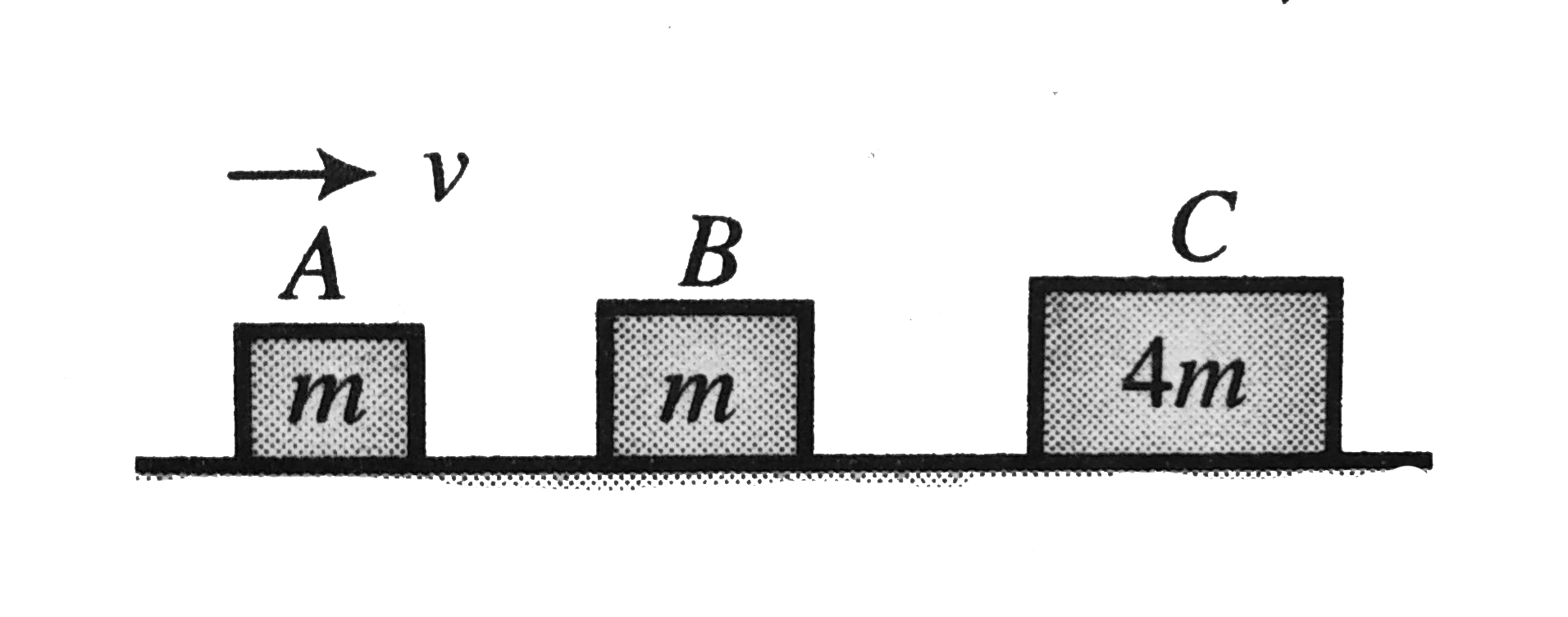
Three blocks are initially placed as sho...

Three blocks are initially placed as shown in the figure. Block `A` has mass `m` and initial velocity `v` to the right. Block `B` with mass `m` and block `C` with mass `4m` are both initially at rest. Neglect friction. All collisions are elastic. The final velocity of blocks `A` is

A

`0.6` v to the left

B

`0.4` v to the left

C

v to the left

D

`0.4` v to the right

Text Solution

Verified by Experts

Promotional Banner

Topper's Solved these Questions

  • CENTRE OF MASS, IMPULSE AND MOMENTUM

    DC PANDEY|Exercise Only one option is correct for JEE Advanced|55 Videos
  • CENTRE OF MASS, IMPULSE AND MOMENTUM

    DC PANDEY|Exercise More a than one option is Correct|1 Videos
  • CENTRE OF MASS

    DC PANDEY|Exercise Medical entrances gallery|27 Videos
  • CENTRE OF MASS, LINEAR MOMENTUM AND COLLISION

    DC PANDEY|Exercise Level 2 Subjective|21 Videos

Similar Questions

Explore conceptually related problems

Three blocks A, B and C each of mass m are placed on a surface as shown in the figure. Blocks B and C are initialyy at rest. Block A is moving to the right with speed v. It collides with block B and stricks to it. The A-B combination collides elastically with block C. Which of the following statement is (are) true about the velocity, of block B and C.

Three blocks are placed as shown in figure. Mass of A, B and C are m_(1), m_(2),"and "m_(3) respectively. The force exerted by block 'C' on 'B' is :-

Three blocks A,B and C are suspended as shown in the figure. Mass of each block A and C is m. if the system is in equilibrium and mass of B is M, then

There are hundred indentical blocks equally spaced on a frictionless track as shown in the figure . Initially , all the blocks are separate . Each collision is perfectly inelastic . The final velocity will be

Figure shows three identical blocks 1,2 & 3 each of mass m kept on frictionless surface. Block 1 is given initial velocity v_(0) in the direction shown. Block 1 hits block 2 and stops

Three blocks are placed on smooth horizontal surface and lie on same horizontal straight line. Block 1 and block 3 have mass m each and block 2 has mass M (M gt gt m) . Block 2 and block 3 are initially stationary, while block 1 is initially moving towards block 2 with speed v as shown. Assume that all collisions are head on and perfectly elastic. What value of M//m ensures that block 1 and block 3 have the same final speed?

Three blocks of masses m , m and M are kept on a frictionless floor as shown in the figure .The leftmost block is given velocity v towards the right . All the collision between the blocks are perfectly inelastic . The loss in kinetic energy after all the collision is 5//6th of initial kinetic energy. The ratio of M//m will be

Two identical blocks, each having mass M, are placed as shown in figure. These two blocks A and B are smoothly conjugated, so that when another block C of mass m passes from A to B there is no jerk. All the surfaces are frictionless, and all three blocks are free to move. Block C is released from rest, then

DC PANDEY-CENTRE OF MASS, IMPULSE AND MOMENTUM-Comprehension type questions
  1. Three blocks are initially placed as shown in the figure. Block A has ...

    Text Solution

    |

  2. Comprehension # 1 If net force on a system in a particular direction...

    Text Solution

    |

  3. Comprehension # 1 If net force on a system in a particular direction...

    Text Solution

    |

  4. Comprehension # 1 If net force on a system in a particular direction...

    Text Solution

    |

  5. Comprehension # 1 If net force on a system in a particular direction...

    Text Solution

    |

  6. Comprehension # 2 When two bodies collide normally they exert equal ...

    Text Solution

    |

  7. Comprehension # 2 When two bodies collide normally they exert equal ...

    Text Solution

    |

  8. Two identiacal masses are as shown in figure. One is thrown upwards wi...

    Text Solution

    |

  9. Two identiacal masses are as shown in figure. One is thrown upwards wi...

    Text Solution

    |

  10. Two identiacal masses are as shown in figure. One is thrown upwards wi...

    Text Solution

    |

  11. Comprehension # 4 When the mass of a system is variable, a thrust fo...

    Text Solution

    |

  12. Comprehension # 4 When the mass of a system is variable, a thrust fo...

    Text Solution

    |

  13. Comprehension # 4 When the mass of a system is variable, a thrust fo...

    Text Solution

    |

  14. Acceleration of two identical particles moving in a straight line are ...

    Text Solution

    |

  15. Acceleration of two identical particles moving in a straight line are ...

    Text Solution

    |

  16. Comprehension # 5 One particle of mass 1 kg is moving along positive...

    Text Solution

    |

