Home
Class 11
PHYSICS
Three blocks of identical masses are pla...

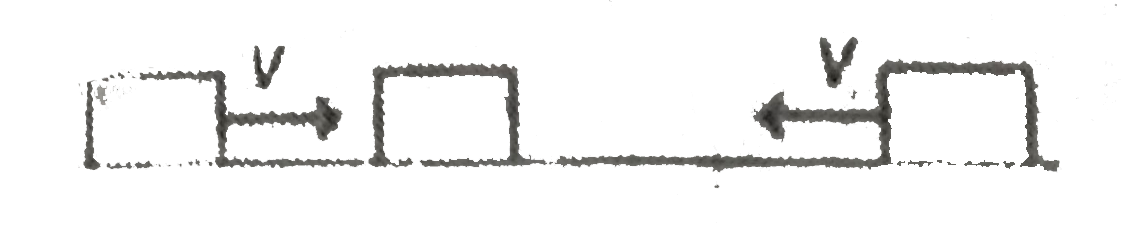
Three blocks of identical masses are placed on a frictionless table as shown . The centre block is at rest , whereas the other two blocks are moving directly towards the stationary block with identical speed v . The centre block is initially closer to the left block than the right one . All collisions are elastic . After long time , which of the following is true .

A

The centre block is moving towards left

B

The centre block is at rest somewhere to the left of its initial position .

C

The centre block is at rest at its initial position

D

The centre block is at rest somewhere to the right of its initial position .

Text Solution

Verified by Experts

Promotional Banner

Topper's Solved these Questions

  • CENTRE OF MASS, IMPULSE AND MOMENTUM

    DC PANDEY|Exercise Only one option is correct for JEE Advanced|55 Videos
  • CENTRE OF MASS, IMPULSE AND MOMENTUM

    DC PANDEY|Exercise More a than one option is Correct|1 Videos
  • CENTRE OF MASS

    DC PANDEY|Exercise Medical entrances gallery|27 Videos
  • CENTRE OF MASS, LINEAR MOMENTUM AND COLLISION

    DC PANDEY|Exercise Level 2 Subjective|21 Videos

Similar Questions

Explore conceptually related problems

Three identical blocks, each having a mass m are pushed by a force F on the Frictionless table as shown in figure. What is the net force on the block A?

Three identical blocks each of mass M are along a frictionless table and a force F is acting as shown. Which of the following statements is false ?

Three identical blocks A, B and C are placed on horizontal frictionless surface. The blocks B and C are at rest. But A is approaching towards B with a speed of 10 ms^(-1) The coefficient of restitution for all collision is 0.5. The speed of the block C just after collision is

Two identical masses are attached by a light string that passes over a small pulley, as shown . The table and the pulley are frictionless. The hanging block is moving

Three blocks are initially placed as shown in the figure. Block A has mass m and initial velocity v to the right. Block B with mass m and block C with mass 4 m are both initially at rest. Neglect friction. All collisions are elastic. The final velocity of block A is

Three blocks are initially placed as shown in the figure. Block A has mass m and initial velocity v to the right. Block B with mass m and block C with mass 4m are both initially at rest. Neglect friction. All collisions are elastic. The final velocity of blocks A is

(a) The right block collides with left block and sticks to it. Find amplitude of the resulting SHM. (b) The block starts from left wall and moves with constant speed v. All collisions are elastic. Find time period of periodic motion.

A set of n identical cubical blocks lies at rest parallel to each other along a line on a smooth horizontal surface. The separation between the near surfaces of any two adjacent blocks is L . The block at one end is given a speed v towards the next one at time 0 t . All collisions are completely inelastic, then

A block of mass m slides 0n a frictionless table. It is constrained to move inside a ring of radius R . At time t=0 , block is moving along the inside of the ring (i.e. in the tangential direction) with velocity v_(0) . The coefficient of friction between the block and the ring is mu . Find the speed of the block at time t .

DC PANDEY-CENTRE OF MASS, IMPULSE AND MOMENTUM-Comprehension type questions
  1. Three blocks of identical masses are placed on a frictionless table as...

    Text Solution

    |

  2. Comprehension # 1 If net force on a system in a particular direction...

    Text Solution

    |

  3. Comprehension # 1 If net force on a system in a particular direction...

    Text Solution

    |

  4. Comprehension # 1 If net force on a system in a particular direction...

    Text Solution

    |

  5. Comprehension # 1 If net force on a system in a particular direction...

    Text Solution

    |

  6. Comprehension # 2 When two bodies collide normally they exert equal ...

    Text Solution

    |

  7. Comprehension # 2 When two bodies collide normally they exert equal ...

    Text Solution

    |

  8. Two identiacal masses are as shown in figure. One is thrown upwards wi...

    Text Solution

    |

  9. Two identiacal masses are as shown in figure. One is thrown upwards wi...

    Text Solution

    |

  10. Two identiacal masses are as shown in figure. One is thrown upwards wi...

    Text Solution

    |

  11. Comprehension # 4 When the mass of a system is variable, a thrust fo...

    Text Solution

    |

  12. Comprehension # 4 When the mass of a system is variable, a thrust fo...

    Text Solution

    |

  13. Comprehension # 4 When the mass of a system is variable, a thrust fo...

    Text Solution

    |

  14. Acceleration of two identical particles moving in a straight line are ...

    Text Solution

    |

  15. Acceleration of two identical particles moving in a straight line are ...

    Text Solution

    |

  16. Comprehension # 5 One particle of mass 1 kg is moving along positive...

    Text Solution

    |

