Home
Class 11
PHYSICS
Comprehension # 4 When the mass of a s...

Comprehension # 4
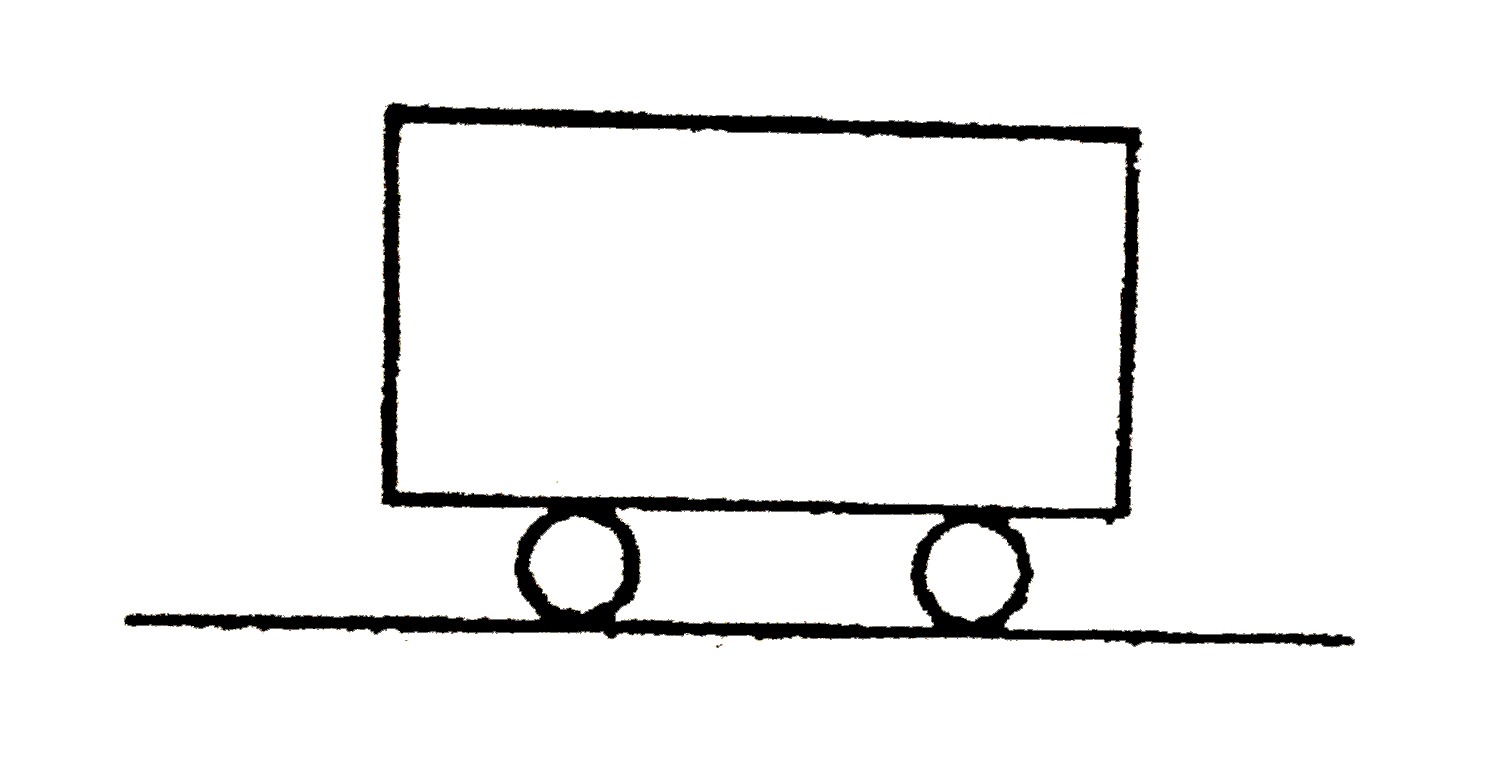
When the mass of a system is variable, a thrust force has to be applied on it in addition to all other forces acting on it. This thrust force is given by : `vec(F) = vec(v)_(r) (+- (dm)/(dt))`. Here `vec(v)_(r)` is the relative velocity with which the mass `dm` either enters or leaves the system.

A car has total mass `50 kg`. Gases are ejected from its backwards with relative velocity `20 m//s`. The rate of ejection of gas is `2 kg//s`. Total mass of gas is `20 kg`. Coefficient of friction between the car and road is `mu = 0.1`.
Car will stop after (from starting) `t = ........... s`.

A

12.2

B

6.4

C

10.6

D

5.8

Text Solution

Verified by Experts

Promotional Banner

Topper's Solved these Questions

  • CENTRE OF MASS, IMPULSE AND MOMENTUM

    DC PANDEY|Exercise More a than one option is Correct|1 Videos
  • CENTRE OF MASS

    DC PANDEY|Exercise Medical entrances gallery|27 Videos
  • CENTRE OF MASS, LINEAR MOMENTUM AND COLLISION

    DC PANDEY|Exercise Level 2 Subjective|21 Videos

Similar Questions

Explore conceptually related problems

Comprehension # 4 When the mass of a sytem is variable, a thrust force has to be applied on it in addition to all other forces acting on it. This thrust force is given by : vec(F) = vec(v)_(r) (+- (dm)/(dt)) Here vec(v)_(r) is the relative velocity with shich the mass dm either or leaves the system. A car has total mass 50 kg . Gases are ejected from this backwards with relative velocity 20 m//s . The rate of ejection of gas is 2 kg//s . Total mass of gas is 20 kg . Coefficient of friction between the car and road is mu = 0.1 . Car will stop after (from starting) t = ........... seconds :-

Comprehension # 4 When the mass of a sytem is variable, a thrust force has to be applied on it in addition to all other forces acting on it. This thrust force is given by : vec(F) = vec(v)_(r) (+- (dm)/(dt)) Here vec(v)_(r) is the relative velocity with shich the mass dm either or leaves the system. A car has total mass 50 kg . Gases are ejected from this backwards with relative velocity 20 m//s . The rate of ejection of gas is 2 kg//s . Total mass of gas is 20 kg . Coefficient of friction between the car and road is mu = 0.1 . Car will start moving after time t = ......... second :-

Comprehension # 4 When the mass of a sytem is variable, a thrust force has to be applied on it in addition to all other forces acting on it. This thrust force is given by : vec(F) = vec(v)_(r) (+- (dm)/(dt)) Here vec(v)_(r) is the relative velocity with shich the mass dm either or leaves the system. A car has total mass 50 kg . Gases are ejected from this backwards with relative velocity 20 m//s . The rate of ejection of gas is 2 kg//s . Total mass of gas is 20 kg . Coefficient of friction between the car and road is mu = 0.1 . Maximum speed of car willl be v = ....... m//s :- (Take in (4)/(3) = 0.28 )

What is the direction of the force acting on a charged particle q, moving with a velocity vec(v) a uniform magnetic field vec(B) ?

The velocity of centre of mass of the system remains constant, if the total external force acting on the system is.

A: If two particle are neither approaching towards nor receding away from other then their relative velocity is zero. R: Relative velocity of 1 w.r.t. 2 is given by vec(v)_(12) = vec(v)_(1) - vec(v)_(2) .

Two particles of mass 1 kg and 3 kg move towards each other under their mutual force of attraction. No other force acts on them. When the relative velocity of approach of the two particles is 2m//s, their centre of mass has a velocity of 0.5 m/s. When the relative velocity of approach becomes 3 m/s. When the relative velocity of approach becomes 3m/s, the velocity of the centre of mass is 0.75 m/s.

When a charged particle moving with velocity vec(V) is subjected to a magnetic field of induction vec(B) the force on it is non-zero. This implies that:

