

Home
Class 12
CHEMISTRY
A dicarboxylic acid of the form do...

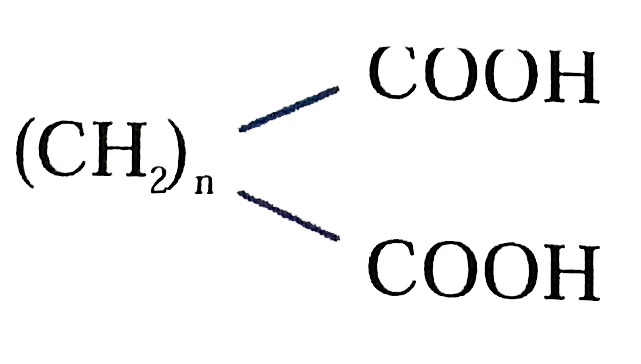
A dicarboxylic acid of the form

does not undergo decarboxylation on strong heating rather gives anothr stable product of molecular weight 100. Identify n.

Text Solution

Verified by Experts

The correct Answer is:
2
Promotional Banner

Topper's Solved these Questions

  • BIOMOLECULES

    NARAYNA|Exercise EXERCISE-4 (NCERT EXAMPLAR PROBLEMS)|12 Videos
  • CHEMICAL KINETICS

    NARAYNA|Exercise EXERCISE -4|30 Videos

Similar Questions

Explore conceptually related problems

Which one of the following acids undergoes decarboxylation on strong heating:

Which of the following beta -keto carboxylic acid does not undergo decarboxylation on heating ?

How many of the following two statements are incorrect? " I) Carboxylic acid on heating with soda lime undergoes decarboxylation reaction occurs through generation of carbocation II) \(CH_{4}\) produced as a chief product in wurtz reaction

Lactic acid gives n number of geometrical isomeric products on strong heating along. What is the value of n?

An organic compound (A) with molecular formula C_8H_8 O forms an orange red precipitate with 2,4 -DNP reagent and gives yellow precipitate on heating with iodine in the presence of sodium hydroxide . It neither reduces Tollen's reagent or Fehling's solution , nor does it decolourise bromine water or Baeyer's reagent. On drastic oxidation with chromic acid, it gives a carboxylic acid (B) having molecular formulae C_7H_6O_2 . Identify the compound (A) and (B) and explain the reactions involved .

Boric acid on heating at 100^@ C , gives (X) . (X) on heating at 160^@ C gives (Y) and (Y) on heating at red hot gives (Z) . Identify (X),(Y) and (Z) .

Variety of products are obtained when dicarboxylic acids are heated. The nature of product depends on the carbon chain length seperating the two carboxylic groups. (I) 1 ,2 and 1,3-dibasic acids on heating give monocarboxylic acid (II) 1,4 and 1,5-dibasic acids on heating give cyclic anhydride (III) 1,6 and 1,7-dibasic acids give cyclic ketones. Indicate whether the following reactions are right or wrong.

Variety of products are obtained when dicarboxylic acids are heated. The nature of product depends on the carbon chain length seperating the two carboxylic groups. (I) 1 ,2 and 1,3-dibasic acids on heating give monocarboxylic acid (II) 1,4 and 1,5-dibasic acids on heating give cyclic anhydride (III) 1,6 and 1,7-dibasic acids give cyclic ketones. Indicate whether the following reactions are right or wrong.

Variety of products are obtained when dicarboxylic acids are heated. The nature of product depends on the carbon chain length seperating the two carboxylic groups. (I) 1 ,2 and 1,3-dibasic acids on heating give monocarboxylic acid (II) 1,4 and 1,5-dibasic acids on heating give cyclic anhydride (III) 1,6 and 1,7-dibasic acids give cyclic ketones. Indicate whether the following reactions are right or wrong.

NARAYNA-CARBOXYLIC ACID-All Questions
  1. consider the reaction CH(3)OH+CO overset("Cobalt carbonyl")underset...

    Text Solution

    |

  2. Consider What is the value of n?

    Text Solution

    |

  3. A dicarboxylic acid of the form does not undergo decarboxylation...

    Text Solution

    |

  4. Find the total number of products obtained when Undergoes decarbo...

    Text Solution

    |

  5. Find the total number of different products obtained when is heat...

    Text Solution

    |

  6. Citric acid contains X carboxylic groups and Y hydroxy groups. Value o...

    Text Solution

    |

  7. Where X is

    Text Solution

    |

  8. 2-Butanone is best converted to propanoic acid by

    Text Solution

    |

  9. Which of the following carboxylic acids is not reduced to the correspo...

    Text Solution

    |

  10. End product of this conversion CH(3)-overset(O)overset(||)(C)-CH(2)-...

    Text Solution

    |

  11. The above conversion can be done by which of the following process?

    Text Solution

    |

  12. H(2)C =CH-overset(CH(3))overset(|)underset(CH(3))underset(|)(C)-COOH o...

    Text Solution

    |

  13. An ester (X) with molecular formula C9 H(10) O2 was treated with exces...

    Text Solution

    |

  14. In the reaction sequence : (Y) will be :

    Text Solution

    |

  15. , Where A and B are respectively,

    Text Solution

    |

  16. A carboxylic acid (C) C+B overset(H^(+))to A sweat smelling compound (...

    Text Solution

    |

  17. Which of the following Carboxylic acids donot undergo decarboxylation ...

    Text Solution

    |

  18. What is the product of the reaction of propenoic acid with ethyl lithi...

    Text Solution

    |

  19. Which of the following keto esters are not likely to be obtained by Cl...

    Text Solution

    |

  20. The rate of dehydration (acid catalysed) and decarboxylation (base cat...

    Text Solution

    |