
Home
Class 12
MATHS
If k is a positive constant such that 0 ...

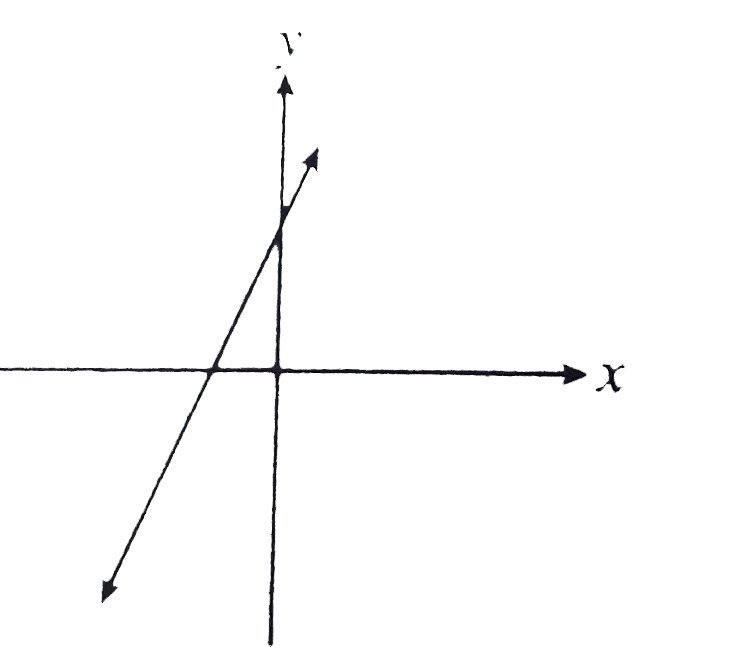
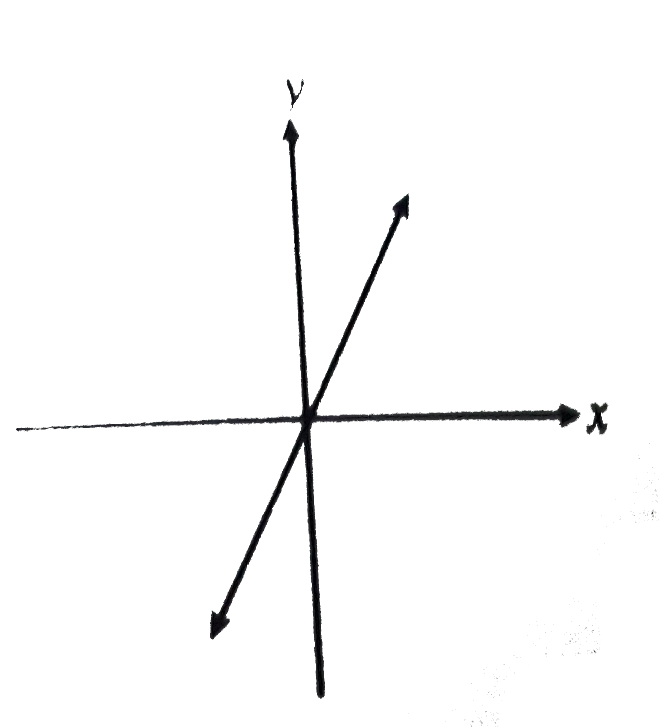
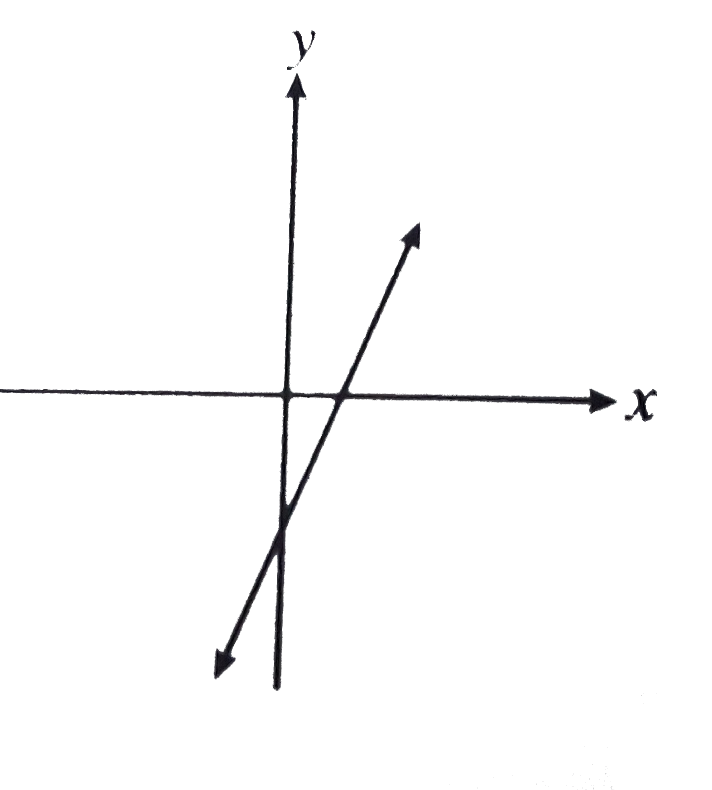
If k is a positive constant such that `0 lt k lt 1`, which of the following could be the graph of `y-x=k(x+y)` ?

A

B

C

D

Text Solution

AI Generated Solution

The correct Answer is:

To solve the equation \( y - x = k(x + y) \) where \( k \) is a positive constant such that \( 0 < k < 1 \), we will follow these steps: ### Step 1: Rearranging the Equation Start with the given equation: \[ y - x = k(x + y) \] We can rearrange this to isolate \( y \): \[ y - k y = k x + x \] This simplifies to: \[ y(1 - k) = (k + 1)x \] ### Step 2: Solving for \( y \) Now, divide both sides by \( (1 - k) \) (since \( k < 1 \), \( 1 - k > 0 \)): \[ y = \frac{(k + 1)}{(1 - k)} x \] ### Step 3: Analyzing the Slope The slope of the line is given by: \[ \text{slope} = \frac{(k + 1)}{(1 - k)} \] Since \( k \) is a positive constant less than 1, both \( k + 1 \) and \( 1 - k \) are positive. Therefore, the slope is positive. ### Step 4: Finding the y-intercept Since the equation is in the form \( y = mx + b \) (where \( b \) is the y-intercept), and there is no constant term added to \( y \), we can conclude that the line passes through the origin (0,0). ### Step 5: Conclusion Since the slope is positive and the line passes through the origin, the graph of the equation \( y - x = k(x + y) \) will be a straight line through the origin with a positive slope. Now, we can eliminate options that do not fit this description: - Any option with a y-intercept (not passing through the origin) can be eliminated. - Any option with a negative slope can also be eliminated. Thus, the correct graph would be the one that shows a straight line through the origin with a positive slope.
Promotional Banner

Topper's Solved these Questions

  • HEART OF ALGEBRA

    ENGLISH SAT|Exercise PRACTICE TEST|14 Videos
  • GETTING STARTED

    ENGLISH SAT|Exercise MCQs|8 Videos
  • HIGHER DEGREE POLYNOMIALS

    ENGLISH SAT|Exercise EXERCISES|6 Videos

Similar Questions

Explore conceptually related problems

f (x) = (x + 3)(x − k) T he function f is defined above. If k is a positive integer, which of the following could represent the graph of y = f (x) in the xy-plane?

The graph of y=f(x) is shown below. Which of the following could represents the graph of y=f(x-2)+1 ?

If g(x)=-2 intersects the graph of y=f(x)+k at one point, which of these choices could be the value of k?

If kgt4 is a constant, how would you translate the graph of y=x^(2) to get the graph of y=x^(2)+4x+k ?

Which could be the graph of y=x^2 + 3x+k , where k is an integer ?

If 12x=k is the directrix of parabola y^2 + 4y+3x=0 , then which of the following true? (A) k=25 (B) k=0 (C) k=5 (D) k=15

Question 1 and 2 refer to the information and graph below. Let function f be defined by the graph in the accompanying figure. Q. For what positive integer k is (1, 0) an x-intercept of the graph of y=f(x-k) ?

If K is constant such that xy + k = e ^(((x-1)^2)/(2)) satisfies the differential equation x . ( dy )/( dx) = (( x^2 - x-1) y+ (x-1) and y (1) =0 then find the value of K .
