Home
Class 11
PHYSICS
Let us call a motion, A when velocity is...

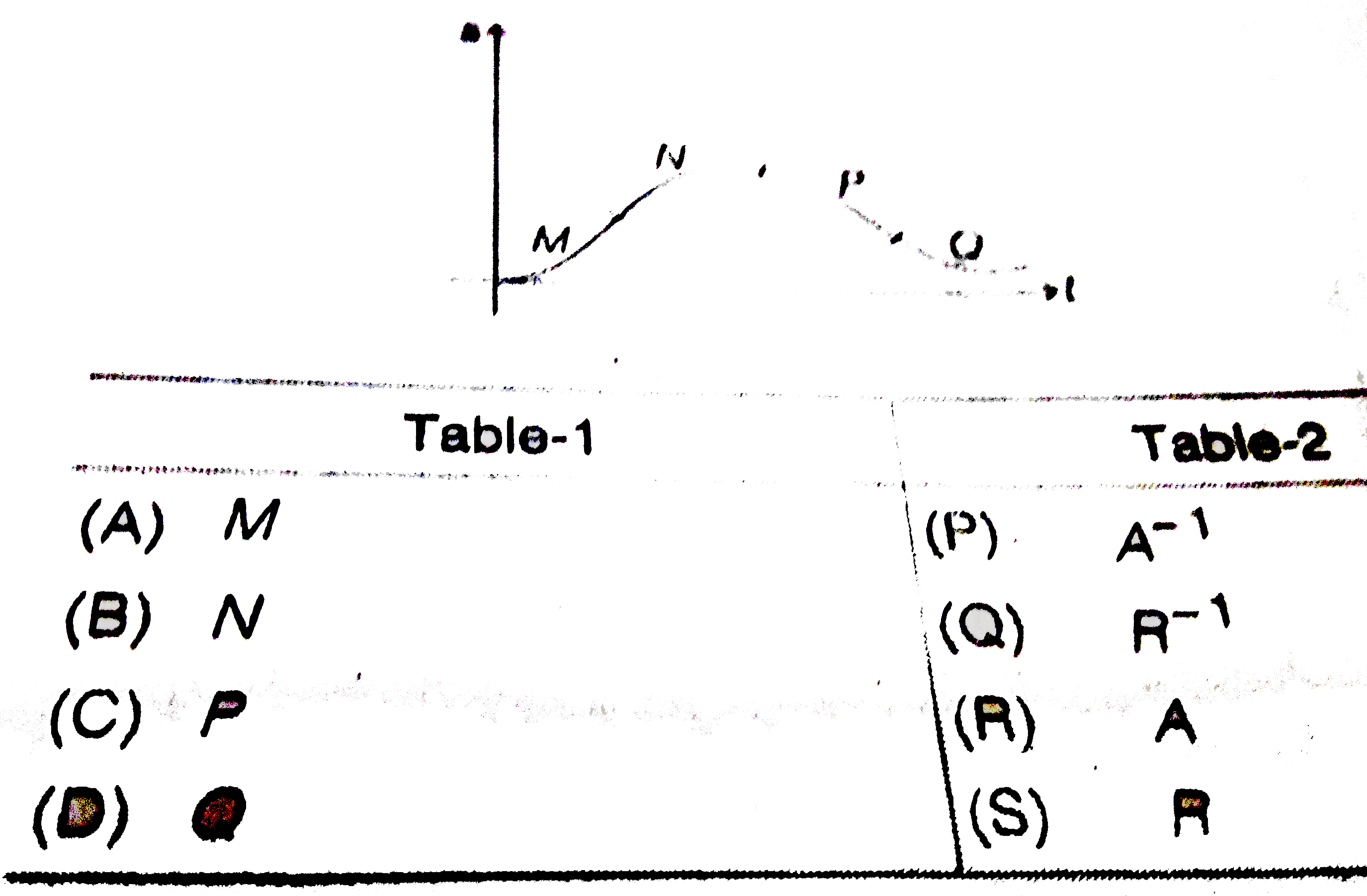
Let us call a motion, `A` when velocity is positive and increasing `A^(-1)` when velocity is negative and increasing `R` when velocity is positive and decreasing and `R^(-1)` when velociyt is negative and decreasing. Now match the following two tales for the given `s-t` graph

Text Solution

Verified by Experts

The correct Answer is:

A, B, C, D
Promotional Banner

Topper's Solved these Questions

  • KINEMATICS 1

    DC PANDEY|Exercise INTEGER_TYPE|15 Videos
  • KINEMATICS 1

    DC PANDEY|Exercise COMPREHENSION_TYPE|19 Videos
  • KINEMATICS

    DC PANDEY|Exercise INTEGER_TYPE|11 Videos
  • LAWS OF MOTION

    DC PANDEY|Exercise Medical entrances gallery|39 Videos

Similar Questions

Explore conceptually related problems

Assertion: In rectilinear motion when velocity is positive distance travelled increases and when velocity is negative distance travelled decreases. Reason: Distance is length of the path covered by a particle.

When height increases, velocity of sound decreases

Assertion : In the s-t graph as shown in figure, velocity of particle is negative and acceleration is positive. Reason : Slope of s-t graph is negative and increasing in magnitude.

Why uncertainty in position is more when uncertainty in velocity is less for an electron ?

Two particles are moving with velocities v_(1) and v_2 . Their relative velocity is the maximum, when the angle between their velocities is

Velocity of a particle is in negative direction with constant acceleration in positive direction. Then match the following:

Represent the velocity-time graph for a uniformly accelerated motion when acceleration is positive.

when temperature in increased by 1^@ C velocity of sound in air increaeses by

Represent the motion of an object in unifrom motion along a straight line when both initial distance and velocity of the object is positive .

Consider a box with three terminals on top of it as shown in figure. Three components namely, two germanium diodes and one resistor are connected across these three terminals in some arrangement A student performs an experiment in which any two of these three terminals are connected in the circuit shown in figure. The student obtains graphs of current-voltage characteristics for unknown combination of components between the two terminals connected in the circuit. The graphs are (i) When A is positive and B is negative (ii) When A is negative and B is positive (iii) When B is negative and C is positve (iv) When B is positive and C is neagtive (v) When A is positive and C is negative (vi) When A is negative and C is positive From these graphs of current - voltage characteristic shown in fig. (c) to (h) determine the arrangement of components between A, B and C.
