Home
Class 12
PHYSICS
An unstable nucleus X can decay into two...

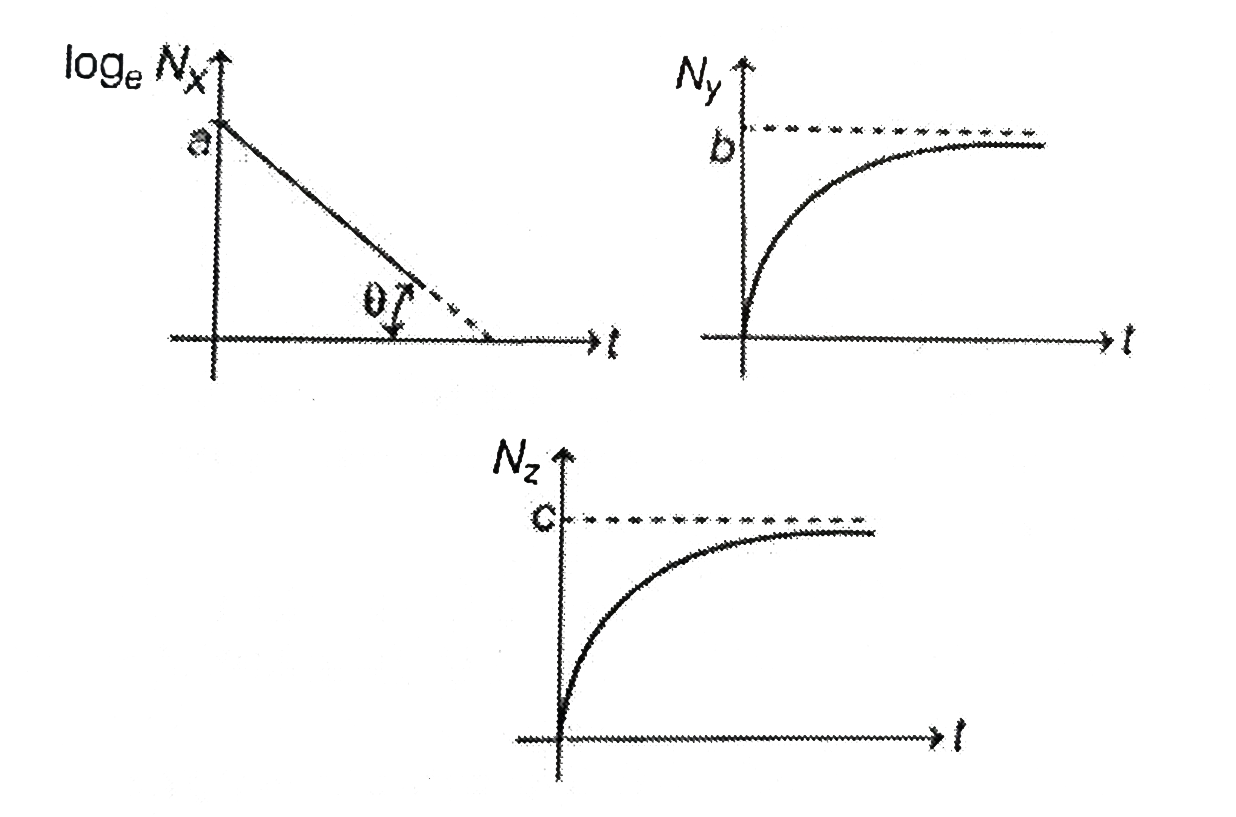
An unstable nucleus X can decay into two stable nuclie Y and Z A sample containing only X is taken at t=0 Three graphs `log_(e)(N_(x)` vs t,`N_(x),` vs t and `N_(z)` vs t are drawn as shown below Here `N_(x),N_(y)` and `N_(z)` represent number of nuclei of X,Y and Z repectively at any instant. t

Choose the correct choice (s) from the following :

A

Decay constant for decay of X into Y is `(b tan theta)/(e^(a))`

B

ecay constant for decay of X into Z is `(c tan theta)/(e^(a))`

C

Number of nuclei of X at t=0-is `e^(a)`

D

Half-life of nuclei X is `(1)/(tan theta)`

Text Solution

Verified by Experts

The correct Answer is:

A, B, C
Promotional Banner

Topper's Solved these Questions

  • MODERN PHYSICS

    DC PANDEY|Exercise for JEE Advanced (More than One Options is Correct )|1 Videos
  • MODERN PHYSICS

    DC PANDEY|Exercise Metch the column|6 Videos
  • MODERN PHYSICS

    DC PANDEY|Exercise Integer Type Questions|17 Videos
  • MAGNETISM AND MATTER

    DC PANDEY|Exercise Medical gallery|1 Videos
  • MODERN PHYSICS - 1

    DC PANDEY|Exercise Level 2 Subjective|23 Videos

Similar Questions

Explore conceptually related problems

Consider radioactive decay of A to B with which further decays either to X or Y , lambda_(1), lambda_(2) and lambda_(3) are decay constant for A to B decay, B to X decay and Bto Y decay respectively. At t=0 , the number of nuclei of A,B,X and Y are N_(0), N_(0) zero and zero respectively. N_(1),N_(2),N_(3) and N_(4) are the number of nuclei of A,B,X and Y at any instant t . At t=oo , which of following is incorrect ?

Consider radioactive decay of A to B with which further decays either to X or Y , lambda_(1), lambda_(2) and lambda_(3) are decay constant for A to B decay, B to X decay and Bto Y decay respectively. At t=0 , the number of nuclei of A,B,X and Y are N_(0), N_(0) zero and zero respectively. N_(1),N_(2),N_(3) and N_(4) are the number of nuclei of A,B,X and Y at any instant t . The net rate of accumulation of B at any instant is

Consider radioactive decay of A to B with which further decays either to X or Y , lambda_(1), lambda_(2) and lambda_(3) are decay constant for A to B decay, B to X decay and Bto Y decay respectively. At t=0 , the number of nuclei of A,B,X and Y are N_(0), N_(0) zero and zero respectively. N_(1),N_(2),N_(3) and N_(4) are the number of nuclei of A,B,X and Y at any instant t . The number of nuclei of B will first increase and then after a maximum value, it decreases for

The rate at which a particular decay process occurs in a radio active sample, is proportional to the number of radio active nuclei present. If N is the number of radio active nuclei present at some instant, the rate of change of N is (dN)/(dt) = - lambdaN . Consider radioavtive decay of A to B which may further decay, either to X or to Y, lambda_(1),lambda_(2) and lambda_(3) are decay constants for A to B decay, B to X decay and B of Y decay respectively. If at t = 0 number of nuclei of A, B, X and Y are N_(0), N_(0) , zero and zero respectively and N_(1),N_(2),N_(3),N_(4) are number of nuclei A,B,X and Y at any intant. At t = oo , which of the following is incorrect ?

Two radio active nuclei X and Y decay into stable nucleus Z X to Z + 2alpha+ beta^- Y to Z + alpha + 2 beta^+ if Z_1 and Z_2 are atomic numbers of X and Y then

The rate at which a particular decay process occurs in a radio sample, is proportional to the number of radio active nuclei present . If N is the number of radio active nuclei present at some instant, the rate of change of N is "dN"/"dt"=-lambdaN . Consider radioactive decay of A to B which may further decay either to X or to Y, lambda_1, lambda_2 and lambda_3 are decay constants for A to B decay , B to X decay and B of Y decay respectively. if at t=0 number of nuclei of A,B , X and Y are N_0, N_0 ,zero and zero respectively and N_1 , N_2, N_3,N_4 are number of nuclei A,B , X and Y at any instant. At t=oo , which of the following is incorrect ?

Let n>=3 and A be a set of n elements.Let P=(x,y,z) where x,y,z in A. Then the number of points such that atleast two of x,y,z are equal is

Nuclei of a radioactive element X are being produced at a constant rate K and this element decays to a stable nucleus Y with a decay constant lambda and half-life T_(1//3) . At the time t=0 , there are N_(0) nuclei of the element X. The number N_(Y) of nuclei of Y at time t is .

Nuclei of a radioactive element X are being produced at a constant rate K and this element decays to a stable nucleus Y with a decay constant lambda and half-life T_(1//3) . At the time t=0 , there are N_(0) nuclei of the element X . The number N_(Y) of nuclei of Y at t=T_(1//2) is.

Nuclei of a radioactive element X are being produced at a constant rate K and this element decays to a stable nucleus Y with a decay constant lambda and half-life T_(1//3) . At the time t=0 , there are N_(0) nuclei of the element X . The number N_(X) of nuclei of X at time t=T_(1//2) is .

DC PANDEY-MODERN PHYSICS-for JEE Advanced (only one option is Correct)
  1. An electron in hydrogen atom first jumps from second excited state to ...

    Text Solution

    |

  2. The magnitude of energy, the magnitude of linear momentum and orbital ...

    Text Solution

    |

  3. The wavelengths and frequencies of photons in transition 1,2 and 3 for...

    Text Solution

    |

  4. Which of the following transition in He^(+) ion will give rise to a sp...

    Text Solution

    |

  5. Suppose the potential energy between an electron and a proton at a dis...

    Text Solution

    |

  6. Let A(n) be the area enclosed by the n^(th) orbit in a hydrogen atom. ...

    Text Solution

    |

  7. Hydrogen atom absorbs radiations of wavelength lambda0 and consequentl...

    Text Solution

    |

  8. The threshold wavelength for photoelectric emission for a material is ...

    Text Solution

    |

  9. From the following equation pick out the possible nuclear fusion react...

    Text Solution

    |

  10. In the Bohr model of the hydrogen atgom

    Text Solution

    |

  11. The mass number of a nucleus is.

    Text Solution

    |

  12. Photoelectric effect supports quantum nature of light because

    Text Solution

    |

  13. If a nucleus .(Z)^(A)x emits one alpha-particle and one beta (negative...

    Text Solution

    |

  14. Find the half life of U^(238), if one gram of it emits 1.24xx10^4 alp...

    Text Solution

    |

  15. A nitrogen nucleus 7^(N^(14)) absorbs a neutron and can transfrom into...

    Text Solution

    |

  16. Nucleus A decays to B with decay constant lambda(1) and B decays to C ...

    Text Solution

    |

  17. An unstable nucleus X can decay into two stable nuclie Y and Z A sampl...

    Text Solution

    |

  18. An electron , initiallty at rest is released from a large distance fro...

    Text Solution

    |

  19. A nucleus X of mass M. initially at rest undergoes alpha decay accordi...

    Text Solution

    |

  20. Consider an atom made up of a protons and a hypothetical particle of t...

    Text Solution

    |
