Home
Class 12
CHEMISTRY
At the point of intersection of the two ...

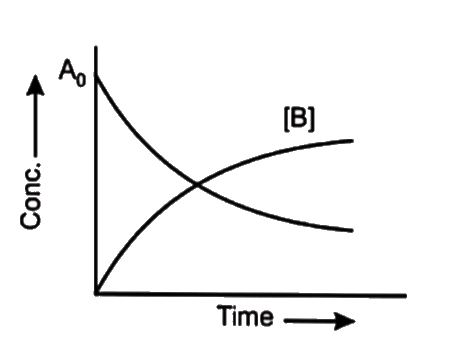
At the point of intersection of the two curves shown the concentration of B is given by _______for the first reaction `A to nB`.

A

`(nA_0)/2`

B

`(A_0)/(n-1)`

C

`(nA_0)/(n + 1)`

D

`((n-1)/(n+1))A_0`

Text Solution

Verified by Experts

The correct Answer is:

C
Promotional Banner

Topper's Solved these Questions

  • JEE MOCK TEST 4

    NTA MOCK TESTS|Exercise CHEMISTRY - SUBJECTIVE NUMERICAL|5 Videos
  • JEE MOCK TEST 3

    NTA MOCK TESTS|Exercise CHEMISTRY|25 Videos
  • JEE MOCK TEST 5

    NTA MOCK TESTS|Exercise CHEMISTRY|25 Videos

Similar Questions

Explore conceptually related problems

At the point of intersection of the two curves shown, the conc. of B is given by ……… for, A rarr nB :

At the point of intersection of the two curves shown, the conc.of B is given by….. ….. ……….for, A rarrnB

Curve of intersection of two spheres in

Curve of intersection of two spehere is

At the point of intersection of the two curves shown for the reaction A rarr nB " time " rarr then concentration of B is given by :

The rate and mechamical reaction are studied in chemical kinetics. The elementary reactions are single step reaction having no mechanism. The order of reaction and molecularity are same for elementary reactions. The rate of forward reaction aA + bBrarr cC+dD is given as: rate =((dx)/(dt))=-1/a(d[A])/(dt)=-1/b(d[B])/(dt)=1/c(d[C])/(dt)=1/d(d[D])/(dt) or expression can be written as : rate =K_(1)[A]^(a)[B]^(b)-K_(2)[C]^(c )[D]^(d) . At equilibrium, rate = 0 . The constants K, K_(1), K_(2) are rate constants of respective reaction. In case of reactions governed by two or more steps reaction mechanism, the rate is given by the slowest step of mechanism. At the point of intersection of the two curve shown for the reaction: Ararr nB the concentration of B is given by:

The number of point of intersection of the two curves y=2sin x and y=5x^(2)+2x+3 is :
