Home
Class 11
PHYSICS
Particles are released from rest A and s...

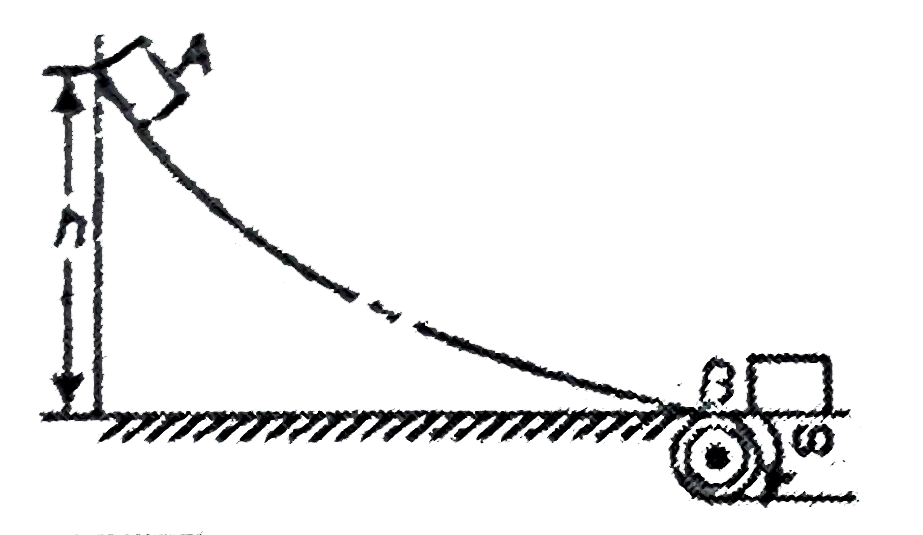
Particles are released from rest A and slide down the smooth surface of hight h to a conveyor B. The correct angular veleocity `omega` of the coneyor pulley of radius r to prevent any sliding on the belt as the particles transfer to the conveyor is

A

`sqrt(2gh)`

B

`(2gh)/(r)`

C

`sqrt(2gh)/(r)`

D

`(2gh^(2))/(r^(2))`

Text Solution

Verified by Experts

(c) First of all, we have to calculate the velocity of particles at the point B.
`:.` Loss in PE =gain in KE or mgh `=(1)/(2)mmv^(2)`
`:.` To Prevent sliding , `v=r_(omega)`
`:.` `omega=(v)/(r)=sqrt(2gh)/(r)`
Promotional Banner

Topper's Solved these Questions

  • CIRCULAR MOTION

    BITSAT GUIDE|Exercise BITAST Archives|5 Videos
  • ELASTICITY

    BITSAT GUIDE|Exercise BITSAT ARCHIVES|9 Videos

Similar Questions

Explore conceptually related problems

A block A starts sliding on a smooth track from a height h as shown in the figure. The track smoothly joins into a conveyor belt which is being driven by a pulley of radius r. I the angular velocity omega of the pulley is such that the block A doesn't slip on the belt, the value of omega is

A particle slides down from the top outside smooth surface of a fixed sphere of radius a=10m . The initial horizontal velocity to be imparted to the particle at the top is 5Km/s ,if it leaves the surface at a point whose vertical height above the centre of sphere is 3a/4. Find the value of K

A block is released at A and slides on smooth surface in shape of quarter circel. The horizontal part is rough if the block comes to rest 1.0 m away from B, then what is the coefficient of kinetic friction?

Block of mass m are released from rest and they slide down the inclined surface as shown in figure. Show that the work done by the frictional forces on the blocks are same in all the cases. Also calculate the speeds with which the blocks reach point B. The coefficient of friction for all the surface is mu_k .

A particle of mass m is released from a height H on a smooth curved surface which ends into a vertical loop of radius R , as shown. Choose the correct alernative(s) if H=2R .

A particle of mass m is released from rest from a point A of a wedge of mass 4m free to slide on a frictionless horizontal plane. The particle slides down the smooth face AB of the wedge. When the velocity of the wedge is 0.2 m/s the velocity of the particle in m/s relative to the wedge is

A particle of mass m is released from rest from a point A of a wedge of mass 4m free to slide on a frictionless horizontal plane. The particle slides down the smooth face AB of the wedge. When the velocity of the wedge is 0.2 m/s the velocity of the particle in m/s relative to the wedge is

A particle of mass m oscillates inside the smooth surface a fixed pipe of radius R . The axis of the pipe is horizontal and the particle moves from B to A and back. At an instant the kinetic energy of the particle is K (say at position of the particle shown in figure ). Then choose the correct value of force applied by particle on the pipe at this instant.

