

Home
Class 11
PHYSICS
A point on the periphery of a rotating d...

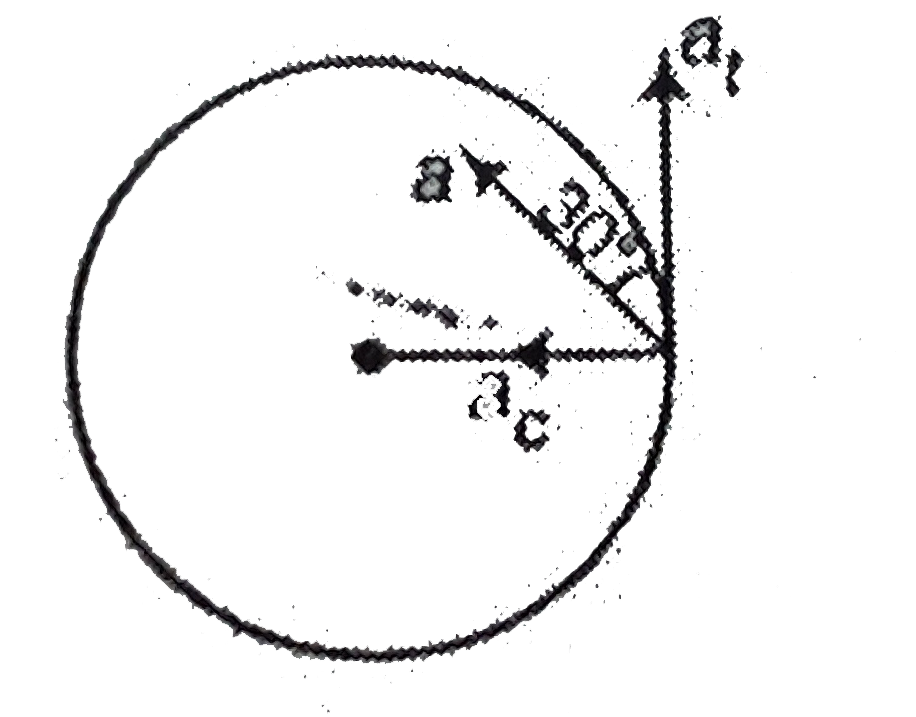
A point on the periphery of a rotating disc has its acceleration vector making angle of `30^(@)` with the velocity . The ratio `(a_(c)//a_(t) (a_(c)` "is centripetal acceleration and `a_(1)` is tangential acceleration ") equals

A

`sin 30^(@)`

B

`cos 30^(@)`

C

`tan 30^(@)`

D

None

Text Solution

Verified by Experts

(c) The tangential acceleration is along the tengent and `a_(c)` acts radially inward. The resultant acceleration

`:." " tan 30^(@)=(a_(c))/(a_(t))`
Promotional Banner

Topper's Solved these Questions

  • CIRCULAR MOTION

    BITSAT GUIDE|Exercise BITAST Archives|5 Videos
  • ELASTICITY

    BITSAT GUIDE|Exercise BITSAT ARCHIVES|9 Videos

Similar Questions

Explore conceptually related problems

Find the relation between acceleration a_(1) and a_(2)

Two blocks are arranged as shown in figure. Find the ratio of a_(1)//a_(2) . ( a_(1) is acceleration of m_(1) and a_(2) that of m_(2))

An object is thrown at an angle 60^(@) above horizontal with velocity 20ms^(-1) . How do the radial acceleration a_(c) vary during ascent.

In given system a_(1) and a_(2) are the accelerations of blocks 1 and 2. Then constraint relation is

If a_(r ) and a_(t) respresent radial and tangential acceleration, the motion of a particle will be circualr is

(a) A point moving in a circle of radius R has a tangential component of acceleration that is always n times the normal component of acceleration (radial acceleration). At a certain instant speed of particle is v_(0) . What is its speed after completing one revolution? (b) The tangential acceleration of a particle moving in xy plane is given by a_(t) = a_(0) cos theta . Where a_(0) is a positive constant and q is the angle that the velocity vector makes with the positive direction of X axis. Assuming the speed of the particle to be zero at x = 0 , find the dependence of its speed on its x co-ordinate.

Calculate the relative acceleration of A w.r.t. B if B is moving with acceleration a_(0) towards right.

a. If the velocity of a body is zero, does it mean that its acceleration is also zero ? (Yes//No) b. If the acceleration of a body is zero does it mean that its velocity is also zero ? (Yes//No) c. If a body travels with uniform acceleration a_(1) for a time t_(2) thenthe average acceleration is given by a_(av) =(a_(1)t_(1)+a_(2)t_(2))/(t_(1)+t_(2) (Yes//No) d. If a body starts from rest and moves with uniform acceleration the displacemects of the body is 1 s , 2 s, 3 s , etc., are in the ration of (1: 4: 9), etc. (True//False) e. For a body moving whith uniform acceleration, the displacent of the bosy in successive seconds is in the ration of 1: 3: 5: 7 .........................(True//False) .

A body travels along a straight line with uniform acceleration a_(1) for time t_(1) and with uniform acceleration a_(2) for time t_(2) for time t_(2) . What is the average acceleration?