

Home
Class 11
PHYSICS
A small body of mass m slides down from ...

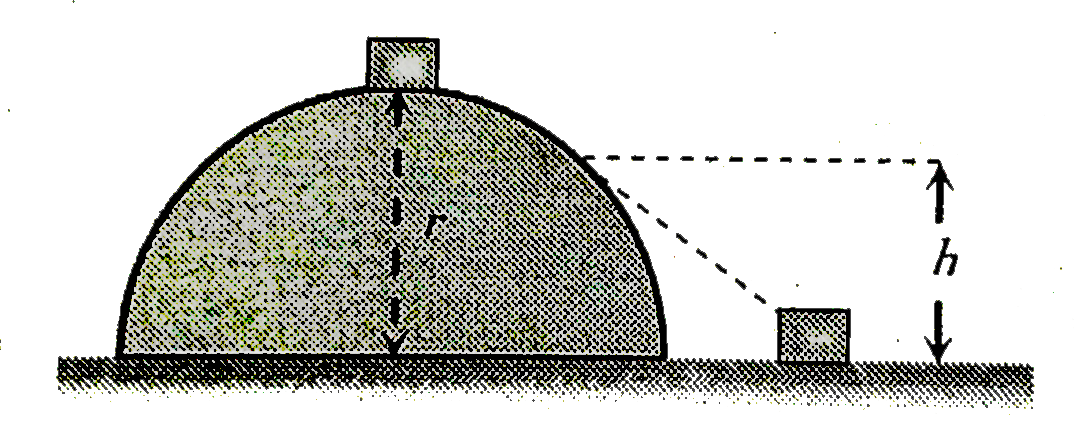
A small body of mass m slides down from the top of a hemisphere of radius r . The surface of block and hemisphere are frictionless. The height at which the body lose contact with the surface of the sphere is

A

`(3)/(2)R`

B

`(2)/(3) R`

C

`(1)/(2) R`

D

`(1)/(3) R`

Text Solution

Verified by Experts

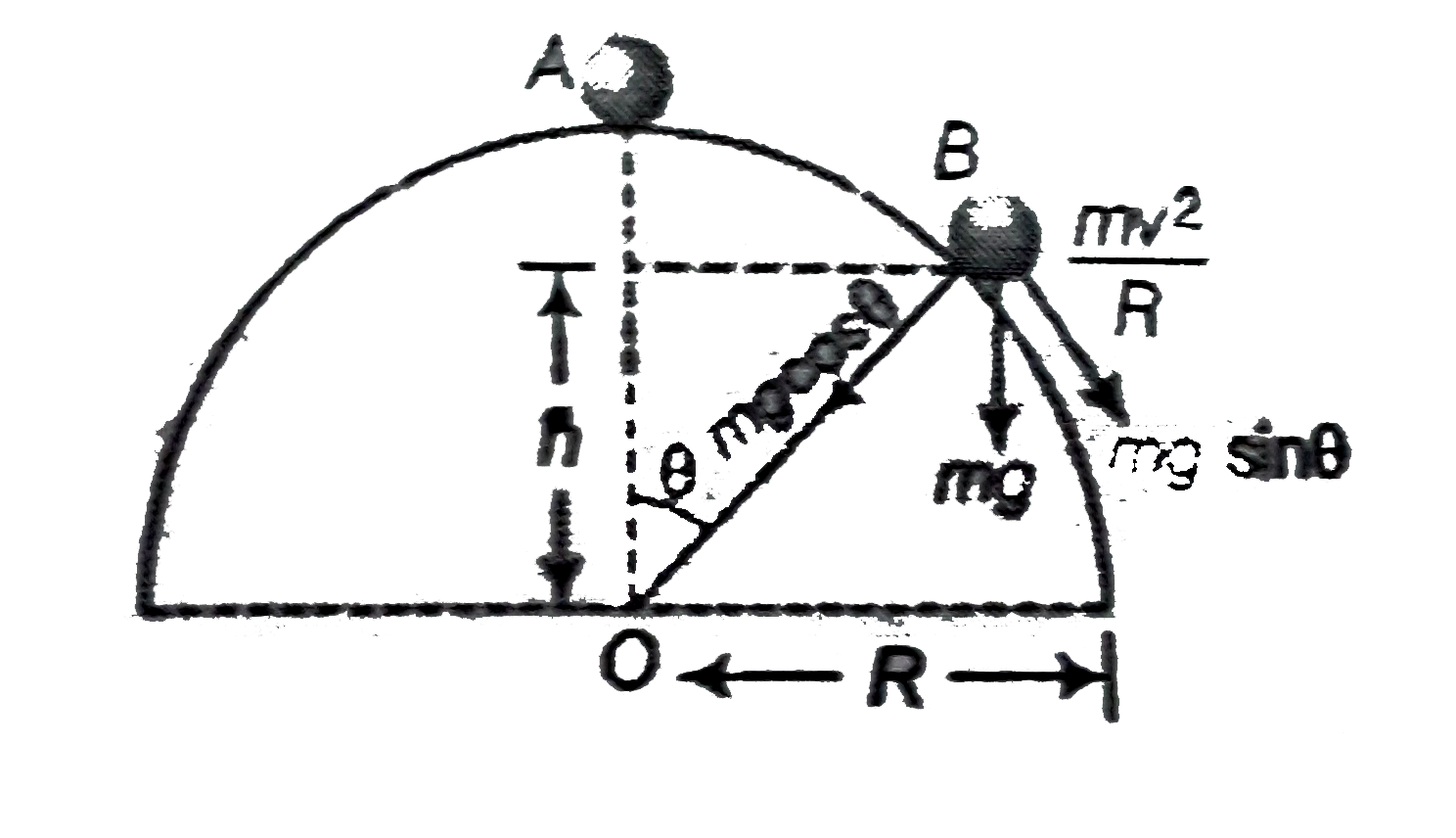
(b) Suppose body slips at point B

`mgcostheta=(mv^(2))/(R)[v=sqrt(2g(R-h))]`
gcostheta=(2g(R-h))/(R)`
`costheta=(2(R-h))/(R)`
`(h)/(R)=(2(R-h))/(R)" " [costheta=(h)/(R)]`
`:." "h=(2)/(3)R`
Promotional Banner

Topper's Solved these Questions

  • CIRCULAR MOTION

    BITSAT GUIDE|Exercise BITAST Archives|5 Videos
  • ELASTICITY

    BITSAT GUIDE|Exercise BITSAT ARCHIVES|9 Videos

Similar Questions

Explore conceptually related problems

A small block slides down from the top of hemisphere of radius R = 3 m as shown in the figure. The height 'h' at which the block will lose contact with the surface of the sphere is __________ m. (Assume there is no friction between the block and the hemisphere)

A small body of mass m slides without friction from the top of a hemisphere of radius r. At what hight will the body be detached from the centre of hemisphere?

The total surface area of a solid hemisphere of radius r is

A small body of mass m slide without friction from the top of a hemispherical cup of radius r as shown in figure. If leaves the surface to the cup at vertial distance h below the highest point then

A particle of mass m is released from the top of a smooth hemisphere of radius R with the horizontal speed mu . Calculate the angle with verticle where it loses contact with the hemisphere.

A body of mass 2kg slides down a curved track which is quadrant of a circle of radius 1 metre . All the surfaces are frictionless. If the body starts from rest, its speed at the bottom of the track is

What is the total surface area of hemisphere if the radius of hemisphere is r.

Find the ratio of the total surface area of a sphere and a hemisphere of same radius.

A particle of mass m is placed in equlibrium at the top of a fixed rough hemisphere of radius R. Now the particle leaves the contact with the surface of the hemisphere at angular position theta with the vertical wheere cos theta""(3)/(5). if the work done against frictiion is (2mgR)/(10x), find x.