Home
Class 11
PHYSICS
A mass m is moving with a constant veloc...

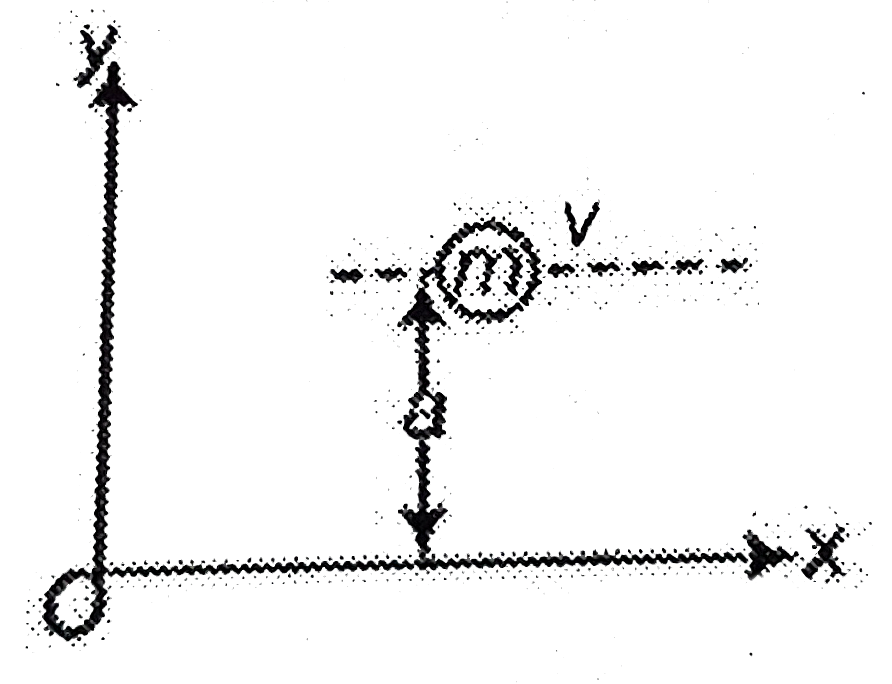
A mass m is moving with a constant velocity along a line parallel to the x-axis, away from the origin. Its angular momentum with respect to the origin.

A

zero

B

remains constant

C

goes on increasing

D

goes on decreasing

Text Solution

Verified by Experts

b) Angular moment of particle w.r.t. origin= linear momentum x perpendicualr distance on line of action of linear momentum from origin [`=mv xx a = mva`= constant]
Promotional Banner

Topper's Solved these Questions

  • ROTATIONAL MOTION

    BITSAT GUIDE|Exercise BITSAT Archives|9 Videos
  • NEWTONS LAWS OF MOTION AND FRICTION

    BITSAT GUIDE|Exercise BITSAT Archives|23 Videos
  • SCALARS AND VECTORS

    BITSAT GUIDE|Exercise All Questions|34 Videos

Similar Questions

Explore conceptually related problems

A body of mass m is moving with a constant velocity along a line parallel to the x-axis, away from the origin. Its angular momentum with respect to the origin

A mass m moving with a constant velocity along a line parallel to the axis, away from the origin. Its anguarl momentum with respect to the origin

A body of mass m is moving with a constant velocity along a line parallel to the x-axis, away from the origin. Calculate its angular momentum with respect to the origin?

A particle performs uniform circular velocity along a line parallel to the x-axis, away from the origin. Its angular momentum with respect to the origin.

A particle is moving in the xy-plane with a constant velocity along a line parallel to the X-axis away from the origin. The magnitude of its angular momentum about the origin.

If the particle of mass m is moving with constant velocity v parallel to x-axis in x-y plane as shown in (figure), Find its angular momentum with respect of origin at any time t .

A particle of mass m is moving with constant velocity v parallel to the x-axis as shown in the figure. Its angular momentum about origin O is

If a particle of mass m is moving with constant velocity v parallel to x -axis in x-y plane as shown in fig. Its angular moment with respect to origin at any time t will be

A particle moves with a constant velocity pralel to the X-axis. Its angular momentum with respect to the origin