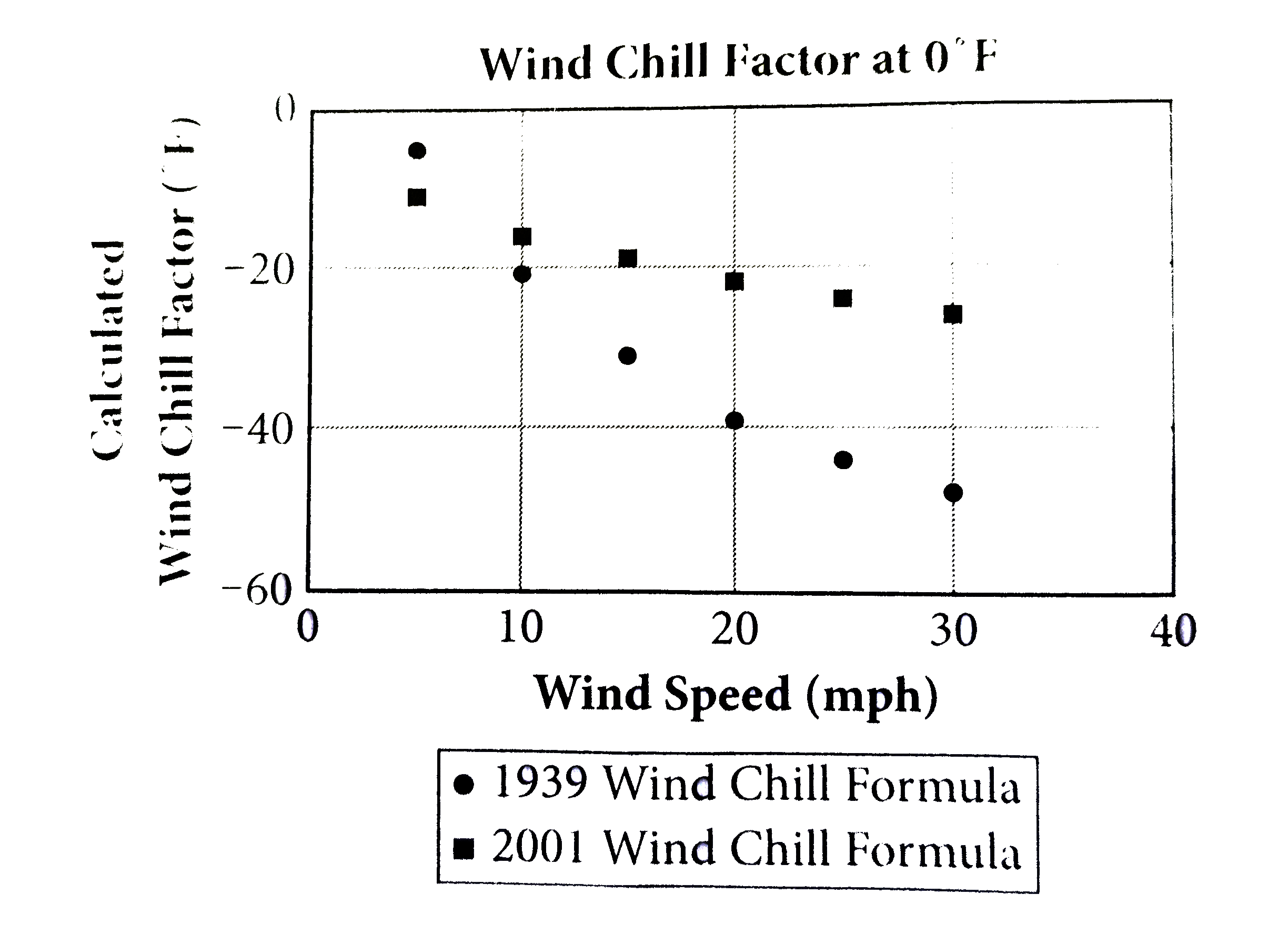
What wind speed would produce the same wind chill using the 1939 ormula as the wind chill produced using the 2001 formula when the outside temperture is `0^(@)F` and the wind speed is 40 miles per hour ?
What wind speed would produce the same wind chill using the 1939 ormula as the wind chill produced using the 2001 formula when the outside temperture is `0^(@)F` and the wind speed is 40 miles per hour ?
A
10 miles per hour
B
15 miles per hour
C
20 miles per hour
D
40 miles per hour
Text Solution
Verified by Experts
The correct Answer is:
B
Since the conditions mentioned are the same as those in the previous question, start with the wind chill calculate using the 2001 formula for that question, `-30^(@)F.`
Draw a horizontal line from `- 30^(@)F` on the y-axis until it intersects a data point on the 1939 formula plot. Draw a vertical line from the point down to the x-axis : you'll find that in 1939, a wind speed of approximately 15 mph would yield a wind chill of `-30^(@)F.` Therefore, the correct answer is (B).
Draw a horizontal line from `- 30^(@)F` on the y-axis until it intersects a data point on the 1939 formula plot. Draw a vertical line from the point down to the x-axis : you'll find that in 1939, a wind speed of approximately 15 mph would yield a wind chill of `-30^(@)F.` Therefore, the correct answer is (B).



Topper's Solved these Questions
Similar Questions
Explore conceptually related problems
(##KPL_SAT_PRD_PLS_C09_E01_002_Q01.png" width="80%"> Wind chill, a measurement that reflacts the temperature that one feels when outside based on the actual temperature and the wind speed, was first introduced in 1939, and the formula was revised in 2001. If the outside temperature is 0^(@)F, what is the approximate wind chill at 40 miles per hour based on the 2001 formula ?
The reduction in speed, r,in miles per hour, of an engine having n bogies attached to it is given as : r = 4sqrt(n) . The final spee d , s, in miles per hour , at which the engine can pull then bogies attached is given as: s = 40 - r . What is the speed of the train , to the nearest tenths, in miles per hour, when there are 15 bogies attached ?
A train standing in a station-yard blows a whistle of frequency 400 Hz in still air. A wind starts blowing in the direction from the yard to the station wit a speed of 10 ms^(-1)? . What are the frequeney, wavelength and speed of sound foran observer standing on the station's platform ? Is the situation exactly equivalent to the case when the air is still and the observer runs towards the yard at the speed of 10 ms^(-1)?
A military band was marching on a street in the same direction as the normal traffic flow. A motorist was approching the band from behind in his car just at the moment when they were playing the musical note A (frequency 440 Hz ) in unison. The same band' performance was also simultaneously being broad live on the ratio from a stationary microphone which was situated on the sidewalk just ahead of the band. The motorist noticed that the combination of the direct sound coming from the band ahead of the band brodcast produced discernible beats. Timing the beats, he counted 4 beats in 3 seconds. He noted from the speedmeter that his car was travelling at 18 kilometers per hour. Calculate the speed in meters per seconds at which the band was marching assuming that the speed of sound on that day was 330 ms^(-1) . (It was a very cold day)
A stationary source emits sound of frequency upsilon=1200Hz . If a wind blows at the speed of 0.1c deduce (i) the percentage change in the wavelength and (ii) the change in the frequency for a stationary observer on the wind side of the source. What happens when there is no wind, but the observer moves at speed 0.1c towards the source?
A stationary source emits sound of frequency upsilon=1200Hz . If a wind blows at the speed of 0.1c deduce (i) the percentage change in the wavelength and (ii) the change in the frequency for a stationary observer on the wind side of the source. What happens when there is no wind, but the observer moves at speed 0.1c towards the source?
A car travels from Twon A to Twon B at an average speed of 40 miles per hour, and returns immediately along the same route at an average speed of 50 miles per hour. What is the average speed in miles per hour for the round - trip?
A car fitted with a device which transmits sound 60 times per minute. There is no wind and speed of sound in still air is 345 m/s. If you hear the sound 68 times per minute when you are moving towards the car with a speed of 12 m/s, the speed of the car must be nearly.
A commercial airline has calculated that the approximately fuel mileage for its 600-passenger airplane is 0.2 miles per gallon when the plane travels at an average speed of 500 miles per hour. Flight 818's fuel tank has 42,000 gallons of fuel at the beginning of an international flight. If the plane travels at average speed of 500 miles per hour, which of the following functions f models the number of gallons of fuel remaining in the tank t hours after the flight begins?