Home
Class 11
PHYSICS
Two blocks A and B of mass m and 2m res...

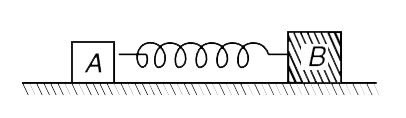
Two blocks A and B of mass m and `2m` respectively are connected by a light spring of force constant k. They are placed on a smooth horizontal surface. Spring is stretched by a length x and then released. Find the relative velocity of the blocks when the spring comes to its natural length

A

`(sqrt((3k)/(2m)))x`

B

`(sqrt((2k)/(3m)))x`

C

`sqrt((2kx)/m)`

D

`sqrt((3km)/(2x)`

Text Solution

Verified by Experts

The correct Answer is:

A
Promotional Banner

Topper's Solved these Questions

  • WORK, ENERGY AND POWER

    PHYSICS GALAXY - ASHISH ARORA|Exercise unsolvedMCQ|78 Videos
  • WORK, ENERGY AND POWER

    PHYSICS GALAXY - ASHISH ARORA|Exercise unsolved|1 Videos
  • WORK, ENERGY AND POWER

    PHYSICS GALAXY - ASHISH ARORA|Exercise Discussion Question|31 Videos
  • RIGID BODIES AND ROTATIONAL MOTION

    PHYSICS GALAXY - ASHISH ARORA|Exercise Unsolved Numerical|63 Videos

Similar Questions

Explore conceptually related problems

Two blocks A and B of masses m and 2m, respectively , are connected by a massless spring of force constant k and are placed on a smooth horizontal plane. The spring is stretched by an amount x and then released . The relative velocity of the blocks when the spring comes to its natural length is

Two blocks A and B of masses 3 kg and 6 kg are connected by a massless spring of force constant "1800 N m"^(-1) and then they are placed on a smooth horizontal surface. The blocks are pulled apart to stretch the spring by 5 cm and then released. What is the relative velocity (in ms^(-1) ) of the blocks when the spring comes to its natural length?

Two blocks A and B of mass m and 2m respectively are connected by a massless spring of spring constant K . This system lies over a smooth horizontal surface. At t=0 the bolck A has velocity u towards right as shown while the speed of block B is zero, and the length of spring is equal to its natural length at that at that instant. {:(,"Column I",,"Column II"),((A),"The velocity of block A",(P),"can never be zero"),((B),"The velocity of block B",(Q),"may be zero at certain instants of time"),((C),"The kinetic energy of system of two block",(R),"is minimum at maximum compression of spring"),((D),"The potential energy of spring",(S),"is maximum at maximum extension of spring"):}

Two blocks A and B of masses m and 2m respectively are connected together by a light spring of stiffness k and then placed on a smooth horizontal surface. The blocks are pushed towards each other such that spring gets compressed by a length x_(0) and then released from rest. Find the work done on the block A by the spring, by the time the spring acquires its natural length.

Two blocks of masses m_(1) and m_(2) are connected by an ideal sprit, of force constant k . The blocks are placed on smooth horizontal surface. A horizontal force F acts on the block m_(1) . Initially spring is relaxed, both the blocks are at rest. What is acceleration of centre of mass of system at the instant of maximum elongation of spring

A light spring of force constant 'K' is held between two blocks of masses 'm' and '2m'. The two blocks and the spring system rests on a smooth horizontal floor. Now th blocks are moved towards each other compressing the springs by 'x' and suddenly released. The relative velocity between the blocks when the spring attains its natural length will be

Two blocks m_(1) and m_(2) are connected by a spring of force constant K and are placed on a frictionless horizontal surface. Initially the spring is given extension x_(0) when the sysetem is released from rest, find the distance moved by two blocks before they again comes to rest.

Two blocks of masses m_(1) and m_(2) are connected by an ideal sprit, of force constant k . The blocks are placed on smooth horizontal surface. A horizontal force F acts on the block m_(1) . Initially spring is relaxed, both the blocks are at rest. Which of the following statement is not true tn the watt of above system.

Two blocks A and B of masses m and 2m are connected by a massless spring of natural length L and spring constant k . The blocks are intially resting on a smooth horizontal floor with the spring at its natural length , as shown . A third identical block C of mass m moves on the floor with a speed v_(0) along the line joining A and B and collides elastically with A . FInd (a) the velocity of c.m. of system (block A + B + spri ng) and (b) the minimum compression of spring.

PHYSICS GALAXY - ASHISH ARORA-WORK, ENERGY AND POWER-MCQ
  1. A car is moving in a circular horizontal track of radius 10 m with a c...

    Text Solution

    |

  2. The velocity-time graph of a particle moving in a straight line is sho...

    Text Solution

    |

  3. Two blocks A and B of mass m and 2m respectively are connected by a l...

    Text Solution

    |

  4. The potential energy of a particle of mass m is given by U=(1)/(2)kx^(...

    Text Solution

    |

  5. A particle P is sliding down a frictionless hemispherical bowl. It pas...

    Text Solution

    |

  6. A small block of mass m slides along a smooth frictionless track as sh...

    Text Solution

    |

  7. A stone tied to a string of length L is whirled in a vertical circle w...

    Text Solution

    |

  8. A long horizontal rod has a bead which can slide along its length and ...

    Text Solution

    |

  9. An insect crawls up a hemispherical surface very slowly (see the figur...

    Text Solution

    |

  10. An ideal spring with spring constant k is hung from the ceiling and a ...

    Text Solution

    |

  11. An ideal massless spring is compressed by 1 m by a force of 100 N. The...

    Text Solution

    |

  12. The following figure -3.116 illustrates the relation between the posit...

    Text Solution

    |

  13. A ball of mass m is attached to the lower end of a light vertical spri...

    Text Solution

    |

  14. A heavy particle is suspended by a string of length 60 cm from a fixed...

    Text Solution

    |

  15. Work done by the conservative force on a system is equal to :

    Text Solution

    |

  16. Select the correct alternative(s).

    Text Solution

    |

  17. Work done by a force on an object is zero, if

    Text Solution

    |

  18. A particle moves in a straight line with constant acceleration under ...

    Text Solution

    |

  19. Kinetic energy of a particle moving in a straight line is proportional...

    Text Solution

    |

  20. In a projectile motion, power of the gravitational force

    Text Solution

    |
