Home
Class 12
CHEMISTRY
The variation of equivalent conductance ...

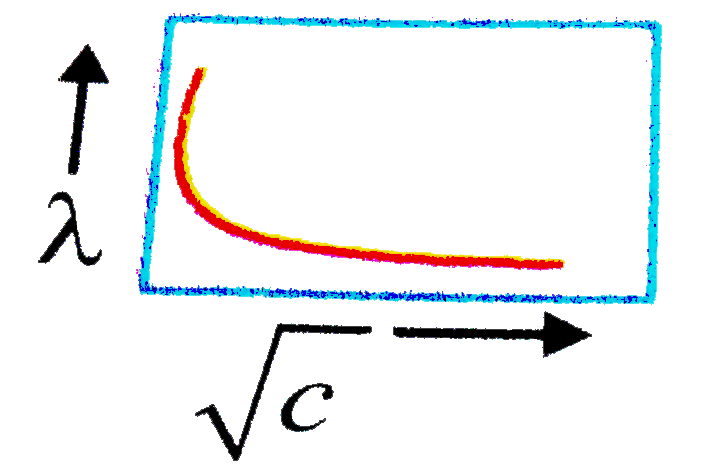
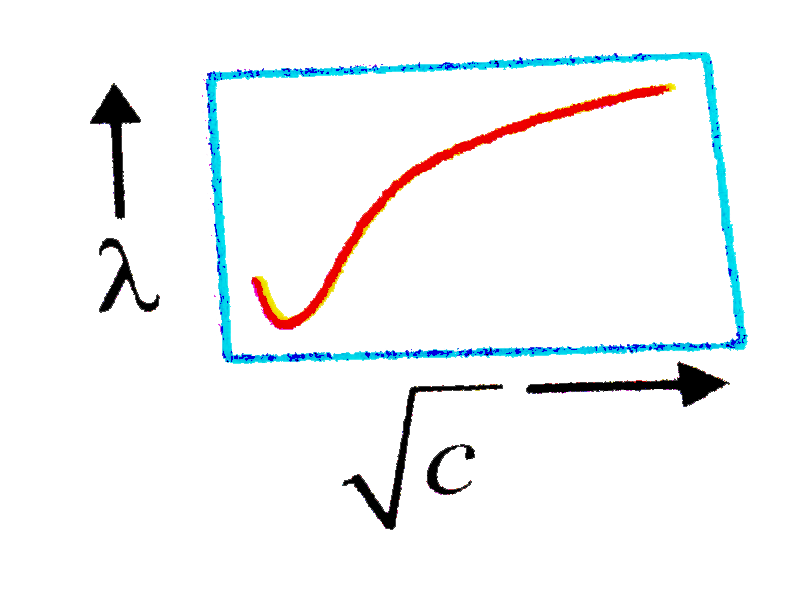
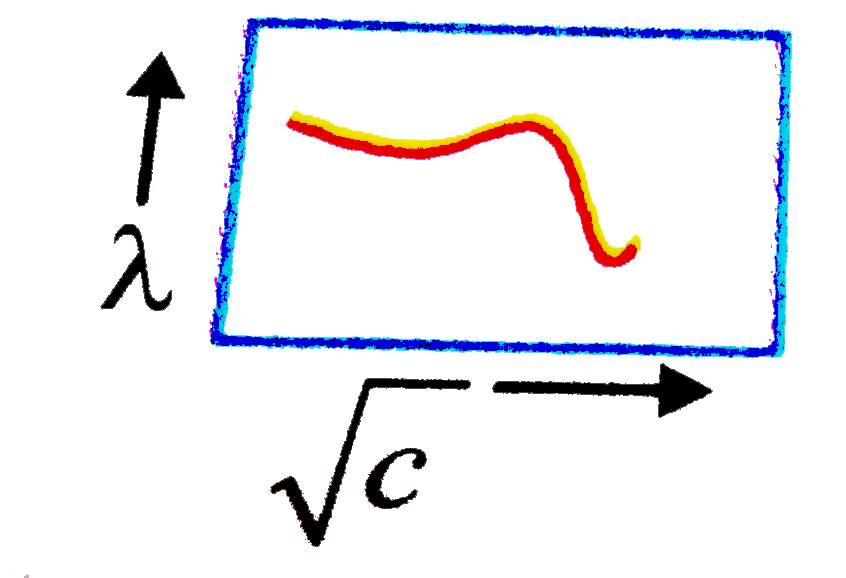
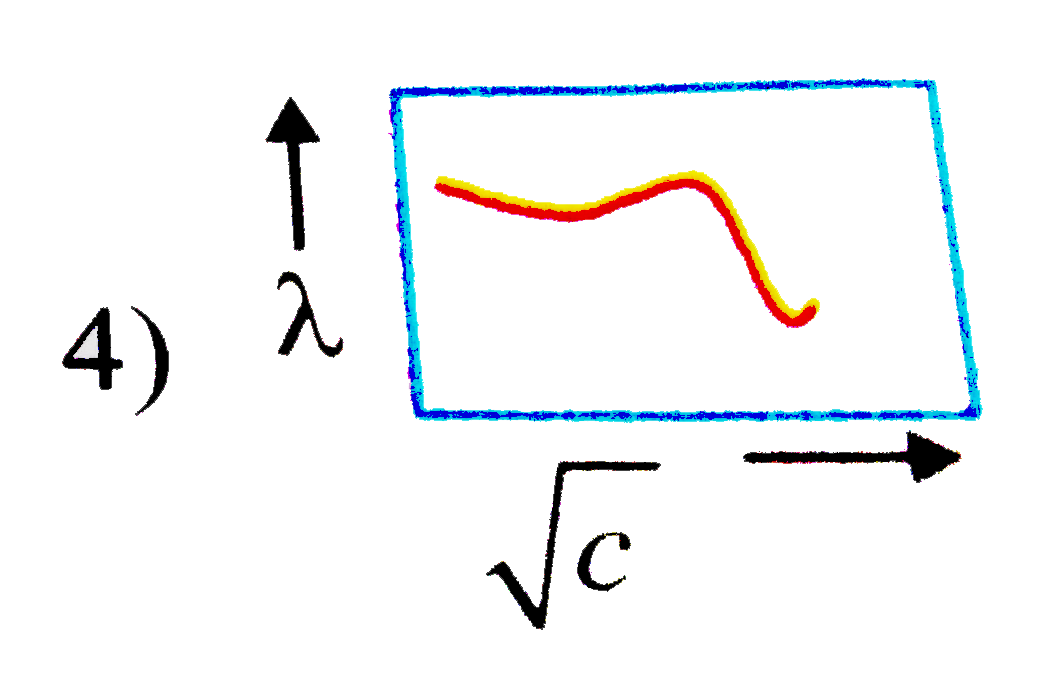
The variation of equivalent conductance of a weak electrolyte with `(concentration)^(1//2)` is represented as

A

B

C

D

Text Solution

AI Generated Solution

The correct Answer is:

To solve the problem regarding the variation of equivalent conductance of a weak electrolyte with \((\text{concentration})^{1/2}\), we can follow these steps: ### Step-by-Step Solution: 1. **Understanding Equivalent Conductance**: - Equivalent conductance (\(\Lambda\)) is defined as the conductance of an electrolyte solution divided by the number of equivalents of the electrolyte in the solution. It is a measure of the ability of ions to conduct electricity in a solution. 2. **Behavior of Weak Electrolytes**: - Weak electrolytes do not completely dissociate in solution. Therefore, their conductance increases with dilution because the degree of dissociation increases as the concentration decreases. 3. **Relationship with Concentration**: - For weak electrolytes, the equivalent conductance (\(\Lambda\)) is related to the concentration (\(C\)) of the solution. As the concentration decreases (or dilution increases), the equivalent conductance increases. 4. **Graphical Representation**: - The problem asks for the graph of equivalent conductance (\(\Lambda\)) versus \((\text{concentration})^{1/2}\). - As the concentration decreases, \((\text{concentration})^{1/2}\) will also decrease, but since we are plotting \(\Lambda\) against \((\text{concentration})^{1/2}\), we expect that as \((\text{concentration})^{1/2}\) increases, \(\Lambda\) will also increase. 5. **Shape of the Graph**: - The graph will be a straight line starting from the origin, indicating a direct proportionality between equivalent conductance and the square root of concentration for weak electrolytes. 6. **Conclusion**: - Therefore, the correct representation of the variation of equivalent conductance of a weak electrolyte with \((\text{concentration})^{1/2}\) will be a straight line graph that rises as \((\text{concentration})^{1/2}\) increases. ### Final Answer: The variation of equivalent conductance of a weak electrolyte with \((\text{concentration})^{1/2}\) is represented as a straight line graph that increases with increasing \((\text{concentration})^{1/2}\). ---

To solve the problem regarding the variation of equivalent conductance of a weak electrolyte with \((\text{concentration})^{1/2}\), we can follow these steps: ### Step-by-Step Solution: 1. **Understanding Equivalent Conductance**: - Equivalent conductance (\(\Lambda\)) is defined as the conductance of an electrolyte solution divided by the number of equivalents of the electrolyte in the solution. It is a measure of the ability of ions to conduct electricity in a solution. 2. **Behavior of Weak Electrolytes**: ...
Promotional Banner

Topper's Solved these Questions

  • ELECTRO CHEMISTRY

    NARAYNA|Exercise LEVEL-II(H.W)|56 Videos
  • ELECTRO CHEMISTRY

    NARAYNA|Exercise LEVEL-V|67 Videos
  • ELECTRO CHEMISTRY

    NARAYNA|Exercise NCERT BASED QUESTIONS|8 Videos
  • 15TH GROUP ELEMENTS

    NARAYNA|Exercise EXERCISE - 4 (NCERT EXEMPLERS/HOTs)|27 Videos

Similar Questions

Explore conceptually related problems

The variation equivalent conductance of stronge electrolyte with sqrt(Concentration) is correctly shown in the figure.

The increases in equivalent conductivity of a weak electrolyte with dilution is due to :

The equivalent conductance of a 1 N solution of an electrolyte is nearly:

The variation of equivalent conductance versus concentration of a strong electrolyte is correctly given in the plot

NARAYNA- ELECTRO CHEMISTRY-LEVEL-I(H.W)
  1. The reason for increase in electrical conduction of a weak electrolyte...

    Text Solution

    |

  2. The specific conductances of four electrolytes in ohm^(-1)cm^(-1) are ...

    Text Solution

    |

  3. The variation of equivalent conductance of a weak electrolyte with (co...

    Text Solution

    |

  4. The variation equivalent conductance of stronge electrolyte with sqrt(...

    Text Solution

    |

  5. Equivalent conductance of 1M CH(3)COOH is 10ohm^(-1) cm^(2) "equiv"^(-...

    Text Solution

    |

  6. if ^^(c) of NH(4)OH is 11.5Omega^(-1) cm^(2) mol^(-1), its degree of d...

    Text Solution

    |

  7. The values of wedge(m)^(oo) forNH(4)Cl,NaOH, and NaCl are, respectivel...

    Text Solution

    |

  8. The molar conductances of NaCI, HCI and CH3 COONa at infinite dilution...

    Text Solution

    |

  9. If a salt bridge is not used between two half cells, voltage

    Text Solution

    |

  10. An electrochemical cell stops working after some time because

    Text Solution

    |

  11. Consider a voltaic cell based on these half - cell reactions Ag^(+)(...

    Text Solution

    |

  12. A reversible galvanic cell is connected to an external battery. If the...

    Text Solution

    |

  13. The EMF of the cell Ni|Ni^(2+) (0.01M) Cl^(-)(0.01M)//Cl(2), pt is ...

    Text Solution

    |

  14. The reduction potential of a hydrogen electrode at pH 10 at 298K is : ...

    Text Solution

    |

  15. The oxidation potential of 0.05 MH(2)SO(4) is

    Text Solution

    |

  16. Number of Faradays involved in the net reaction of Lead accumulator is

    Text Solution

    |

  17. Following are some of the facts about a dry cell I : It is alos call...

    Text Solution

    |

  18. Iron rod is dipped in concentrated HNO(3) After some time the iron rod...

    Text Solution

    |

  19. Which of the following is correct regarding mechanical passivity

    Text Solution

    |

  20. Zn acts as sacrifical or cathodic protect iont to prevent rusting of i...

    Text Solution

    |
