Home
Class 12
CHEMISTRY
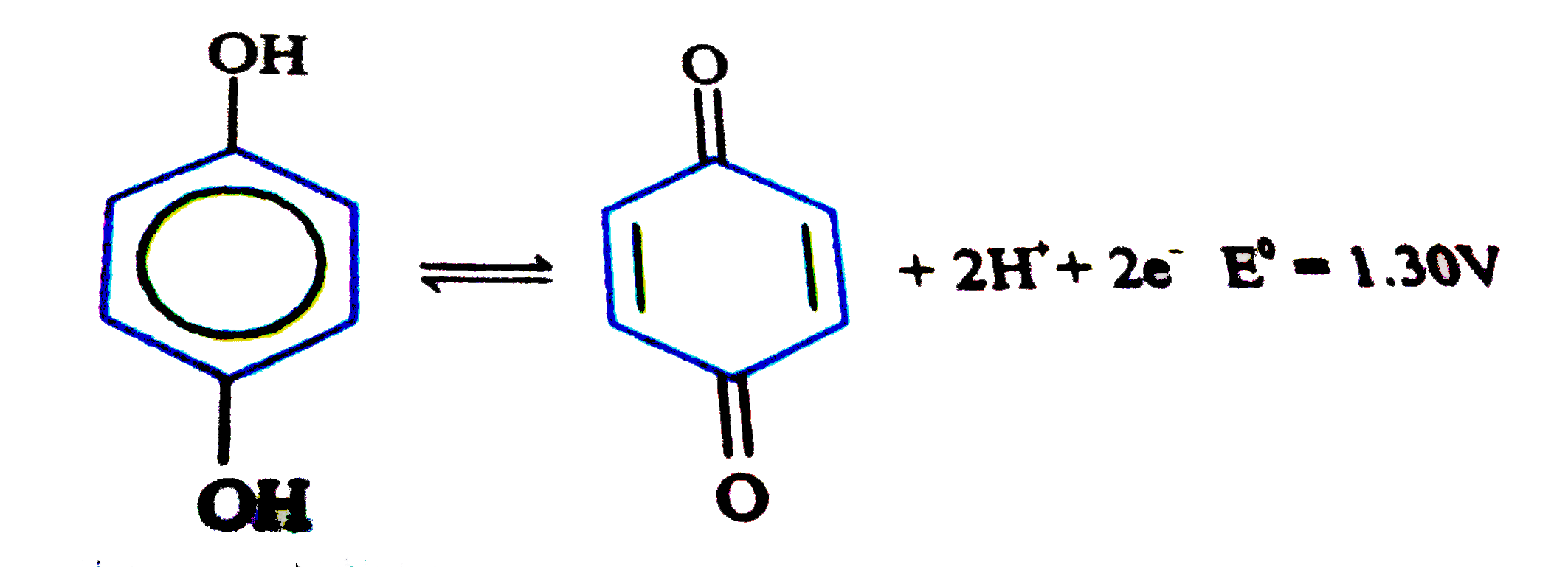
For the half cell At pH = 3 electro...

For the half cell

At pH = 3 electrode potential is

A

`1.36 V`

B

`1.30 V`

C

`1.42 V`

D

`1.20 V`

Text Solution

Verified by Experts

The correct Answer is:
B

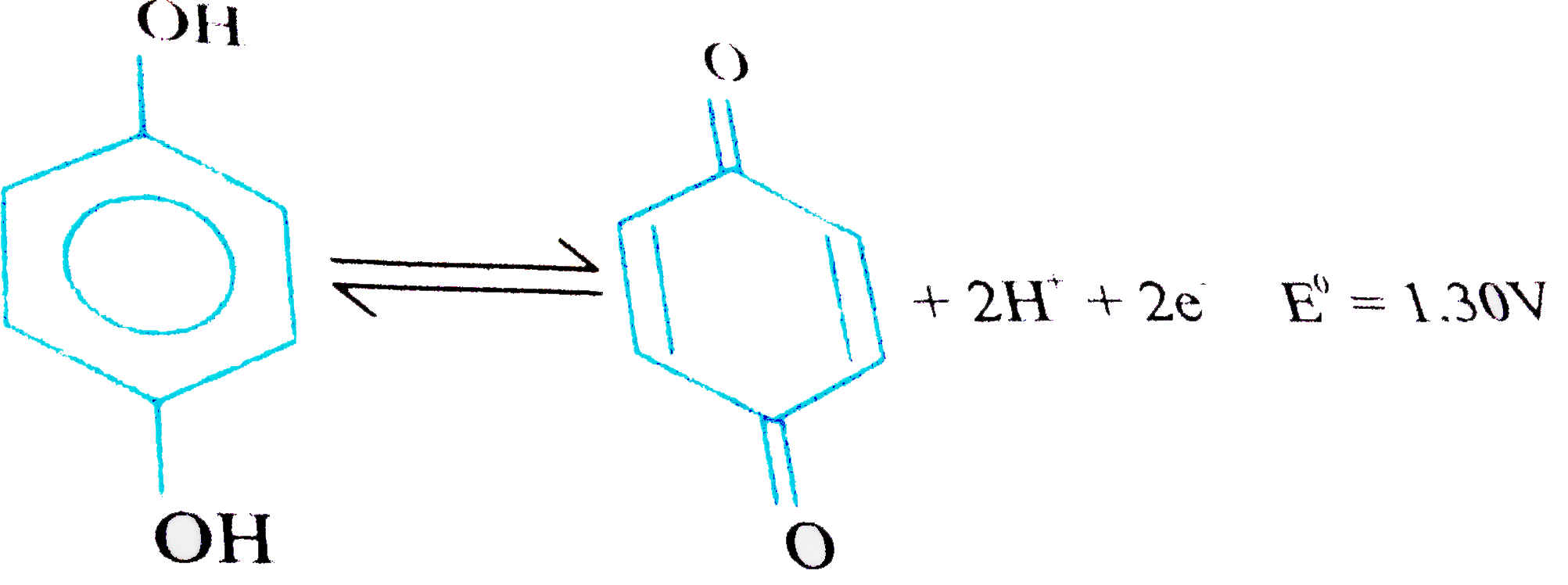
[A] = [B] in quinhydrane electrode
`E=E^(@)-(0.0591)/(2)log [H^(+)]^(2)`
`=E^(@)+0.059 1P^(H)=1.42V`
Promotional Banner

Topper's Solved these Questions

  • ELECTRO CHEMISTRY

    NARAYNA|Exercise SUBJECTIVE QUESTIONS|48 Videos
  • ELECTRO CHEMISTRY

    NARAYNA|Exercise LEVEL-V|67 Videos
  • 15TH GROUP ELEMENTS

    NARAYNA|Exercise EXERCISE - 4 (NCERT EXEMPLERS/HOTs)|27 Videos

Similar Questions

Explore conceptually related problems

For the half cell At pH=2 , the electrode potential is

For the half cell At pH=2 . Electrod potential is :

when two half-cells of electrode potential of E_1 and E_2 are combined to form a half cell of electrode potential E_3 , then (when n_1,n_2"and"n_3 are no. of electrons exchanged in first second and combined half-cells:

Calculating the emf from standard potentials: A galvanic cell consists of an Al electrode in a 1.0M Al(NO_(3))_(3) solution and an Fe electrode in a 1.0M Fe(NO_(3))_(2) solution. Calculate the standard emf of this electrohemical cell at 25^(@)C . Also write the cell reaction. Strategy: From the table of standard electrode potentials, write the two reduction half reaction and standard electrode potentials for the cell. Change the direction of the half-cell reaction corresponding tol the smaller (or more negative) electrode potential. Multiply the when the half-reactions are added the electrons cancel. The sum of the half-reactions is the cell reaction. Add the electrode potentials to get the cell emf.

What is the electrode potential of a gasous hydrogen electrode dipped in a solution pH=5.0 relative to the calomel electrode with an electrode potential of +0.28V ?

NARAYNA- ELECTRO CHEMISTRY-LEVEL-VI
  1. In two vessels each containing 500mL water, 0.05m mol of aniline (K(b)...

    Text Solution

    |

  2. Construct the cell corresponding to the reaction : 3Cr^(2+)(1M)rarr 2C...

    Text Solution

    |

  3. For the half cell At pH = 3 electrode potential is

    Text Solution

    |

  4. For the galvanic cell : Ag|AgCl(s)),KCl(0.2M)||KBr(0.001M),AgBr(s)|A...

    Text Solution

    |

  5. Consider the reaction fo extraction of gold from its ore Au +2CN^(-)...

    Text Solution

    |

  6. A hydrogen electrode X was placed in a buffer solution of sodium aceta...

    Text Solution

    |

  7. An saturated solution in AgA (K(sp) = 3 xx 10^(-14)) and AgB(K(sp) = 1...

    Text Solution

    |

  8. The standard emf of the cell. Cd(s) | CdCl(2) (aq) rightarrow 2Ag(s)...

    Text Solution

    |

  9. The standard electrode potentials, E(I(2)//I^(-))^(@), E(Br^(-)//Br(2)...

    Text Solution

    |

  10. In which of the following (E("cell")-E("cell")^(@))=0

    Text Solution

    |

  11. Select the correct statements if 9.65 A current is passed for 1 hour t...

    Text Solution

    |

  12. The electolysis of acetate solution produces ethane according to react...

    Text Solution

    |

  13. 100ml of 0.05M CuSO(4)("aq") solution was electrolysed using inert ele...

    Text Solution

    |

  14. What is the potential of an electrode which originally contained 0.1 M...

    Text Solution

    |

  15. E^(@) in the given diagram is

    Text Solution

    |

  16. Cr(2)O(7)^(-2)+14H^(+)+6Fe^(+2)rarr2Cr^(+3)+6Fe^(+3)+7H(2)O Given : ...

    Text Solution

    |

  17. During the working of the following cell Pb-Hg(1M)|Pb^(2+)(aq)(0.1M)...

    Text Solution

    |

  18. A standard solution of KNO(3) is used to make salt bridge, because

    Text Solution

    |

  19. For the calomel half-cell, Hg, Hg(2)Cl(2)|Cl^(-)(aq) values of electro...

    Text Solution

    |

  20. At what [Br^(-)]/sqrt(CO(3)^(2-)] does the following cell have its rea...

    Text Solution

    |

