Home
Class 12
PHYSICS
A certain triple-star system consists of...

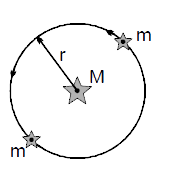
A certain triple-star system consists of two stars, each of mass m, revolving about a central star, mass M, in the same circular orbit. The two stars stay at opposite ends of a diameter of the circular orbit, see figure. Derive an expression for the period of revolution of the stars, the radius of the orbit is r.

Text Solution

Verified by Experts

`(4pi r^(3//2))/(sqrt(G(4M+m)))`
Promotional Banner

Topper's Solved these Questions

  • GRAVITATION

    MOTION|Exercise Exercise - 4 | Level - I (Previous year | JEE Main)|16 Videos
  • GRAVITATION

    MOTION|Exercise Exercise - 4 | Level - II (Previous Year | JEE Advanced)|15 Videos
  • GRAVITATION

    MOTION|Exercise Exercise - 3 | level - 1 (Subjective | JEE Advanced)|13 Videos
  • GEOMETRICAL OPTICS

    MOTION|Exercise Exercise - 4 | Level-II|55 Videos
  • HEAT - 1

    MOTION|Exercise EXERCISE -4 (Level - II) Previous Year | JEE Advanced|22 Videos

Similar Questions

Explore conceptually related problems

An isolated triple star systerm consists of two identical stars, each of mass m and f fixed star of mass M . They revolve around the central star in the same circular orbit to radius r . The orbiting stars are always at opposite ends of a diameter of the orbit. The time period of revolution of each star around the fixed is equal to:

A triple star ststem consists of two stars each of mass m in the same circular orbit about central star with mass M=2xx10^(33)kg . The two outer stars always lie at opposite ends of a diameter of their common circular orbit the radius of the circular orbit is r=10^(11) m and the orbital period each star is 1.6xx10^(7)s [take pi^(2)=10 and G=(20)/(3)xx10^(-11)Mn^(2)kg^(-2) ] Q. The orbital velocity of each star is

A triple star ststem consists of two stars each of mass m in the same circular orbit about central star with mass M=2xx10^(33)kg . The two outer stars always lie at opposite ends of a diameter of their common circular orbit the radius of the circular orbit is r=10^(11) m and the orbital period each star is 1.6xx10^(7)s [take pi^(2)=10 and G=(20)/(3)xx10^(-11)Mn^(2)kg^(-2) ] Q. The mass m of the outer stars is:

A triple star ststem consists of two stars each of mass m in the same circular orbit about central star with mass M=2xx10^(33)kg . The two outer stars always lie at opposite ends of a diameter of their common circular orbit the radius of the circular orbit is r=10^(11) m and the orbital period each star is 1.6xx10^(7)s [take pi^(2)=10 and G=(20)/(3)xx10^(-11)Mn^(2)kg^(-2) ] Q. The total machanical energy of the system is

A pair of stars rotates about a common centre of mass. One of the stars has a mass M and the other m . Their centres are a distance d apart, d being large compared to the size of either star. Derive an expression for the period of revolution of the stars about their common centre of mass. Compare their angular momenta and kinetic energies.

Two stars of masses m and 2m at a distance d rotate about their common centre of mass in free space. The period of revolution is :

Two satellites of masses M and 4M are orbiting the earth in a circular orbit of radius r. Their frequencies of revolution are in the ratio of

If a planet of mass m is revolving around the sun in a circular orbit of radius r with time period, T then mass of the sun is

Two satellites of masses M and 16 M are orbiting a planet in a circular orbitl of radius R. Their time periods of revolution will be in the ratio of
