Home
Class 12
PHYSICS
A bead of mass m can slide without frict...

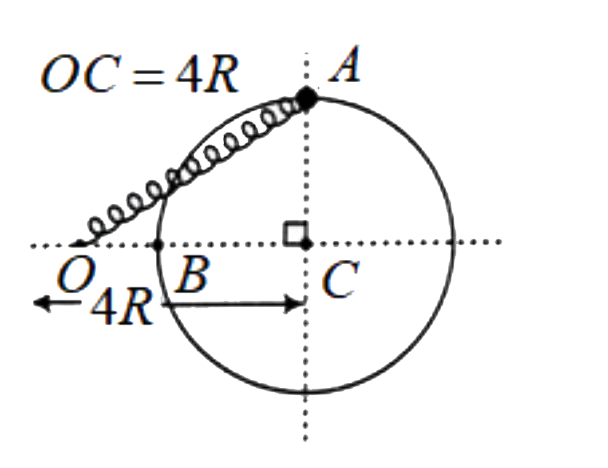
A bead of mass m can slide without friction on a fixed circular horizontal ring of radius 3R having a centre at the point C. The bead is attached to one of the ends of spring of spring constant k. Natural length of spring is R and the other end of the spring is R and the other end of the spring is fixed at point O as shown in the figure. If the bead is released from position A, then the kinetic energy of the bead when it reaches point B is

A

`25/2 kR^2`

B

`9/2 kR^2`

C

`8 kR^2`

D

`12 KR^2`

Text Solution

Verified by Experts

The correct Answer is:

C
Promotional Banner

Topper's Solved these Questions

  • JEE MOCK TEST 20

    NTA MOCK TESTS|Exercise PHYSICS|25 Videos
  • JEE MOCK TEST 23

    NTA MOCK TESTS|Exercise PHYSICS|25 Videos

Similar Questions

Explore conceptually related problems

A Bead of mass m is attached to one end of a spring of natural length 'R' and spring cosntant 'k=((sqrt3+1)mg)/R' . The other end of the spring is fixed at point 'A' on a smooth vertical ring of radius 'R' as shown

A spring has natural length 40 cm and spring constant 500 N//m . A block of mass 1 kg is attached at one end of the spring and other end of the spring is attached to a ceiling. The block is relesed from the position, where the spring has length 45 cm .

A ring of mass m is attached to a horizontal spring of spring constant k and natural length l_0 . The other end of the spring is fixed and the ring can slide on a horizontal rod as shown. Now the ring is shifted to position B and released Find the speed of the ring when the spring attains its natural length.

A bead of mass m is attached to one end of a spring of natural length R and spring constant K=((sqrt(3)+1)mg)/(R ) . The other end of the spring is fixed at a point A on a smooth vertical ring of radius R as shown in fig. The normal reaction at B just after it is released to move is

A bead of mass 'm' is attached to one end of a spring of natural length R & spring constant k = ((sqrt3 + 1))/(R) . The other end of the spring is fixed at point A on a smooth vertical ring of radius R as shown. The normal reaction at B just after it is released to move is

A block of mass 'm' is attached to a spring in natural length of spring constant 'k' . The other end A of the spring is moved with a constat velocity v away from the block . Find the maximum extension in the spring.

A ring of mass m can slide over a smooth vertical rod as shown in figure. The ring is connected to a spring of force constant k = 4 mg//R , where 2R is the natural length of the spring . The other end of spring is fixed to the ground at a horizontal distance 2R from base of the rod . If the mass is released at a height 1.5 J then the velocity of the ring as it reaches the ground is

A bead of mass m slides without friction on a vertical hoop of radius R . The bead moves under the combined influence of gravity and a spring of spring constant k attached to the bottom of the hoop. For simplicity assume, the equilibrium length of the spring to be zero. The bead is released at the top of the hoop with negligible speed as shown . The bead, on passing the bottom point will have a velocity of :

A small block of mass m, can move without friction on the outside of a fixed vertical circular track of radiusR. The block is attached to a spring of natural length R//2 and spring constant K. The other end of spring is connected to a point at height R//2 directly above the centre of track. Consider block to be at rest at top most point A of track. If the block is slowly pushed from rest at the highest A. When the spring reaches in horizontal state, then.

A small block of mass m, can move without friction on the outside of a fixed vertical circular track of radiusR. The block is attached to a spring of natural length R//2 and spring constant K. The other end of spring is connected to a point at height R//2 directly above the centre of track. If the block is released from rest when the spring is in horizontal state (see figure) then at that moment,

NTA MOCK TESTS-JEE MOCK TEST 21-PHYSICS
  1. A 10 muF capacitor is charged to a potential difference of 50 V and is...

    Text Solution

    |

  2. A particle of mass 2 xx 10^-5 kg moves horizontally between two horizo...

    Text Solution

    |

  3. Two identical vessels contain two different ideal gases at the same te...

    Text Solution

    |

  4. The K(alpha) line obtained for molybdenum (Z = 42) is 0.71 Å. Then, th...

    Text Solution

    |

  5. Wire having tension 225 N produces six beats per second when it is tun...

    Text Solution

    |

  6. The arrangement is released from rest. The minimum angle theta at whic...

    Text Solution

    |

  7. The length and breadth of a metal sheet are 3.124m and 3.002m respecti...

    Text Solution

    |

  8. A bead of mass m can slide without friction on a fixed circular horizo...

    Text Solution

    |

  9. There is a thin uniform disc of radius R and mass per unit area σ in w...

    Text Solution

    |

  10. A cylinder of mass M and radius R lies on a plank of mass M as shown. ...

    Text Solution

    |

  11. Two wires of the same material (Young's modulus=Y) and same length L b...

    Text Solution

    |

  12. A layer of oil with density 724 kg m^(-3) floats on water of density 1...

    Text Solution

    |

  13. A uniform ball of radius r rolls without slipping down from the top of...

    Text Solution

    |

  14. A vessel contains two non-reactive gases neon (monoatomic) and oxygen ...

    Text Solution

    |

  15. In a transistor, the collector current varies by 0.49 mA and emitter c...

    Text Solution

    |

  16. If in nuclear fission, a piece of uranium of mass 6.0 g is lost, the e...

    Text Solution

    |

  17. In the given circuit, what is the current (in A) through the battery?

    Text Solution

    |

  18. A galvanometer coil has a resistance 90 Omega and full scale deflectio...

    Text Solution

    |

  19. At what distance from a convex mirror of focal length 2.5 m should a b...

    Text Solution

    |

  20. The resistance of each straight section r = 2 Omega. Find the equivale...

    Text Solution

    |
