Home
Class 11
PHYSICS
A car accelerates from rest at a constan...

A car accelerates from rest at a constant rate `alpha` for some time, after which it decelerates at a constant rate `beta,` to come to rest. If the total time elapsed is t seconds. Then evalute (a) the maximum velocity reached and (b) the total distance travelled.

Text Solution

Verified by Experts
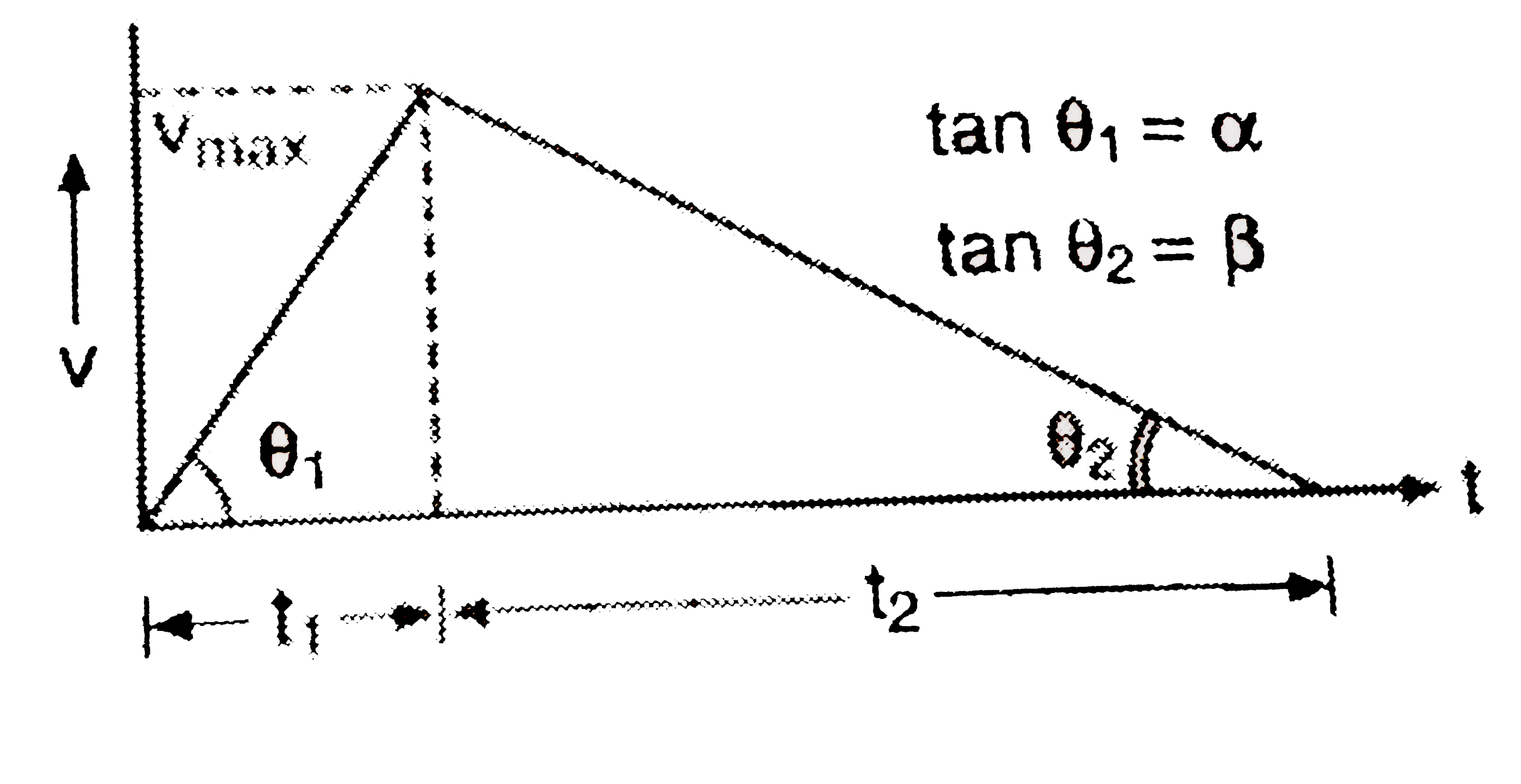
If the car accelerates for time `t_(1)` and decelerates for time `t_(2)` then according to give problem,
`t = t_(1) + t_(2)`.....(i)
If `v_("max")` is the maximum velocity of the car, fron `v//t` curve, we have
`alpha = (v_("max"))/(t_(1))` and `beta = (v_("max"))/(t_(2))` [as slope of `v//t` curve gives acc.] so that `[(1)/(alpha) + (1)/(beta)] = ((t_(1) + t_(2)))/(v_("max"))`
Which in the light of Eqn. (i) gives
`v_("max") = (alpha beta t)/((alpha + beta))`....(ii)
Further as area under `v//t` curve gives the distance covered in a given time so,
`s = (1)/(2) (v_("max")) t = (alpha beta t^(2))/(2 (alpha + beta))`....(iii)
Eqn. (ii) and (iii) are the desired result.

Alternative: From 1 st equation of motion we have :
`v = 0 + alpha t_(1) " and " 0 = v - beta t_(2)`
Which in the light of Eqn. (i) gives
`v = alpha beta t//(alpha + beta)`....(iv) and from II equation of motion we have
`s_(1) = (1)/(2) alpha t_(1)^(2)` and `s_(2) = v t_(2) - (1)/(2) beta t_(2)^(2)` i.e., `s = s_(1) + s_(2) = (1)/(2) alpha t_(1)^(2) + v t_(2) - (1)/(2) beta t_(2)^(2)`
`= (1)/(2) alpha (v^(2))/(alpha^(2)) + v (v)/(beta) - (1)/(2) beta (v^(2))/(beta^(2))`
or `s = (1)/(2) v^(2) [(1)/(alpha) + (1)/(beta)]`
`= (1)/(2) (alpha^(2) beta^(2) t^(2))/((alpha + beta)^(2)) xx [(alpha + beta)/(alpha beta)] = (1)/(2) (alpha beta t^(2))/((alpha + beta))`.....(v)
Promotional Banner

Topper's Solved these Questions

  • MOTION IN A STRAIGHT LINE

    GRB PUBLICATION|Exercise Problem|14 Videos
  • MOTION IN A STRAIGHT LINE

    GRB PUBLICATION|Exercise Problems and Practice|16 Videos
  • FRICTION AND CIRCULAR MOTION

    GRB PUBLICATION|Exercise Comprehension type|11 Videos
  • MOTION IN TWO AND THREE DIMENSIONS

    GRB PUBLICATION|Exercise All Questions|210 Videos

Similar Questions

Explore conceptually related problems

A car acceleration form rest at a constant rate alpha for some time, after which it decelerates at a constant rate beta , to come to rest. If the total time elapsed is t evaluate (a) the maximum velocity attained and (b) the total distance travelled.

A car accelerates from rest at a constant rate for some time after which it decelerates at a constant rate beta to come to rest. If the total time elapsed is t, the maximum velocity acquired by the car is given by :

A car accelerates from rest at a constant rate alpha for sometime , after which it decelerates at a constant rate beta and comes to rest. If T is the total time elapsed, the maximum velocity acquired by the car is

A bus accelerated from rest at a constant rate alpha for some time, after which it decelerates at a constant rate beta to come to rest. If the total time elapsed is t seconds. Then evaluate following parameters from the given graph (a) the maximum velocity achieved. (b) the total distance travelled graphically and (c) Average velocity.

A car accelerates from rest at a constant rate alpha for some time, after which it decelerates at a constant rate beta and ultimately comes to rest.If the total time-lapse is t, what is the total distance described and maximum velocity reached ?

A car accelerates from rest at acionstant rate 36 km h^@ to comet to rest. If the total time elapsed id 1 hour, calculate (i) the maximum velocity attained by the car and (ii) the total distance travelled by car.

A particle accelerates from rest at a constant rate for some time and attains a velocity of 8 m/sec. Afterwards it decelerates with the constant rate and comes to rest. If the total time taken is 4 sec, the distance travelled is

A car accelerates from rest at a constant rate of 2 m s^(-2) for some time. The it retatds at a constant rate of 4 m s^(-2) and comes to rest. It remains in motion for 6 s .

