Home
Class 11
PHYSICS
Two particles A and B move with constant...

Two particles A and B move with constant velocities `v_(1)` and `v_(2)` along two mutually perpendicular strainght lines. Towards the intersection point O. At moment `t = 0` the particle were located at distance `l_(1)` and `l_(2)` from O respectively. Find the time when they are nearest and also this shortest distance

Text Solution

Verified by Experts
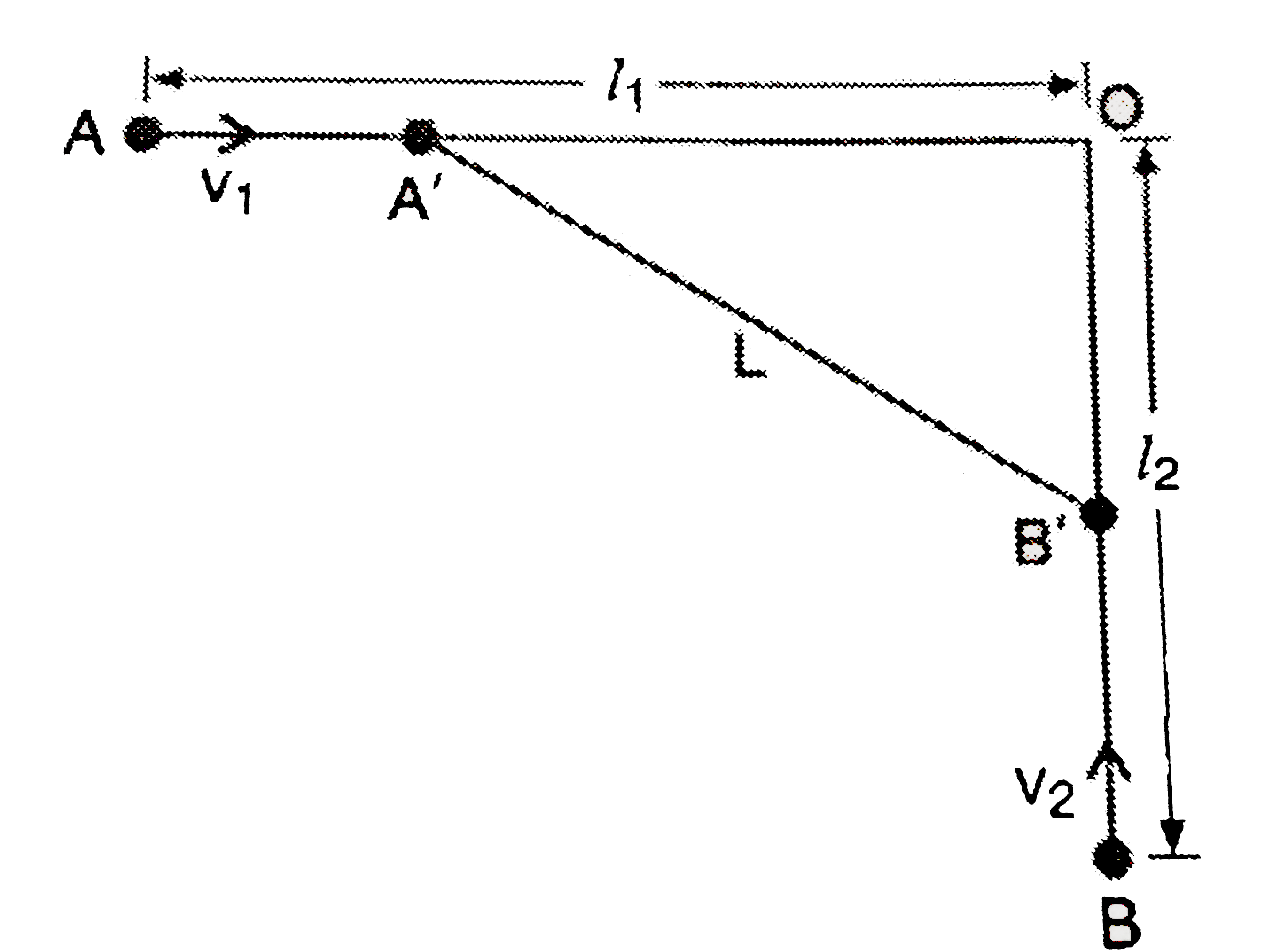
As shown in Fig. 4.54, in time t, A will move a distance `v_(1) t` while `B, v_(2)t`, so after time `t` the distnace of A and B from O will be `(l_(1) - v_(1)t)` and `(l_(2) - v_(2) t)` respectively. So the distance between them L at time t will be given by
`L^(2) = (l_(1) - v_(1)t)^(2) + (l_(2) - v_(2)t)^(2)`.....(i)
Differentiating Eqn. (i) with respect to time,
`2L (dL)/(dt) = 2 (l_(1) - v_(1) t) + 2 (l_(2) - v_(2)t) (-v_(2))`
Now for L to be minimum `(dL//dt) = 0`
So, `(v_(1)^(2) + v_(2)^(2)) t = l_(1) v_(1) + l_(2) v_(2)`
i.e., `t = (l_(1) v_(1) + l_(2) v_(2))/((v_(1)^(2) + v_(2)^(2)))`....(ii)
Substituting this value of `t` from Eqn. (ii) in (i) and simplifying, we get
`L_("min") = (l_(1) v_(2) - l_(2) v_(1))/(sqrt((v_(1)^(2) + v_(2)^(2))))`.....(iii)
Eqn. (ii) and (iii) are the desired results.
Promotional Banner

Topper's Solved these Questions

  • MOTION IN A STRAIGHT LINE

    GRB PUBLICATION|Exercise Problems and Practice|16 Videos
  • MOTION IN A STRAIGHT LINE

    GRB PUBLICATION|Exercise Objective question|168 Videos
  • MOTION IN A STRAIGHT LINE

    GRB PUBLICATION|Exercise Comprehension type Queston|14 Videos
  • FRICTION AND CIRCULAR MOTION

    GRB PUBLICATION|Exercise Comprehension type|11 Videos
  • MOTION IN TWO AND THREE DIMENSIONS

    GRB PUBLICATION|Exercise All Questions|210 Videos

Similar Questions

Explore conceptually related problems

Two particles, 1 and 2, move with constant velocities v_1 and v_2 along two mutually perpendicular straight lines toward the intersection point O. At the moment t=0 the particles were located at the distances l_1 and l_2 from the point O. How soon will the distance between the particles become the smallest? What is it equal to?

Two ships, V and W, move with constant velocities 2 ms^(-1) and 4 ms^(-1) along two mutually perpendicular straight tracks toward the intersection point O. At the moment t=0 , the ships V & W were located at distances 100 m and 200 m respectively from the point O. The distance between them at time t is :-

Two ships, V and W, move with constant velocities 2 ms^(-1) and 4 ms^(-1) along two mutually perpendicular straight tracks toward the intersection point O. At the moment t=0 , the ships V & W were located at distances 100 m and 200 m respectively from the point O. The distance between them will be shortest at t= ........

Two ships, 1 and 2, move with constant velocities 3 m/s and 4 m/s along two mutually perpendicular straight tracks toward the intersection point O. At the moment t = 0 the ships were located at the distances 120 m and 200 m from the point O. How soon will the distance between the ships become the shortest and what is it equal to ?

Two particles move with constant velocities towards point O along straight lines in a plane as shown. The shortest distance A and B is

A particle move with velocity v_(1) for time t_(1) and v_(2) for time t_(2) along a straight line. The magntidue of its average acceleration is

Two particles are moving with velocities v_(1) and v_2 . Their relative velocity is the maximum, when the angle between their velocities is

Two particles are moving along two long straight lines, in the same plane with same speed equal to 20 cm//s. The angle between the two linse is 60^@ and their intersection point isO. At a certain moment, the two particles are located at distances 3m and 4m from O and are moving twowards O. Subsequently, the shortest distance between them will be

Two particles, 1 and 2, move with constant velocities v_1 and v_2 . At the initial moment their radius vectors are equal to r_1 and r_2 . How must these four vectors be interrelated for the particles to collide?

