Home
Class 11
PHYSICS
On applying a force F the mass M is disp...

On applying a force F the mass M is displaced vertically down by from equilibrium position, Find the force F in terms of the force constant k of the spring and displacement y for the cases (A) and (B) as shown in

Text Solution

Verified by Experts
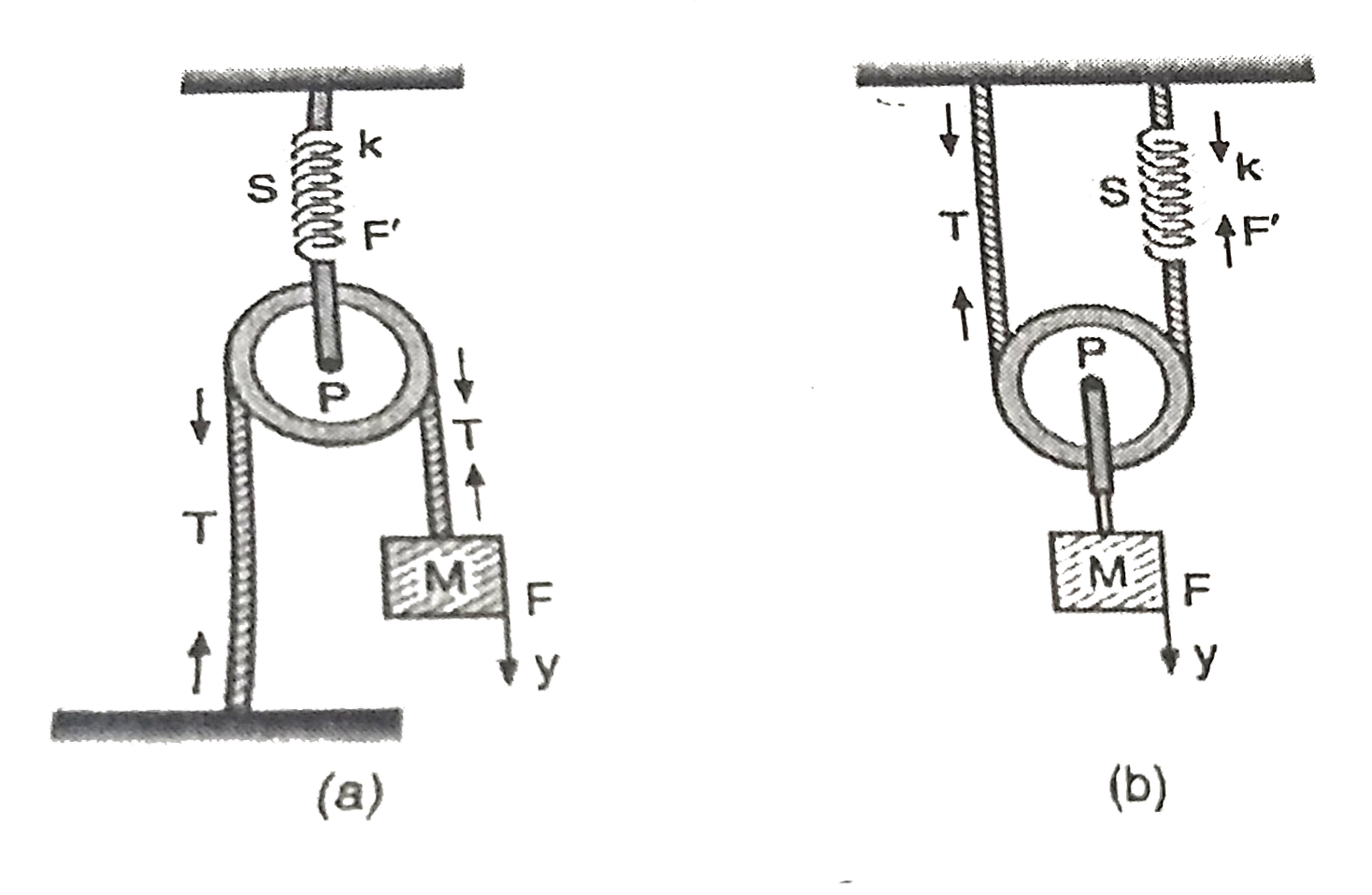
Case (A) for the equilibrium of mass M
`F=T` …(i)
and for the equilibrium of pulley
`2T=F'` …(ii)
But as due to shift of mass M by y, the spring strentches by `(y//2)` so
`F' = k(y//2)` ….(iii)
So, substituting F' from Eqn. (iii) in Eqn. (ii) and then T from Eqn (ii) in Eqn. (i) we get

Case (B) As tension in massless string and spring will be same,
`T=F'`
And for equilibrium of pulley `T+F'=F` ...(i)
So, from Eqns (i) and (ii) `F=2F'` ....(ii)
Now if the mass M shifts by y the spring will stretch by 2y (as string is inextensible)
`F' =k(2y)` ....(iv)
So, subsituting f' from Eqn (iv) in Eqn (iii)
`F=(4k)y` ...(b)
Promotional Banner

Topper's Solved these Questions

  • FORCE AND NEWTONS LAWS OF MOTION

    GRB PUBLICATION|Exercise Problem for practice|30 Videos
  • FORCE AND NEWTONS LAWS OF MOTION

    GRB PUBLICATION|Exercise Objective Questions|134 Videos
  • FORCE AND NEWTONS LAWS OF MOTION

    GRB PUBLICATION|Exercise Comprehension|12 Videos
  • BASIC MATHEMATICS

    GRB PUBLICATION|Exercise Problems For Practice|35 Videos
  • FRICTION AND CIRCULAR MOTION

    GRB PUBLICATION|Exercise Comprehension type|11 Videos

Similar Questions

Explore conceptually related problems

On applying a force F, point P is displaced vertically down by y from equilibrium positionl. Find force F in terms of the force constant k of the spring and displacement y, for the cases (a) and (b), as shown in fig.

Figure shows a system consisting of a massless pulley, a spring of force constant k and ablock of mass m. If the block is slightly displaced vertically down from its equillibrium position and then released, find the period of its vertical oscillation in cases (a) & (b).

The force constant between the restoring force F and displacement x of a spring accoring to the graph shown will be

The value of force constant between the applied elastic force F and displacement will be

A mass M is suspended as shown in fig. The system is in equilibrium. Assume pulleys to be massless. K is the force constant of the spring. The extension produced in the spring is given by

A mass M is suspended as shown in fig. The system is in equilibrium. Assume pulleys to be massless. K is the force constant of the spring. Find the net tension force acting on the lower support.

A mass 1 kg is attaced to the hook of a spring and the spring is suspended vertically from a ceiling (see Fig. 5.12a). The spring is displaced from its equilibrium position by a distance x. The spring constant of the spring is 2.0xx10^(2)" N"//"m" . Calculate the displacement x. Figure 5-12 (a) Mass of 1 kg attached to a spring is suspended vertically. (b) Spring displace from equilibrium position by a distance x.

Figure shows a system consisting of a massless pulley, a spring of force constant k and a block of mass m. If the block is slightly displaced vertically down from is equilibrium position and then released, the period of its vertical oscillation is

Figure shows a system consisting of a massles pulley, a spring of force constant k and a block of mass m . If the block is sligthtly displaced vertically down from its equilibrium and released, find the period of its vertical oscillation in cases (a) and (b).

A small block of mass m is kept on a bigger block of mass M which is attached to a vertical spring of spring constant k as shown in the figure. The system oscilates verticaly. a.Find the resultant force on the smaller block when it is displaced through a distance x above its equilibrium position. b. find the normal force on the smaller blok at this position. When is this force smallest smaller block at this position. When is this force smallest in magnitude? c. What can be the maximum amplitude with which the two blocks may oscillate together?

GRB PUBLICATION-FORCE AND NEWTONS LAWS OF MOTION-Problem
  1. What is the tension in a rod of length length L and mass M at a dista...

    Text Solution

    |

  2. A small mirror of area A and mass m is suspended in a vertical plane b...

    Text Solution

    |

  3. The pulley arrangements of Figs. (a) and (b) are identical. The mass o...

    Text Solution

    |

  4. Three equal weights of mass m each are hanging on a string passing ove...

    Text Solution

    |

  5. An elevator and its load weigh a total of 166 kg. Find the tension T i...

    Text Solution

    |

  6. In the situation shown in figure, both the pulleys and the strings are...

    Text Solution

    |

  7. A monkey of mass m climbs up to a rope hung over a fixed pulley. The o...

    Text Solution

    |

  8. Two 100 g blocks hang at the ends of a light flexible cord passing ove...

    Text Solution

    |

  9. A dynomometer D (a force meter ) is attached to two masses M = 10 kg a...

    Text Solution

    |

  10. A disc of mass m(2) is placed on a table. A stiff spring is attached t...

    Text Solution

    |

  11. Two blocks A and B are connected to each other by a string and a sprin...

    Text Solution

    |

  12. On applying a force F the mass M is displaced vertically down by from ...

    Text Solution

    |

  13. What are the rate of change of momenta of the pendulum bobs 1 and 2 as...

    Text Solution

    |

  14. At wood machine is attached below the left hand pan of a physical bala...

    Text Solution

    |

  15. Find the mass of the hanging block in which will prevent the smaller b...

    Text Solution

    |

  16. In the figure a painter of mass 100 kg pulls himself up with the crate...

    Text Solution

    |

  17. A very flexible uniform chain of mass M and length L is suspended vert...

    Text Solution

    |

  18. One end (say B) of a massless spring having force constant k is attach...

    Text Solution

    |

  19. In the pulley system shown the movable pulleys A,B and C have mass m e...

    Text Solution

    |

  20. Write equations of forces in terms of the relative acceleration for th...

    Text Solution

    |

