Home
Class 11
PHYSICS
What force F must be applied so that m(1...

What force F must be applied so that `m_(1)` and `m_(2)` are at rest on `m_(3)` in

Text Solution

Verified by Experts

The correct Answer is:
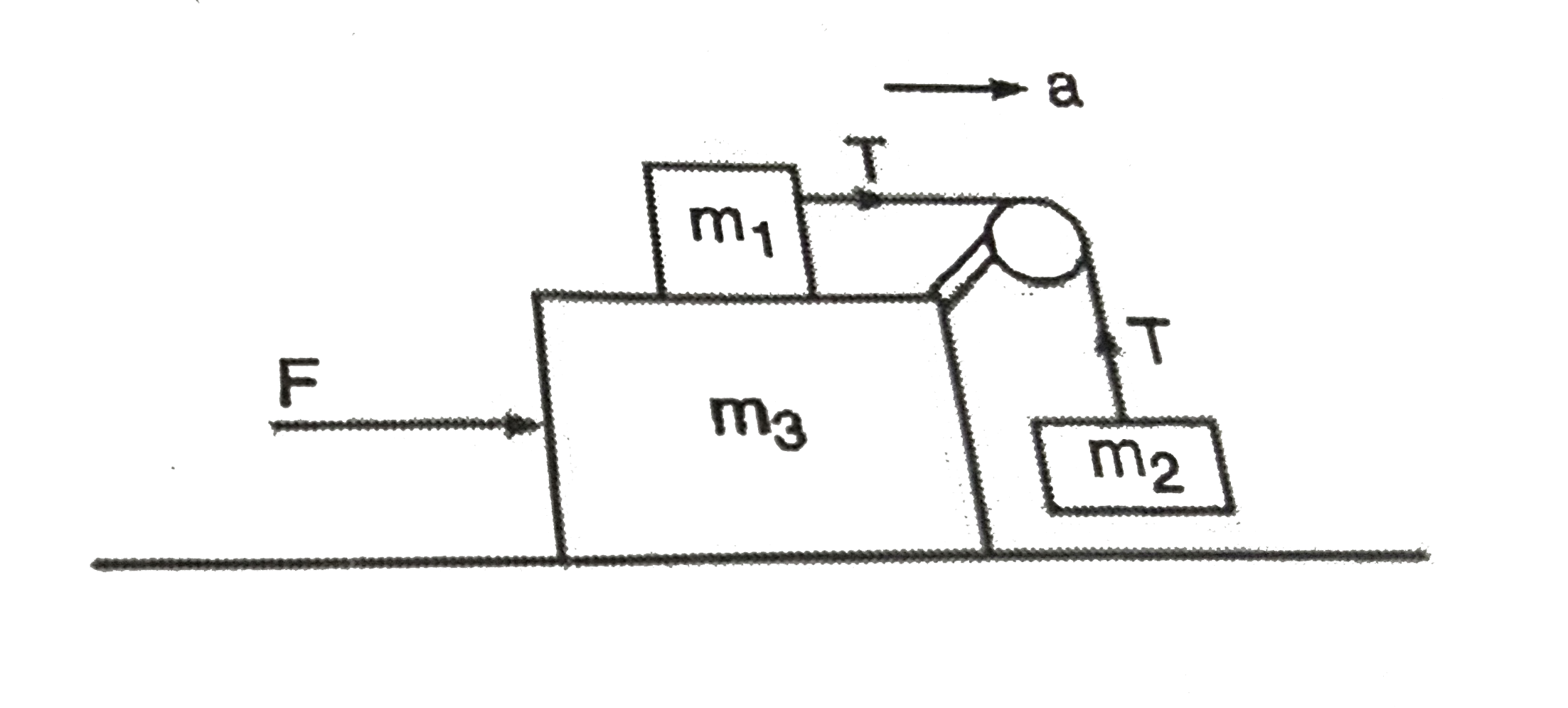
`F=(m_(1)+m_(2)+m_(3))m_(2)g//m_(1)`


`T=m_(2)g`
Now, `T=m_(1)a`
`m_(2)g=m_(1)a`
`a=((m_(2)g)/m_(1))`
Common acceleration of the system is:
`a=F/((m_(1)+m_(2)+m_(3)))`
`F=((m_(1)+m_(2)+m_(3))m_(2)g)/m_(1)`
Promotional Banner

Topper's Solved these Questions

  • FORCE AND NEWTONS LAWS OF MOTION

    GRB PUBLICATION|Exercise Objective Questions|134 Videos
  • FORCE AND NEWTONS LAWS OF MOTION

    GRB PUBLICATION|Exercise More than one choice is correct|15 Videos
  • FORCE AND NEWTONS LAWS OF MOTION

    GRB PUBLICATION|Exercise Problem|33 Videos
  • BASIC MATHEMATICS

    GRB PUBLICATION|Exercise Problems For Practice|35 Videos
  • FRICTION AND CIRCULAR MOTION

    GRB PUBLICATION|Exercise Comprehension type|11 Videos

Similar Questions

Explore conceptually related problems

All surfaces assumed to be frictionless calculate the horizontal force F that must be applied so that m_(1) and m_(2) do not move relative to m_(3) is :–

A large cubical shaped block of mass M rests on a fixed horizontal surface. Two blocks of mass m_(1) and m_(2) are connected by a light inextensible string passing over a light pulley as shown. Neglect friction everywhere. Then the constant horizontal force of magnitude F that should be applied to M so that m_(1) and m_(2) do not mov relative to M is:

In the adjoining figure all surface are frictionless . What force F must by applied to M_(1) to keep M_(3) free from rising or falling?

In the figure2.217 all the surfaces are frictionless. What force F is required to be applied on the bigger block so that m_(2) and m_(3) will remain at rest on it.

Figure-2.52 shows a box of mass m is placed on a wedge of mass M on a smooth surface. How much force F is required to be applied on M so that during motion m remains at rest on its surface

A board of mass m = 1 kg lies on a table and a weight of M = 2 kg on the board. What minimum force F must be applied on the board in order to pull it out from under the road ? The coefficient of friction between board and table is mu_(2) = 0.5 : (Take g = 10 m//s^(2) )

Three block of masses m_(1),m_(2) and m_(3) kg are placed in contact with each other on a frictionless table. A force F is applied on the heaviest mass m_(1) , the acceleration of m_(2) will be

A right-angled triangular block of mass M rests on a horizontal table . The inclination of the block is 30^(@) with the table . A cubical block of mass m is placed on the incline of the block . What horizontal force must be applied on M so that m may remain stationery relative to the block ? [Hint: Apply d' Alember's principal and consider free-body diagrams of m and the system ( m+ M).]

Two blocks of masses m_(1) and m_(2) are connected by a spring of stiffness k. The coefficient of friction between the blocks and the surface is mu . Find the minimum constant force F to be applied to m_(1) in order to just slide the mass m_(2) .

GRB PUBLICATION-FORCE AND NEWTONS LAWS OF MOTION-Problem for practice
  1. A light rope fixed to a peg on the ground passes over a tree branch an...

    Text Solution

    |

  2. A trolley A has a simple pendulum suspended from a frame fixed to its ...

    Text Solution

    |

  3. What force F must be applied so that m(1) and m(2) are at rest on m(3)...

    Text Solution

    |

  4. A unifrom flexible chain of length L with weight lambda per unit lengt...

    Text Solution

    |

  5. Calculate the tension in the string shown in (a) The pulleys and the...

    Text Solution

    |

  6. A block A of mass m is tied to a fixed point C on a horizontal table t...

    Text Solution

    |

  7. shows a man of mass 60 kg standing on a light weighing machine kept in...

    Text Solution

    |

  8. The systems shown in are in equilibrium if the spring balance is calib...

    Text Solution

    |

  9. What is the reading of the spring balance in the following device?

    Text Solution

    |

  10. 2 kg box rests on a frictionless of angle 30^(@) supported by a spring...

    Text Solution

    |

  11. From three identical springs (each having force constant k) using all ...

    Text Solution

    |

  12. Consider the situations shown in fig (a) and (b) initially the spring ...

    Text Solution

    |

  13. Two identical blocks, each of mass m, are connected through a massless...

    Text Solution

    |

  14. Masses m(1), m(2), m(3) and m(4) are arranged in a system as shown in ...

    Text Solution

    |

  15. A solid body moves through air, at very high speed V faster than the v...

    Text Solution

    |

  16. A mass m(1) is connected by a weghtless cable of water, whose mass is ...

    Text Solution

    |

  17. A van accelerates uniformly down an inclined hill going from reast to ...

    Text Solution

    |

  18. A very flexible chain of mass M and length l is suspended vertically i...

    Text Solution

    |

  19. Two blocks of masses m(1)=2 kg and m(2)=5 kg hang over a massless pull...

    Text Solution

    |

  20. A mass M is hung with a light inextensible string as shown in Find the...

    Text Solution

    |

