Text Solution
Verified by Experts
The correct Answer is:



Topper's Solved these Questions
FORCE AND NEWTONS LAWS OF MOTION
GRB PUBLICATION|Exercise Objective Questions|134 VideosFORCE AND NEWTONS LAWS OF MOTION
GRB PUBLICATION|Exercise More than one choice is correct|15 VideosFORCE AND NEWTONS LAWS OF MOTION
GRB PUBLICATION|Exercise Problem|33 VideosBASIC MATHEMATICS
GRB PUBLICATION|Exercise Problems For Practice|35 VideosFRICTION AND CIRCULAR MOTION
GRB PUBLICATION|Exercise Comprehension type|11 Videos
Similar Questions
Explore conceptually related problems
GRB PUBLICATION-FORCE AND NEWTONS LAWS OF MOTION-Problem for practice
- Calculate the tension in the string shown in (a) The pulleys and the...
Text Solution
|
- A block A of mass m is tied to a fixed point C on a horizontal table t...
Text Solution
|
- shows a man of mass 60 kg standing on a light weighing machine kept in...
Text Solution
|
- The systems shown in are in equilibrium if the spring balance is calib...
Text Solution
|
- What is the reading of the spring balance in the following device?
Text Solution
|
- 2 kg box rests on a frictionless of angle 30^(@) supported by a spring...
Text Solution
|
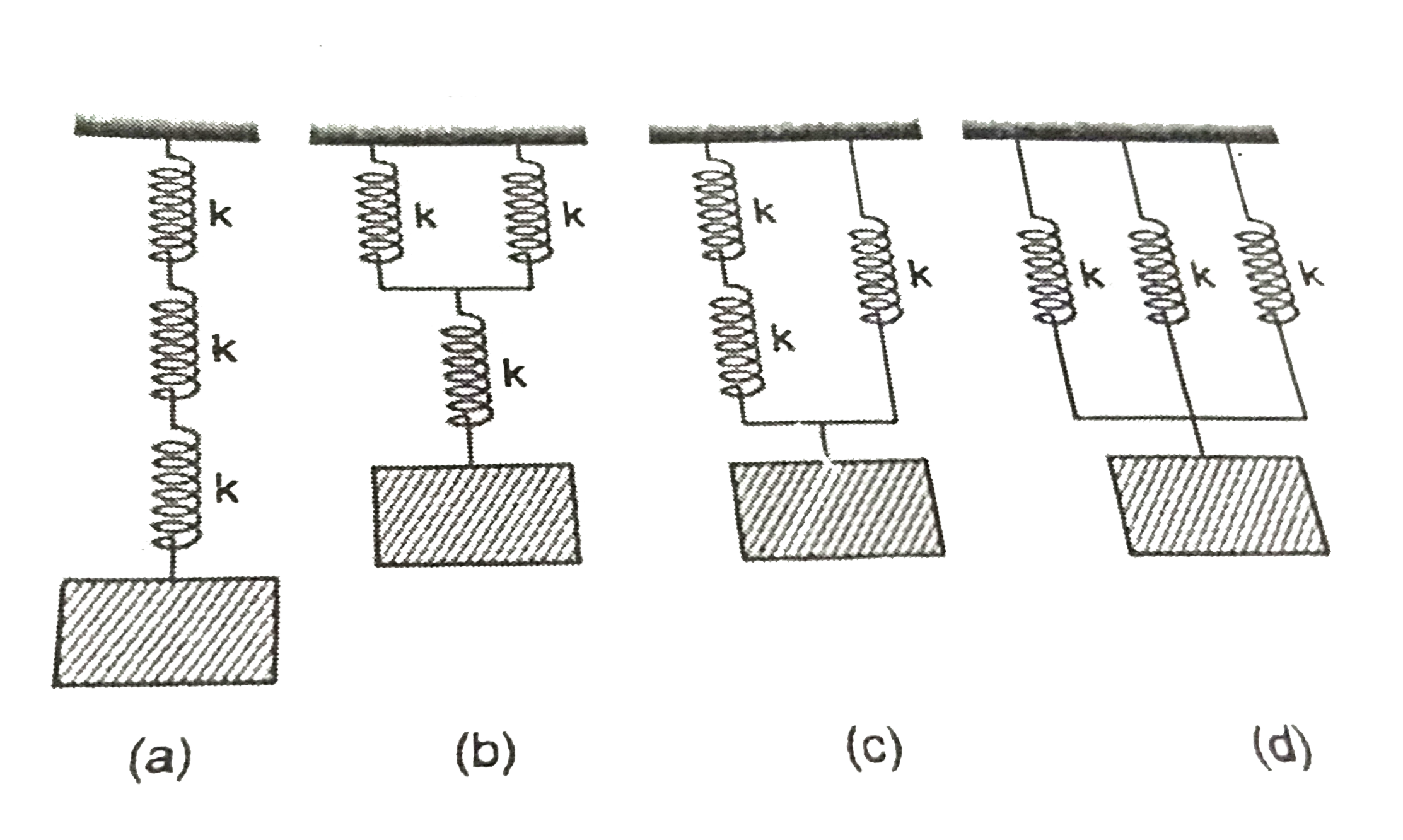
- From three identical springs (each having force constant k) using all ...
Text Solution
|
- Consider the situations shown in fig (a) and (b) initially the spring ...
Text Solution
|
- Two identical blocks, each of mass m, are connected through a massless...
Text Solution
|
- Masses m(1), m(2), m(3) and m(4) are arranged in a system as shown in ...
Text Solution
|
- A solid body moves through air, at very high speed V faster than the v...
Text Solution
|
- A mass m(1) is connected by a weghtless cable of water, whose mass is ...
Text Solution
|
- A van accelerates uniformly down an inclined hill going from reast to ...
Text Solution
|
- A very flexible chain of mass M and length l is suspended vertically i...
Text Solution
|
- Two blocks of masses m(1)=2 kg and m(2)=5 kg hang over a massless pull...
Text Solution
|
- A mass M is hung with a light inextensible string as shown in Find the...
Text Solution
|
- Find the acceleration of rod A and wedge B in the arrangement shown in...
Text Solution
|
- In the arrangement shown in fig the mass of the ball 1 is eta=1.8 time...
Text Solution
|
- In the arrangement shown in fig the bodies have masses m(0), m(1) and ...
Text Solution
|
- In the arrangement shown in fig neglect the masses of pulleys and stri...
Text Solution
|