Home
Class 11
PHYSICS
In the arrangement shown in fig the bodi...

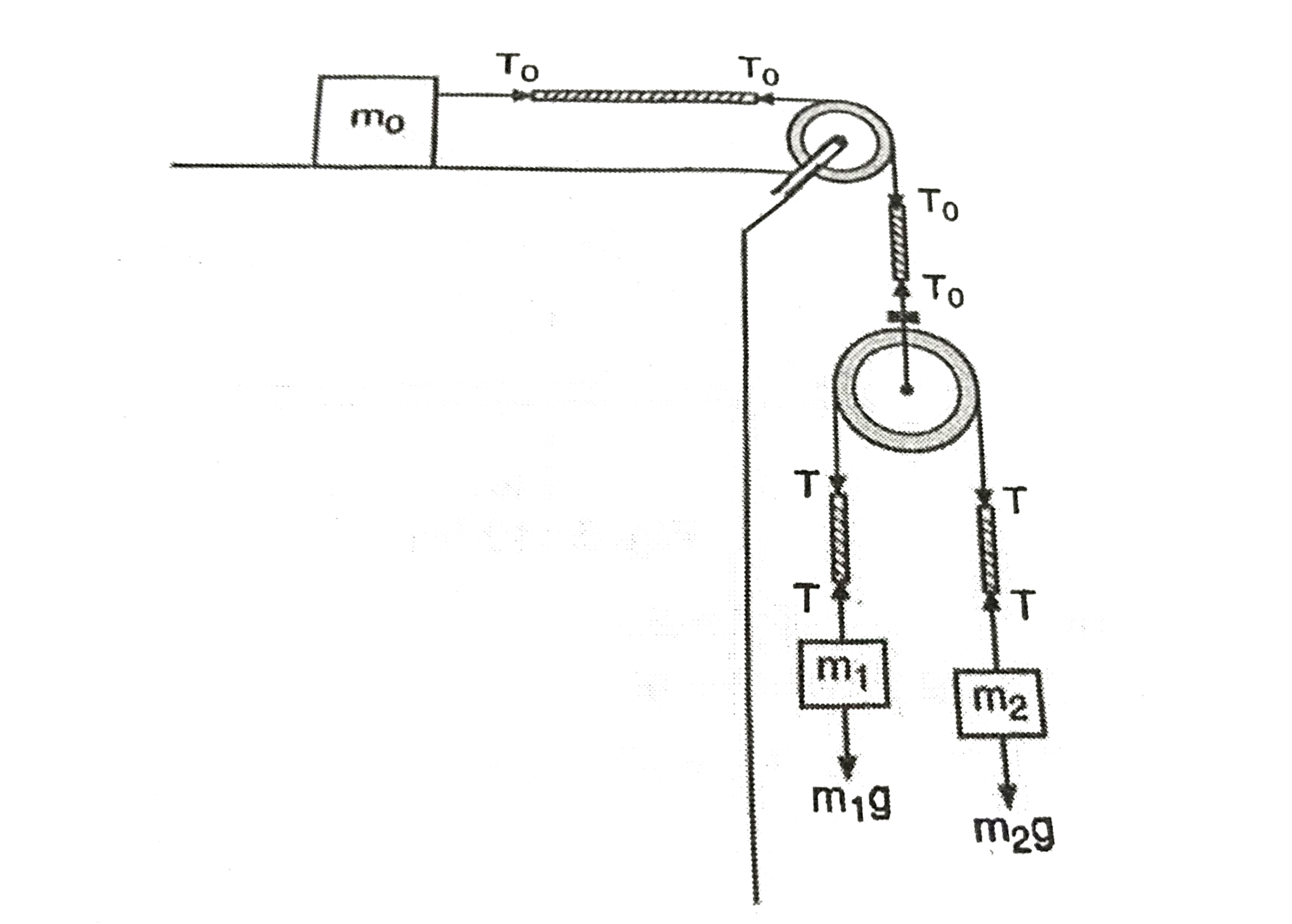
In the arrangement shown in fig the bodies have masses `m_(0), m_(1) and m_(2)` the friction is absent the masses of pulleys and the threads are negligible find the acceleration of the body `m_(1)`

Text Solution

Verified by Experts

Let the acceleration of `m_(0)` with respect to the table is `a_(0)` and that of `m_(1)` and `m_(2)` is a in magnitude with respect to the movable pulley
Suppose `m_(1)` moves upward and `m_(2)` moves downward then their accelerations with respect to the table will be:
`a_(1)=a-a_(0)` upward
and `a_(2)=a+a_(0)` downward
By Newton's second law we have
`T_(0)=m_(0)a_(0)` ....(i)
`T-m_(1)g=m_(1)(a-a_(0))` ....(ii)
and `m_(2)g-T=m_(2)(a+a_(0))` ....(iii)
For movable pulley
`T_(0)-2T=0xxa_(0)` ....(iv)
Solving above equations for a, we get
`a=(4m_(1)m_(2)+m_(0)(m_(1)-m_(2))g)/(4m_(1)m_(2)+m_(0)(m_(1)+m_(2)))`
Promotional Banner

Topper's Solved these Questions

  • FORCE AND NEWTONS LAWS OF MOTION

    GRB PUBLICATION|Exercise Objective Questions|134 Videos
  • FORCE AND NEWTONS LAWS OF MOTION

    GRB PUBLICATION|Exercise More than one choice is correct|15 Videos
  • FORCE AND NEWTONS LAWS OF MOTION

    GRB PUBLICATION|Exercise Problem|33 Videos
  • BASIC MATHEMATICS

    GRB PUBLICATION|Exercise Problems For Practice|35 Videos
  • FRICTION AND CIRCULAR MOTION

    GRB PUBLICATION|Exercise Comprehension type|11 Videos

Similar Questions

Explore conceptually related problems

In the arrangement shown in figure the bodies have masses m_0 , m_1 , m_2 , the friction is absent, the masses of the pulleys and the threads are negligible. Find the acceleration of the body m_1 . Look into possible cases.

In the arrangement shown in the figure, the blocks have masses 3m,m and 2m , the friction is absent, the masses of the pulleys and the threads are negligible. Find the acceleration of mass 3m .

A pulley fixed to the ceiling carries a thread with bodies of masses m_(1) and m_(2) attached at its ends. The masses of the pulley and thread are negligible, friction is absent. Find the acceleration of the centre of mass (a_("cm")) of this system.

In the fig, find the acceleration of mass m_(2) .

A pulley fixed to the ceiling carries a thread with bodies of masses m_1 and m_2 attached to its ends. The masses of the pulley and the thread are negligible, friction is absent. Find the acceleration w_C of the centre of inertia of this system.

In the arrangement of figure the masses m_0 , m_1 , and m_2 of bodies are equal, the masses of the pulley and the threads are negligible, and there is no friction in the pulley. Find the acceleration w with which the body m_0 comes down, and the tension of the thread binding together the bodies m_1 and m_2 , if the coefficient of friction between these bodies and the horizontal surface is equal to k. Consider possible cases.

Two bodies of masses m_1 and m_2(

In the arrangement shown in figure the masses of the wedge M and the body m are known. The appreciable friction exists only between the wedge and the body m, the friction coefficient being equal to k. The masses of the pulley and the thread are negligible. Find the acceleration of the body m relative to the horizontal surface on which the wedge slides.

GRB PUBLICATION-FORCE AND NEWTONS LAWS OF MOTION-Problem for practice
  1. Calculate the tension in the string shown in (a) The pulleys and the...

    Text Solution

    |

  2. A block A of mass m is tied to a fixed point C on a horizontal table t...

    Text Solution

    |

  3. shows a man of mass 60 kg standing on a light weighing machine kept in...

    Text Solution

    |

  4. The systems shown in are in equilibrium if the spring balance is calib...

    Text Solution

    |

  5. What is the reading of the spring balance in the following device?

    Text Solution

    |

  6. 2 kg box rests on a frictionless of angle 30^(@) supported by a spring...

    Text Solution

    |

  7. From three identical springs (each having force constant k) using all ...

    Text Solution

    |

  8. Consider the situations shown in fig (a) and (b) initially the spring ...

    Text Solution

    |

  9. Two identical blocks, each of mass m, are connected through a massless...

    Text Solution

    |

  10. Masses m(1), m(2), m(3) and m(4) are arranged in a system as shown in ...

    Text Solution

    |

  11. A solid body moves through air, at very high speed V faster than the v...

    Text Solution

    |

  12. A mass m(1) is connected by a weghtless cable of water, whose mass is ...

    Text Solution

    |

  13. A van accelerates uniformly down an inclined hill going from reast to ...

    Text Solution

    |

  14. A very flexible chain of mass M and length l is suspended vertically i...

    Text Solution

    |

  15. Two blocks of masses m(1)=2 kg and m(2)=5 kg hang over a massless pull...

    Text Solution

    |

  16. A mass M is hung with a light inextensible string as shown in Find the...

    Text Solution

    |

  17. Find the acceleration of rod A and wedge B in the arrangement shown in...

    Text Solution

    |

  18. In the arrangement shown in fig the mass of the ball 1 is eta=1.8 time...

    Text Solution

    |

  19. In the arrangement shown in fig the bodies have masses m(0), m(1) and ...

    Text Solution

    |

  20. In the arrangement shown in fig neglect the masses of pulleys and stri...

    Text Solution

    |
