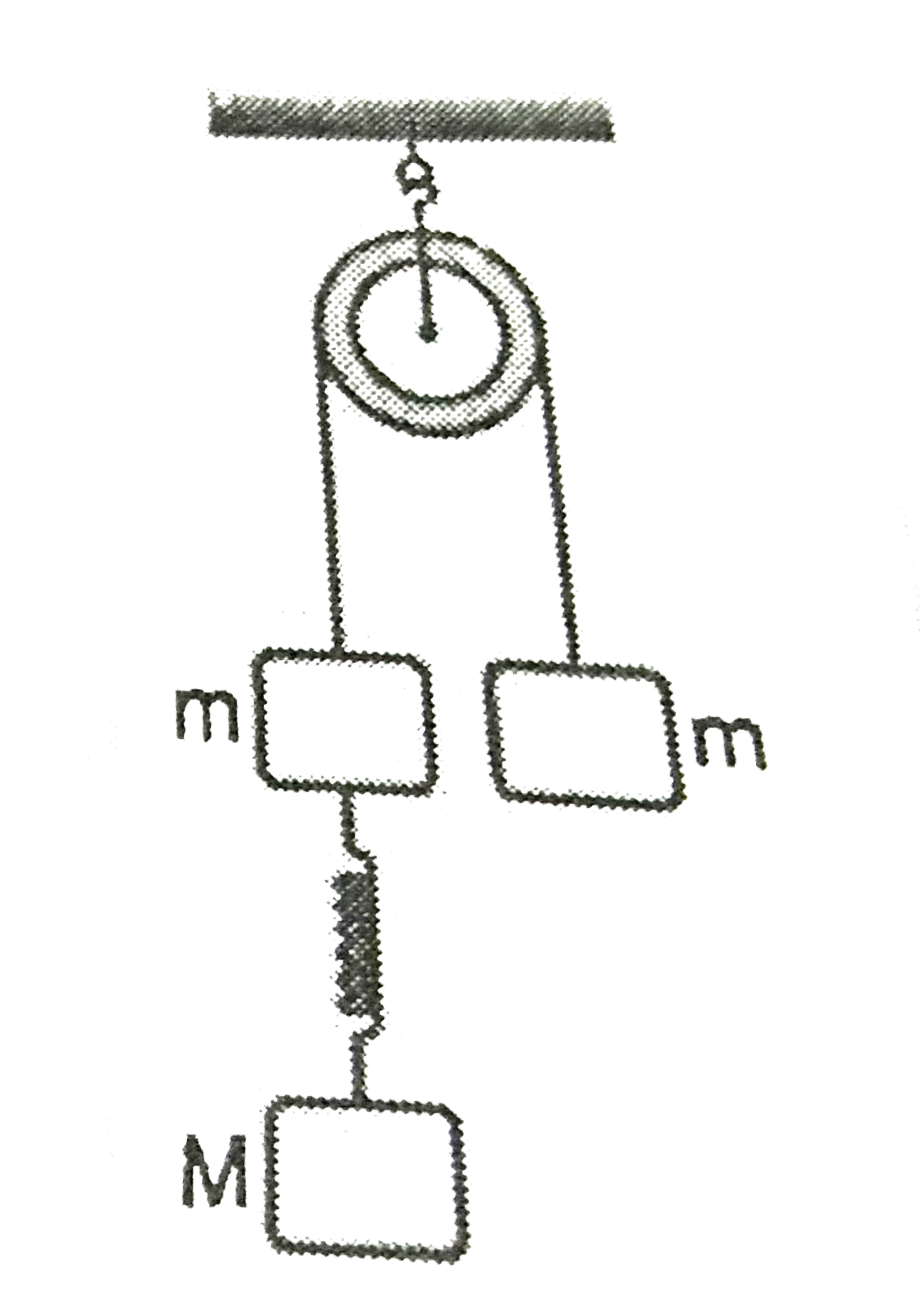
A
B
C
D
Text Solution
Verified by Experts
The correct Answer is:



Topper's Solved these Questions
FORCE AND NEWTONS LAWS OF MOTION
GRB PUBLICATION|Exercise More than one choice is correct|15 VideosFORCE AND NEWTONS LAWS OF MOTION
GRB PUBLICATION|Exercise Assertion- Reason|4 VideosFORCE AND NEWTONS LAWS OF MOTION
GRB PUBLICATION|Exercise Problem for practice|30 VideosBASIC MATHEMATICS
GRB PUBLICATION|Exercise Problems For Practice|35 VideosFRICTION AND CIRCULAR MOTION
GRB PUBLICATION|Exercise Comprehension type|11 Videos
Similar Questions
Explore conceptually related problems
GRB PUBLICATION-FORCE AND NEWTONS LAWS OF MOTION-Objective Questions
- A 45 kg box starts from rest and moves on a smooth plane the force tha...
Text Solution
|
- Three forces are acting on a particle of mass m initially in equilibri...
Text Solution
|
- The system shown in th fig is released from rest. (Neglecting friction...
Text Solution
|
- A particle moves in the x-y plane under is influence of a force such t...
Text Solution
|
- A ball of mass 3kg moving with a speed of 100 m/s, strikes a wall at a...
Text Solution
|
- A 2kg block in on 5 kg block. The system of blocks falls freely due to...
Text Solution
|
- Two blocks A and B connected by an ideal spring of spring constant K=1...
Text Solution
|
- Two small balls of the same size and of masses m(1) and m(2) (m(1) gt ...
Text Solution
|
- Block A and C start from rest and move to the right with acceleration ...
Text Solution
|
- In the arrangement shown in figure m(1)=1kg, m(2)=2kg, pullyes are mas...
Text Solution
|
- Assuming the gravity to be in negative z-direction, a force F=vxxA is ...
Text Solution
|
- System shown in fig is in equilibrium and at rest. The spring and stri...
Text Solution
|
- In the figure the wedge is pushed with an acceleration of sqrt3 m//s ^...
Text Solution
|
- The pulley shown in the diagram is frictionless. A cat of mass 1kg mov...
Text Solution
|
- A particle is moving in a circular path. The acceleration and moment o...
Text Solution
|
- The graph describes an airplane's acceleration during its take-off run...
Text Solution
|
- A physics textbook of mass m rests flat on a horizontal table of mass ...
Text Solution
|
- A rhombus ABCD is shown in the fig The sides of the rhombus can rotate...
Text Solution
|
- An elevator is accelerating upwards with an acceleration of 6m//s^(2) ...
Text Solution
|
- The figure shows the position-time (x-t) graph of one-dimensional moti...
Text Solution
|