Home
Class 11
PHYSICS
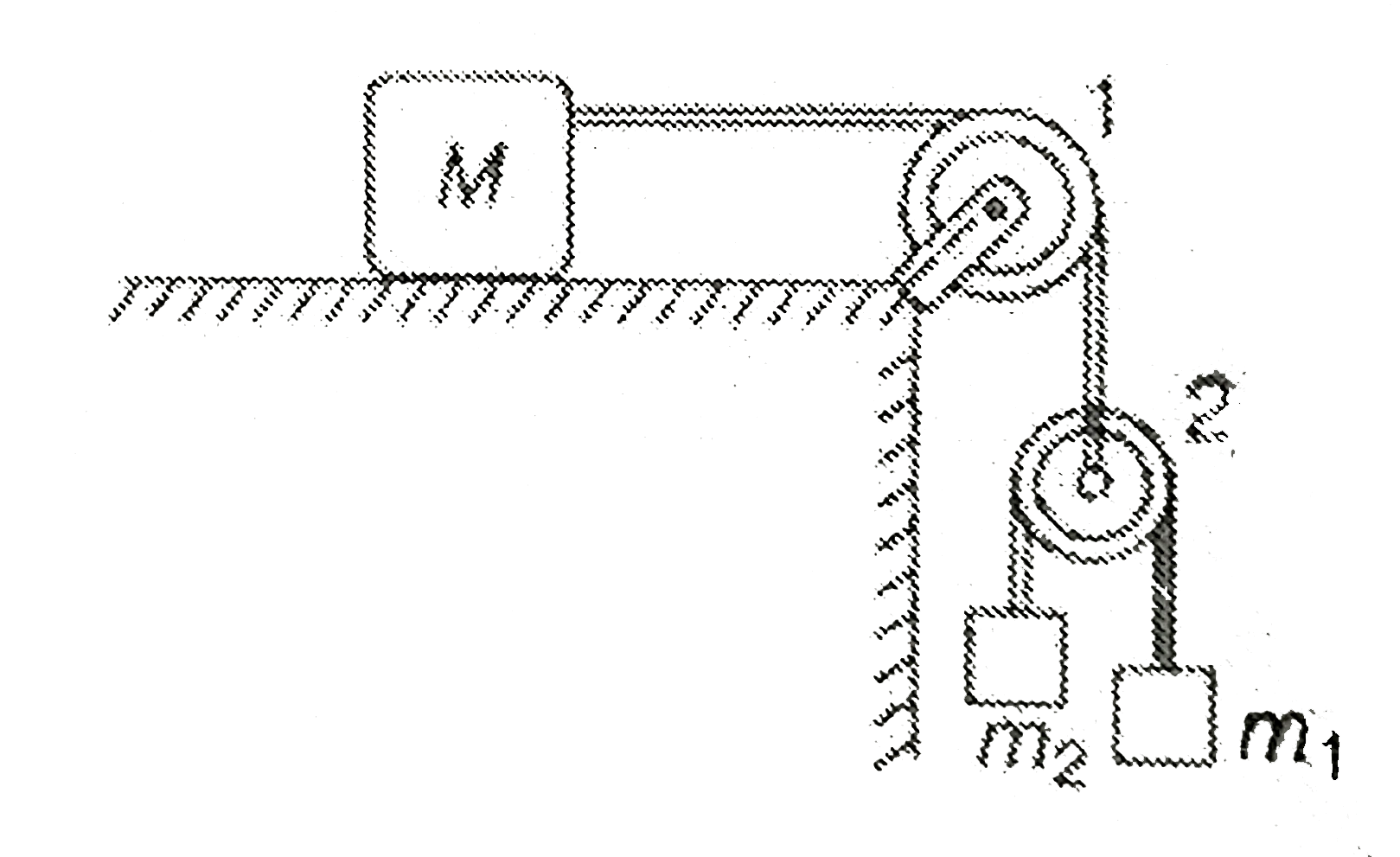
In the arrangement shown in figure m(1)=...

In the arrangement shown in figure `m_(1)=1kg, m_(2)=2kg`, pullyes are massless and strings are light. For what value of M the mass `m_(1)` moves with constant velocity? (Neglect friction)

A

6kg

B

4 kg

C

8 kg

D

10 kg

Text Solution

Verified by Experts

The correct Answer is:

C
Promotional Banner

Topper's Solved these Questions

  • FORCE AND NEWTONS LAWS OF MOTION

    GRB PUBLICATION|Exercise More than one choice is correct|15 Videos
  • FORCE AND NEWTONS LAWS OF MOTION

    GRB PUBLICATION|Exercise Assertion- Reason|4 Videos
  • FORCE AND NEWTONS LAWS OF MOTION

    GRB PUBLICATION|Exercise Problem for practice|30 Videos
  • BASIC MATHEMATICS

    GRB PUBLICATION|Exercise Problems For Practice|35 Videos
  • FRICTION AND CIRCULAR MOTION

    GRB PUBLICATION|Exercise Comprehension type|11 Videos

Similar Questions

Explore conceptually related problems

In the arrangement shown in fig. m_(1)=1kg, m_(2)=2 kg . Pulleys are massless and strings are light. For what value of M, the mass m_(1) moves with constant velocity.

In the arrangment as shown below m_(1) = 1 kg, m_(2) = 2 kg . Pulleys are massless and strings are light . For what value of M the mass m_(1) moves with constant velocity . ( Neglect Friction)

In the system shown in figure m_(B)=4kg , and m_(A)=2kg . The pulleys are massless and friction is absent everywhere. The acceleration of block A is.

In the arrangement shown in Figure, m_A=2kg and m_B=1kg . String is light and inextensible. Find the acceleration of centre of mass of both the blocks. Neglect friction everywhere.

In the arrangement shown the fixed pulley is massless and frictionless. If the acceleration of block of mass 1kg is (30)/(x)m//s^(2) . Find the value of x .

In the arrangement shown in figure pulleys are mass of block A,b and C is m_(1) = 5 kg m_(2) = 4 kg and m_(3) = 2.5 kg respectively .Co-efficient acceleration of friction for both the plane is mu = 0.50 Calculate acceleration of which block when system is released from rest

In the system shown in fig., all pulleys are mass less and the string is inextensible and light. (a) After the system is released, find the acceleration of mass m_(1) (b) If m_(1) = 1 kg, m_(2) = 2 kg "and" m_(3) = 3 kg then what must be value of mass m_(4) so that it accelerates downwards?

Three blocks of masses m_(1), m_(2) and M are arranged as shown in figure. All the surfaces are fricationless and string is inextensible. Pulleys are light. A constant force F is applied on block of mass m_(1) . Pulleys and string are light. Part of the string connecting both pulleys is vertical and part of the strings connecting pulleys with masses m_(1) and m_(2) are horizontal. {:((P),"Accleration of mass " m_(1),(1) F/(m_(1))),((Q),"Acceleration of mass" m_(2),(2) F/(m_(1)+m_(2))),((R),"Acceleration of mass M",(3) "zero"),((S), "Tension in the string",(4) (m_(2)F)/(m_(1)+m_(2))):}

In the arrangement shown in figure pulley P can move whereas other two pulleys are fixed. All of them are light. String is light and inextensible. The coefficient of friction between 2 kg and 3 kg block is mu = 0.75 and that between 3 kg block and the table is mu = 0.5 . The system is released from rest (i) Find maximum value of mass M, so that the system does not move. Find friction force between 2 kg and 3 kg blocks in this case. (ii) If M = 4 kg, find the tension in the string attached to 2 kg block. (iii) If M = 4 kg and mu_(1) = 0.9 , find friction force between the two blocks, and acceleration of M. (iv) Find acceleration of M if m_(1) = 0.75, m_(2) = -0.9 and M = 4 kg.

GRB PUBLICATION-FORCE AND NEWTONS LAWS OF MOTION-Objective Questions
  1. Two small balls of the same size and of masses m(1) and m(2) (m(1) gt ...

    Text Solution

    |

  2. Block A and C start from rest and move to the right with acceleration ...

    Text Solution

    |

  3. In the arrangement shown in figure m(1)=1kg, m(2)=2kg, pullyes are mas...

    Text Solution

    |

  4. Assuming the gravity to be in negative z-direction, a force F=vxxA is ...

    Text Solution

    |

  5. System shown in fig is in equilibrium and at rest. The spring and stri...

    Text Solution

    |

  6. In the figure the wedge is pushed with an acceleration of sqrt3 m//s ^...

    Text Solution

    |

  7. The pulley shown in the diagram is frictionless. A cat of mass 1kg mov...

    Text Solution

    |

  8. A particle is moving in a circular path. The acceleration and moment o...

    Text Solution

    |

  9. The graph describes an airplane's acceleration during its take-off run...

    Text Solution

    |

  10. A physics textbook of mass m rests flat on a horizontal table of mass ...

    Text Solution

    |

  11. A rhombus ABCD is shown in the fig The sides of the rhombus can rotate...

    Text Solution

    |

  12. An elevator is accelerating upwards with an acceleration of 6m//s^(2) ...

    Text Solution

    |

  13. The figure shows the position-time (x-t) graph of one-dimensional moti...

    Text Solution

    |

  14. A particle of mass m is at rest at the origin at time t=0 It is subjec...

    Text Solution

    |

  15. If a simple pendulum has significant amplitude (up to a factor of1//e ...

    Text Solution

    |

  16. A particle tied to a string describes a vertical circular motion of ra...

    Text Solution

    |

  17. A space- craft of mass 100 kg breaks into two, when its velocity is 10...

    Text Solution

    |

  18. An inclined plane makes an angle 30^(@) with the horizontal. A groove ...

    Text Solution

    |

  19. Find the acceleration of block B realtive to the ground if the block A...

    Text Solution

    |

  20. Under the action of force P, the constant acceleration of block B is 3...

    Text Solution

    |
