Home
Class 11
PHYSICS
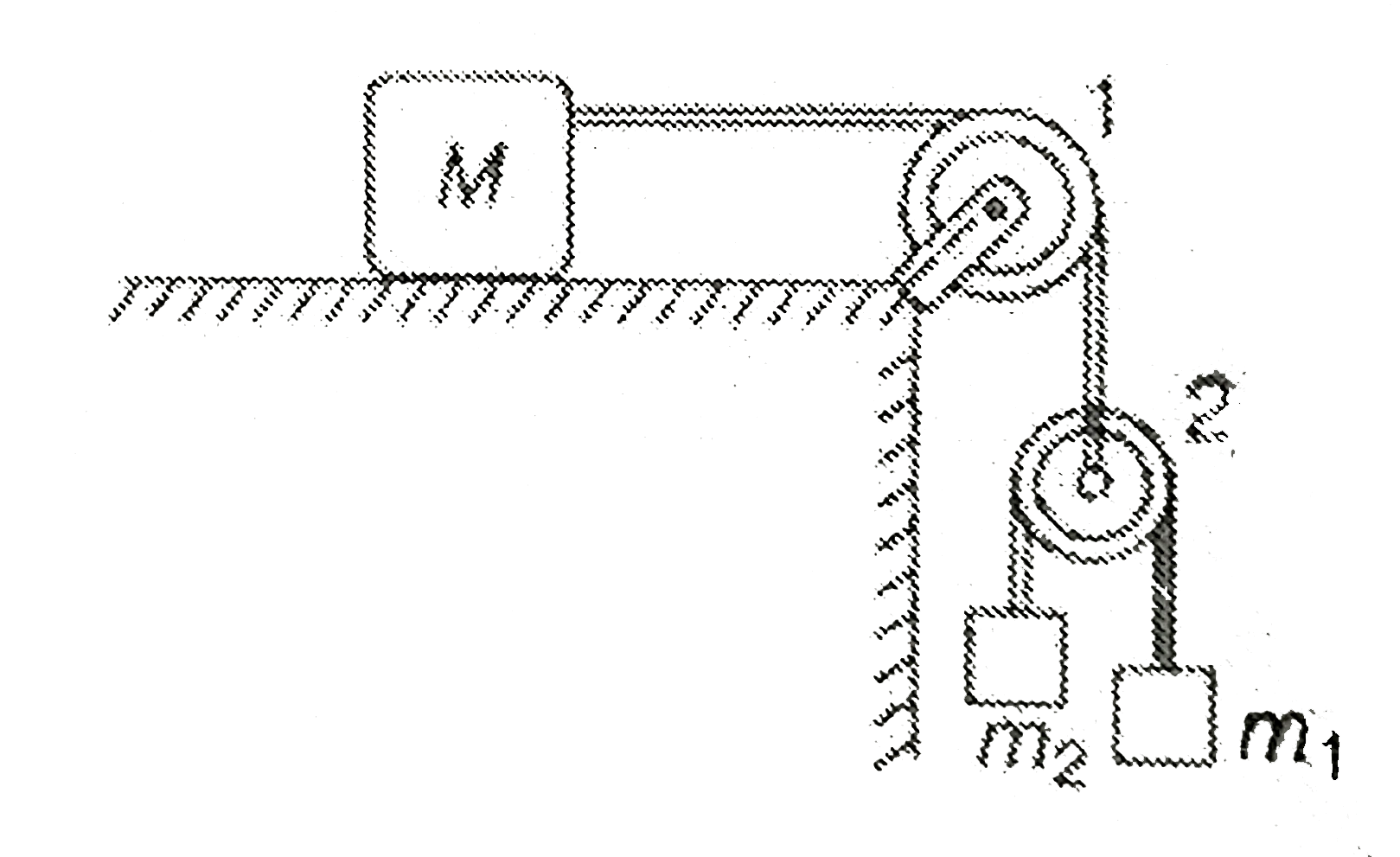
In the arrangement shown in figure m(1)=...

In the arrangement shown in figure `m_(1)=1kg, m_(2)=2kg`, pullyes are massless and strings are light. For what value of M the mass `m_(1)` moves with constant velocity? (Neglect friction)

A

6 kg

B

4 kg

C

8 kg

D

10 kg

Text Solution

Verified by Experts

The correct Answer is:
C

Mass `m_(1)` moves with constant velocity if tension in the lower
string `T_(1)=m_(1)g=(1)(10)=10N` .....(i)
:. Tension in the upper string is
`T_(2)=2T_(1)=20N` ....(ii)
Acceleration of block M is therefore
`a=T_(2)/M=20/M` ....(iii)
This is also the acceleration of pulley 2

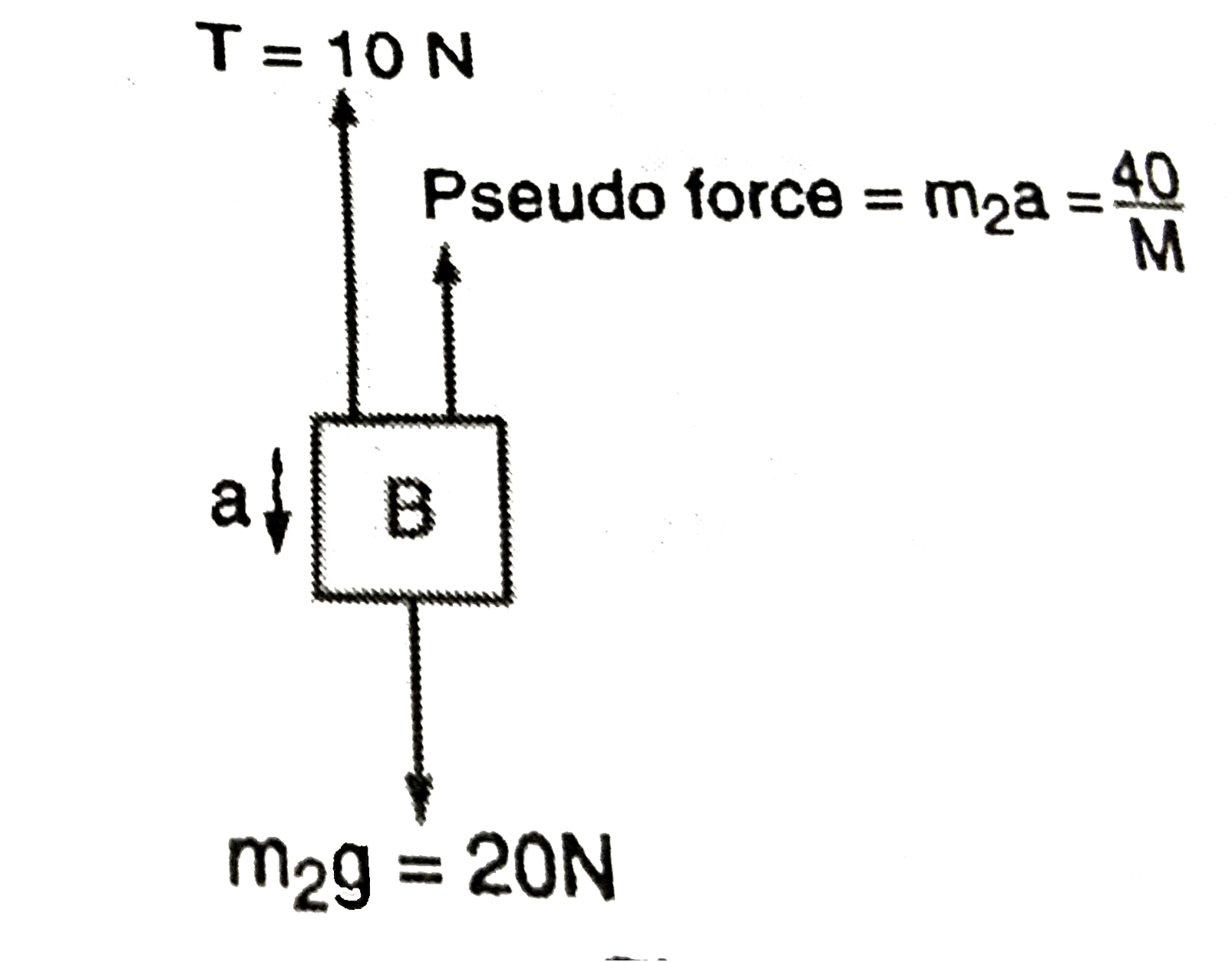
Absolute acceleration of mass `m_(1)` is zero. Thus, acceleration of `m_(1)` relative to pulley 2 is upwards or acceleration of `m_(2)` with respect to pulley 2 is a downwards Drawing free body diagrams of `m_(2)` with respect to pulley 2 Equation of motion gives
`20-40/M-10=2a=40/M`
Solving this we get `M=8` kg
Promotional Banner

Topper's Solved these Questions

  • FORCE AND NEWTONS LAWS OF MOTION

    GRB PUBLICATION|Exercise More than one choice is correct|15 Videos
  • FORCE AND NEWTONS LAWS OF MOTION

    GRB PUBLICATION|Exercise Assertion- Reason|4 Videos
  • FORCE AND NEWTONS LAWS OF MOTION

    GRB PUBLICATION|Exercise Problem for practice|30 Videos
  • BASIC MATHEMATICS

    GRB PUBLICATION|Exercise Problems For Practice|35 Videos
  • FRICTION AND CIRCULAR MOTION

    GRB PUBLICATION|Exercise Comprehension type|11 Videos

Similar Questions

Explore conceptually related problems

In the arrangement shown in fig. m_(1)=1kg, m_(2)=2 kg . Pulleys are massless and strings are light. For what value of M, the mass m_(1) moves with constant velocity.

In the arrangment as shown below m_(1) = 1 kg, m_(2) = 2 kg . Pulleys are massless and strings are light . For what value of M the mass m_(1) moves with constant velocity . ( Neglect Friction)

In the system shown in figure m_(B)=4kg , and m_(A)=2kg . The pulleys are massless and friction is absent everywhere. The acceleration of block A is.

In the arrangement shown in Figure, m_A=2kg and m_B=1kg . String is light and inextensible. Find the acceleration of centre of mass of both the blocks. Neglect friction everywhere.

In the arrangement shown the fixed pulley is massless and frictionless. If the acceleration of block of mass 1kg is (30)/(x)m//s^(2) . Find the value of x .

In the arrangement shown in figure pulleys are mass of block A,b and C is m_(1) = 5 kg m_(2) = 4 kg and m_(3) = 2.5 kg respectively .Co-efficient acceleration of friction for both the plane is mu = 0.50 Calculate acceleration of which block when system is released from rest

In the system shown in fig., all pulleys are mass less and the string is inextensible and light. (a) After the system is released, find the acceleration of mass m_(1) (b) If m_(1) = 1 kg, m_(2) = 2 kg "and" m_(3) = 3 kg then what must be value of mass m_(4) so that it accelerates downwards?

Three blocks of masses m_(1), m_(2) and M are arranged as shown in figure. All the surfaces are fricationless and string is inextensible. Pulleys are light. A constant force F is applied on block of mass m_(1) . Pulleys and string are light. Part of the string connecting both pulleys is vertical and part of the strings connecting pulleys with masses m_(1) and m_(2) are horizontal. {:((P),"Accleration of mass " m_(1),(1) F/(m_(1))),((Q),"Acceleration of mass" m_(2),(2) F/(m_(1)+m_(2))),((R),"Acceleration of mass M",(3) "zero"),((S), "Tension in the string",(4) (m_(2)F)/(m_(1)+m_(2))):}

In the arrangement shown in figure pulley P can move whereas other two pulleys are fixed. All of them are light. String is light and inextensible. The coefficient of friction between 2 kg and 3 kg block is mu = 0.75 and that between 3 kg block and the table is mu = 0.5 . The system is released from rest (i) Find maximum value of mass M, so that the system does not move. Find friction force between 2 kg and 3 kg blocks in this case. (ii) If M = 4 kg, find the tension in the string attached to 2 kg block. (iii) If M = 4 kg and mu_(1) = 0.9 , find friction force between the two blocks, and acceleration of M. (iv) Find acceleration of M if m_(1) = 0.75, m_(2) = -0.9 and M = 4 kg.

GRB PUBLICATION-FORCE AND NEWTONS LAWS OF MOTION-Objective Questions
  1. An inclined plane makes an angle 30^(@) with the horizontal. A groove ...

    Text Solution

    |

  2. Find the acceleration of block B realtive to the ground if the block A...

    Text Solution

    |

  3. Under the action of force P, the constant acceleration of block B is 3...

    Text Solution

    |

  4. Find the acceleration of the body of mass m(2) in the arrangement show...

    Text Solution

    |

  5. If A and B moves with acceleration a block c moves up with acceleratio...

    Text Solution

    |

  6. Three identical rigid circular cylinder A B and C are arrenged on smoo...

    Text Solution

    |

  7. In the arrangement shown, blocks A and B connected with an inextensibl...

    Text Solution

    |

  8. In the figure heavy mass m moves down the smooth surface of a wedge ma...

    Text Solution

    |

  9. A weightless inextensible rope rests on a stationary wedge forming an ...

    Text Solution

    |

  10. Block is attached to system of springs. Calculate equivalent spring co...

    Text Solution

    |

  11. Block A and C start from rest and move to the right with acceleration ...

    Text Solution

    |

  12. In the arrangement shown in figure m(1)=1kg, m(2)=2kg, pullyes are mas...

    Text Solution

    |

  13. Find equivalent spring constant for the system:

    Text Solution

    |

  14. In the above diagram system is in equilibrium if applied force F is do...

    Text Solution

    |

  15. The pulleys and strings shown in the figure are smooth and of negligib...

    Text Solution

    |

  16. A string of negligible mass going over a clamped pulley of mass m supp...

    Text Solution

    |

  17. Two masses each equal to m are lying on x-axis at (-a,0)(+a,0) respect...

    Text Solution

    |

  18. Two blocks A and B of masses 2m and respectively, are connected by a ...

    Text Solution

    |

  19. A piece of wire is bent in the shape of a parabola y=kx^(2) (y-axis ve...

    Text Solution

    |

  20. A block of mass 2 kg is free to move along the x-axis it is at rset an...

    Text Solution

    |

