Home
Class 11
CHEMISTRY
Among NH(3),H(2)O, and HF, which would y...

Among `NH_(3),H_(2)O`, and `HF`, which would you expect to have highest magnitude of hydrogen bonding and why?

Text Solution

Verified by Experts
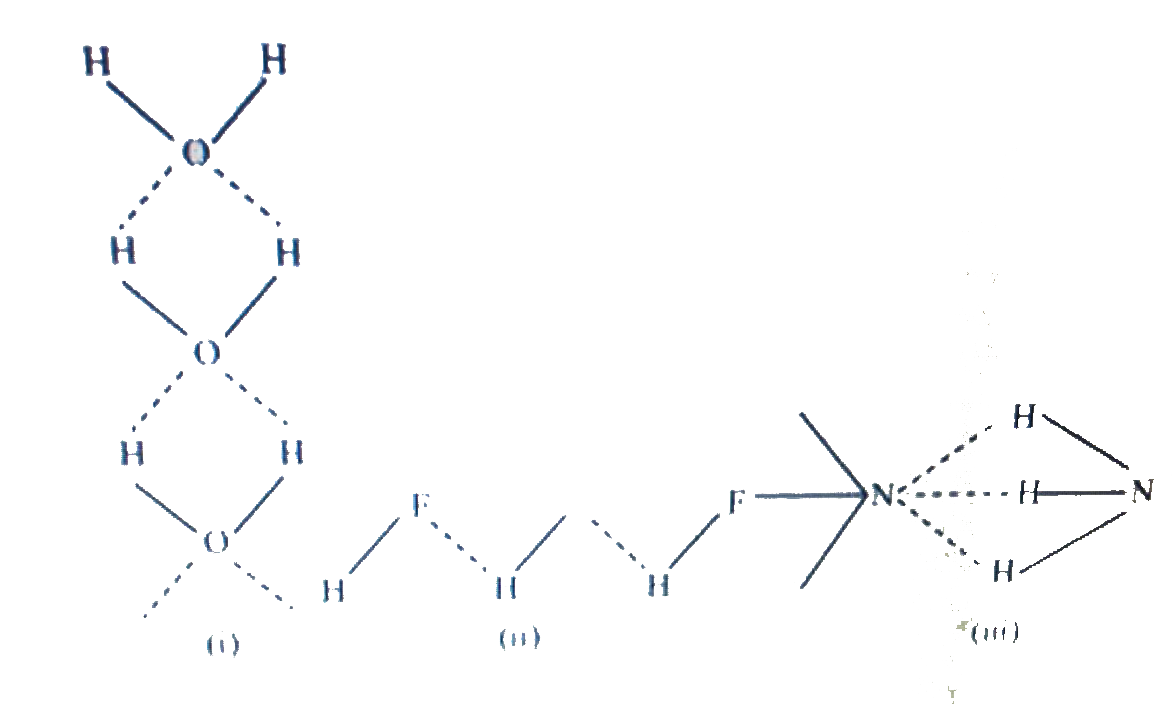
The extent of hydrogen bonding depends upon electronegativity and the number of hydrogen atoms available for bonding. Among nitrogen, fluorine, and oxygen, the increasing order of their electronegativities are `N lt O lt F`.
Hence, the expected order of the extent of hydrogen bonding is `HF gt H2O gt NH_(3)`. But, the actual order is `H_(2)O gt HF gt NH_(3)`.
Although fluorine is more electronegative than oxygen, the extent of hydrogen bonding is higher in water. There is a shortage of hydrogens in HF, whereas there are exactly the right numbers of hydrogens in water. As a result, only straight chain bonding takes place. On the other hand, oxygen forms a huge ring-like structure through its high ability of hydrogen bonding.
In case of ammonia, the extent of hydrogen bonding is limited because nitrogen has only one lone pair. Therefore, it cannot satisfy all hydrogens.
Promotional Banner

Topper's Solved these Questions

  • HYDROGEN

    NCERT|Exercise EXERCISE|36 Videos
  • HYDROCARBONS

    NCERT|Exercise EXERCISE|25 Videos
  • ORGANIC CHEMISTRY- SOME BASIC PRINCIPLES AND TECHNIQUES

    NCERT|Exercise EXERCISE|40 Videos

Similar Questions

Explore conceptually related problems

Which one of the following would you expect to be the most acidic hydrogen site ?

Which of the following would you expect to have highest electronegativity?

Which one of the following compounds would have the highest heat of hydrogenation ?

Which one of the following compounds would have the highest heat of hydrogenation ?

Which of the following compounds would you expect to have a dipole moment ?

NCERT-HYDROGEN-EXERCISE
  1. How do you expect the metallic hydrides to be useful for hydrogen stor...

    Text Solution

    |

  2. How does the atomic hydrogen or oxy-hydrogen torch funtion for cutting...

    Text Solution

    |

  3. Among NH(3),H(2)O, and HF, which would you expect to have highest magn...

    Text Solution

    |

  4. Saline hydrides are known to react with water violently producing fire...

    Text Solution

    |

  5. Arrange the following (i) CaH(2), BeH(2) and TiH(2) in order of increa...

    Text Solution

    |

  6. Compare the stuctures of H(2)O and H(2)O(2).

    Text Solution

    |

  7. What do you understand by the term 'auto-protolysis' of water? What is...

    Text Solution

    |

  8. Consider the reacton of water with F(2) and suggest, in terms of oxida...

    Text Solution

    |

  9. Complete the following chemical reactions. (i) PbS(s)+H(2)O(2)(aq) t...

    Text Solution

    |

  10. Describe the structure of the common form of ice.

    Text Solution

    |

  11. What causes the temporary and permanent hardness of water ?

    Text Solution

    |

  12. Discuss the principle and method of softening of hard water by synthet...

    Text Solution

    |

  13. Write chemical reactions to show the amphoteric nature of water.

    Text Solution

    |

  14. Write chemical reactions to justifty that hydrogen peroxide can functi...

    Text Solution

    |

  15. What is meant by 'demineralised water' and how it can be obtained?

    Text Solution

    |

  16. Is demineralised or distilled water useful for drinking purpose? If no...

    Text Solution

    |

  17. Describe the usefulness of water in bioshphere and biological systems.

    Text Solution

    |

  18. What properties of water make it useful as a solvent? What types of co...

    Text Solution

    |

  19. Knowing the properties of H(2)O and D(2)O, do you think that D(2)O can...

    Text Solution

    |

  20. What is the difference between hydrolysis and hydration?

    Text Solution

    |

