

Home
Class 11
CHEMISTRY
Discuss the principle and method of soft...

Discuss the principle and method of softening of hard water by synthetic ion- exchange resins.

Text Solution

Verified by Experts

The process of treating permanent hardness of water using synthetic resins is based on the exchange of cations `(e.g., Na^(+), Ca2^(+), Mg_(2)+ etc)` and anions `(e.g., Cl^(-) SO_(4)2^(–), HCO^(–) etc)` present in water by `H^(+) and OH^(–)` ions respectively.
Synthetic resins are of two types:
(1) Cation exchange resins
(2) Anion exchange resins
Cation exchange resins are large organic molecules that contain the `–SO_(3)H` group. The resin is firstly changed to RNa (from `RSO_(3)H)` by treating it with NaCl. This resin then exchanges Na+ ions with `Ca_(2+)` and `Mg_(2+)` ions, thereby making the water soft.
`2RNa+M^(2+)_(aq) to R_(2)M_(s)+2Na^(+)_(aq)`
There are cation exchange resins in `H^(+)` form. The resins exchange H+ ions for `Na^(+), Ca_(2+), and Mg_(2+) ions`.
`2RH+M^(2+) Leftrightarrow MR_(2_(aq))+2H_(aq)^(+)`
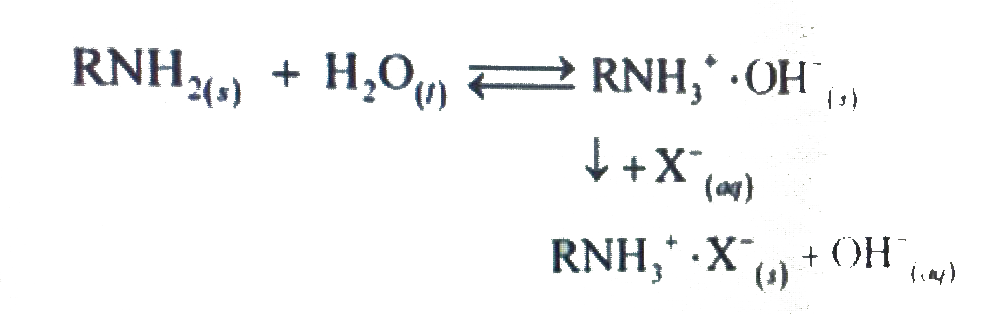
Anion exchange resins exchange OH– ions for anions like `Cl^(-) and SO_(2–)` present in water.

During the complete process, water first passes through the cation exchange process. The water obtained after this process is free from mineral cations and is acidic in nature. This acidic water is then passed through the anion exchange process where `OH(-)` ions neutralize the H+ ions and de-ionize the water obtained.
Promotional Banner

Topper's Solved these Questions

  • HYDROGEN

    NCERT|Exercise EXERCISE|36 Videos
  • HYDROCARBONS

    NCERT|Exercise EXERCISE|25 Videos
  • ORGANIC CHEMISTRY- SOME BASIC PRINCIPLES AND TECHNIQUES

    NCERT|Exercise EXERCISE|40 Videos

Similar Questions

Explore conceptually related problems

Calgon causes the softening of hard water by

Which of the following can be used for softening of hard water?

Ion Exchange Method

Dicuss briefly de- mineralistion of water by ion exchange resin.

NCERT-HYDROGEN-EXERCISE
  1. Compare the stuctures of H(2)O and H(2)O(2).

    Text Solution

    |

  2. What do you understand by the term 'auto-protolysis' of water? What is...

    Text Solution

    |

  3. Consider the reacton of water with F(2) and suggest, in terms of oxida...

    Text Solution

    |

  4. Complete the following chemical reactions. (i) PbS(s)+H(2)O(2)(aq) t...

    Text Solution

    |

  5. Describe the structure of the common form of ice.

    Text Solution

    |

  6. What causes the temporary and permanent hardness of water ?

    Text Solution

    |

  7. Discuss the principle and method of softening of hard water by synthet...

    Text Solution

    |

  8. Write chemical reactions to show the amphoteric nature of water.

    Text Solution

    |

  9. Write chemical reactions to justifty that hydrogen peroxide can functi...

    Text Solution

    |

  10. What is meant by 'demineralised water' and how it can be obtained?

    Text Solution

    |

  11. Is demineralised or distilled water useful for drinking purpose? If no...

    Text Solution

    |

  12. Describe the usefulness of water in bioshphere and biological systems.

    Text Solution

    |

  13. What properties of water make it useful as a solvent? What types of co...

    Text Solution

    |

  14. Knowing the properties of H(2)O and D(2)O, do you think that D(2)O can...

    Text Solution

    |

  15. What is the difference between hydrolysis and hydration?

    Text Solution

    |

  16. How can saline hydrides remove traces of water from organic compouds?

    Text Solution

    |

  17. What do you expect the nature of hydrides is, it formed by elements of...

    Text Solution

    |

  18. Do you expect different products in solution when aluminium (III) chlo...

    Text Solution

    |

  19. How does H(2)O(2) behave as a bleaching agent?

    Text Solution

    |

  20. What do you understand by the terms: (i) hydrogen economy (ii) hydroge...

    Text Solution

    |