Home
Class 11
PHYSICS
Let the speed of the planet at the perih...

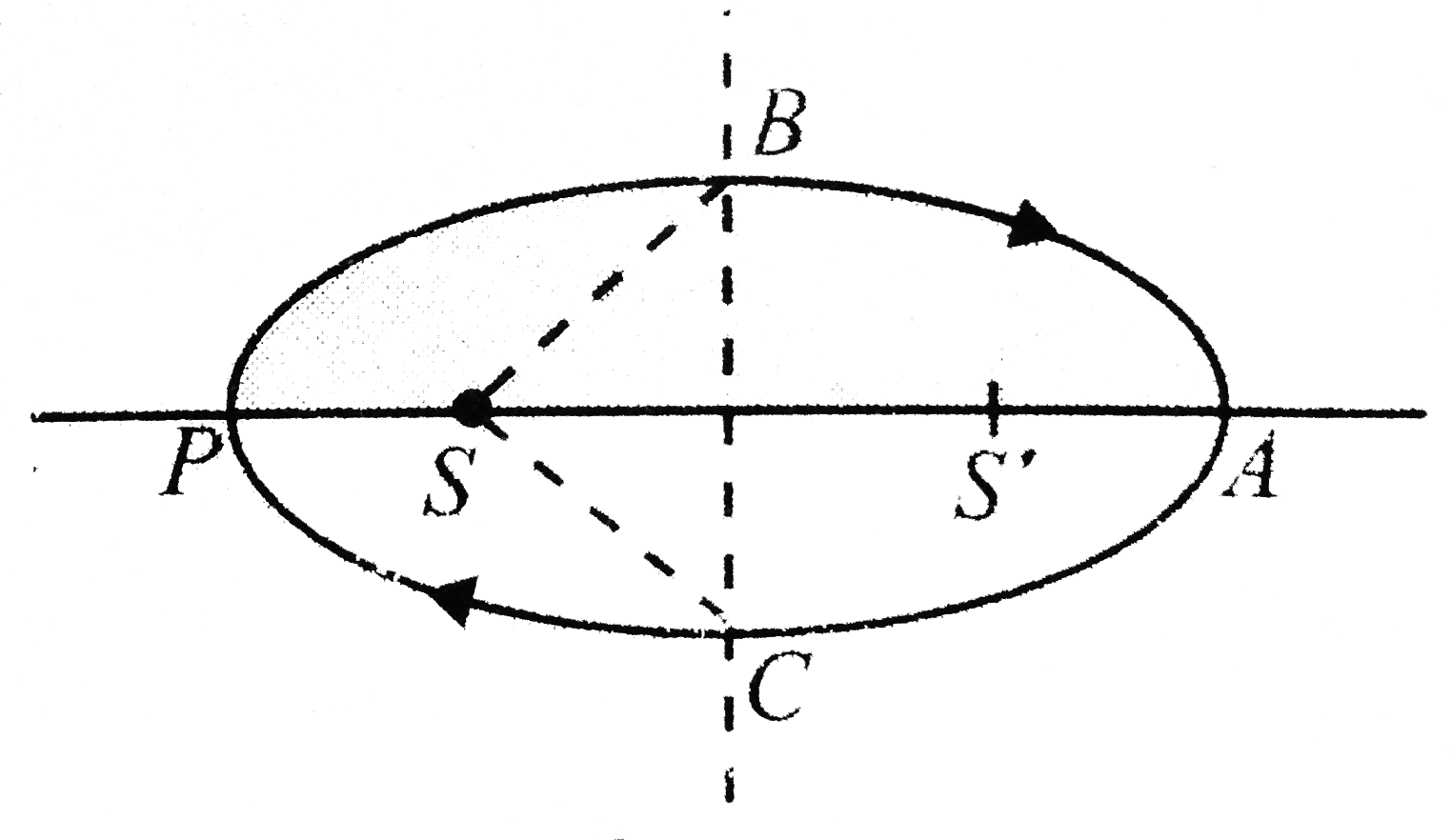
Let the speed of the planet at the perihelion `P` in figure be `v_(P)` and the Sun planet distance `SP` be `r_(P)`. Relater `r_(P), v_(P)` to the corresponding quantities at the aphelion `(r_(A),v_(A))`. Will the planet take equal times to transverse `BAC` and `CPB`?

Text Solution

Verified by Experts

The magnitude of the angular momentum at P is `L_(p)=m_(P)r_(p)u_(p)`. Since inspection tells us that `r_(p)` and `v_(p)` are mutually perpendicular. Similarly . `L_(A)=m_(p)r_(A).v_(A)`. From angular momentum conservation
`m_(p)r_(p)v_(p)=m_(p)r_(A)v_(A)`
or `(v_(p))/(v_(A))=(r_(A))/(r_(p))`
The area, SBAX bounded by the elipse and the raidus vectors SB and SC is large than SBPC in Fig. 9.1 From kepler's second law, equal areas are swept in equal times. Hence the planat will take a longer time to traverse BAC than CPB.
Promotional Banner

Topper's Solved these Questions

Similar Questions

Explore conceptually related problems

A speed of the palnet at the perihelion P be V_(p) and the sun -planet distance SP be r_(P) as shown in fig. Relate {r_(p),v_(p)} to the corresponding quantities at the aphelion {r_(A),V_(A)} . Will the planet take equal times to traverse BAC and CPB?

Let V and I be the readings of the voltmeter and the ammeter respectively as shown in the figure. Let R_(V) " and "R_(A) be their corresponding resistancce Therefore,

If r denotes the mean distance of a planet from the sun and T is the time period of planet, then

The radius of a planet is twice that of the earth but its average density is the same. If the escape speed at the planet and at the earth are v_(p) and v_(e) , respectively, then prove that v_(p)=2v_(e)

The period of revolution of a planet around the sun is 8 times that of the earth. If the mean distance of that planet from the sun is r, then mean distance of earth from the sun is

NCERT-GRAVITATION-EXERCISE
  1. Let the speed of the planet at the perihelion P in figure be v(P) and ...

    Text Solution

    |

  2. Answer the following: (a) You can shield a charge from electrical forc...

    Text Solution

    |

  3. Choose the correct alternative (a)Acceleration due to gravity increa...

    Text Solution

    |

  4. Suppose there existed a planet that went around the sun twice as fast ...

    Text Solution

    |

  5. One of the satellite of jupiter, has an orbital period of 1.769 days a...

    Text Solution

    |

  6. Let us consider that our galaxy consists of 2.5xx10^(11) stars each of...

    Text Solution

    |

  7. Choose the correct alternative : (a) If the zero of the potential en...

    Text Solution

    |

  8. Does the escape speed of a body from the earth depend on (a) the mass ...

    Text Solution

    |

  9. A comet orbits the Sun in a highly elliptical orbit. Does the comet ha...

    Text Solution

    |

  10. Which of the following symptoms is likely to afflict an astronaut in s...

    Text Solution

    |

  11. In the following two exercises, choose the correct answer from among t...

    Text Solution

    |

  12. For the above problem, the direction of the gravitational intensity at...

    Text Solution

    |

  13. A rocket is fired from the earth towards the sun. At what distance fro...

    Text Solution

    |

  14. The mean orbital radius of the Earth around the Sun is 1.5 xx 10^8 km....

    Text Solution

    |

  15. A Saturn year is 29.5 times that earth year. How far is the Saturn fro...

    Text Solution

    |

  16. A body weighs 63 N on the surface of the earth. What is the gravitatio...

    Text Solution

    |

  17. Assuming the earth to be a sphere of uniform mass density, how much wo...

    Text Solution

    |

  18. A rocket is fired vertically with a speed of 5 kms^(-1) from the earth...

    Text Solution

    |

  19. The escape speed of a projectile on the earth's surface is 11.2 km s^(...

    Text Solution

    |

  20. A satellite orbits the earth at a height of 400 km, above the surface....

    Text Solution

    |

  21. Two starts each of one solar mass (=2xx10^(30)kg) are approaching each...

    Text Solution

    |
