



Home
Class 11
CHEMISTRY
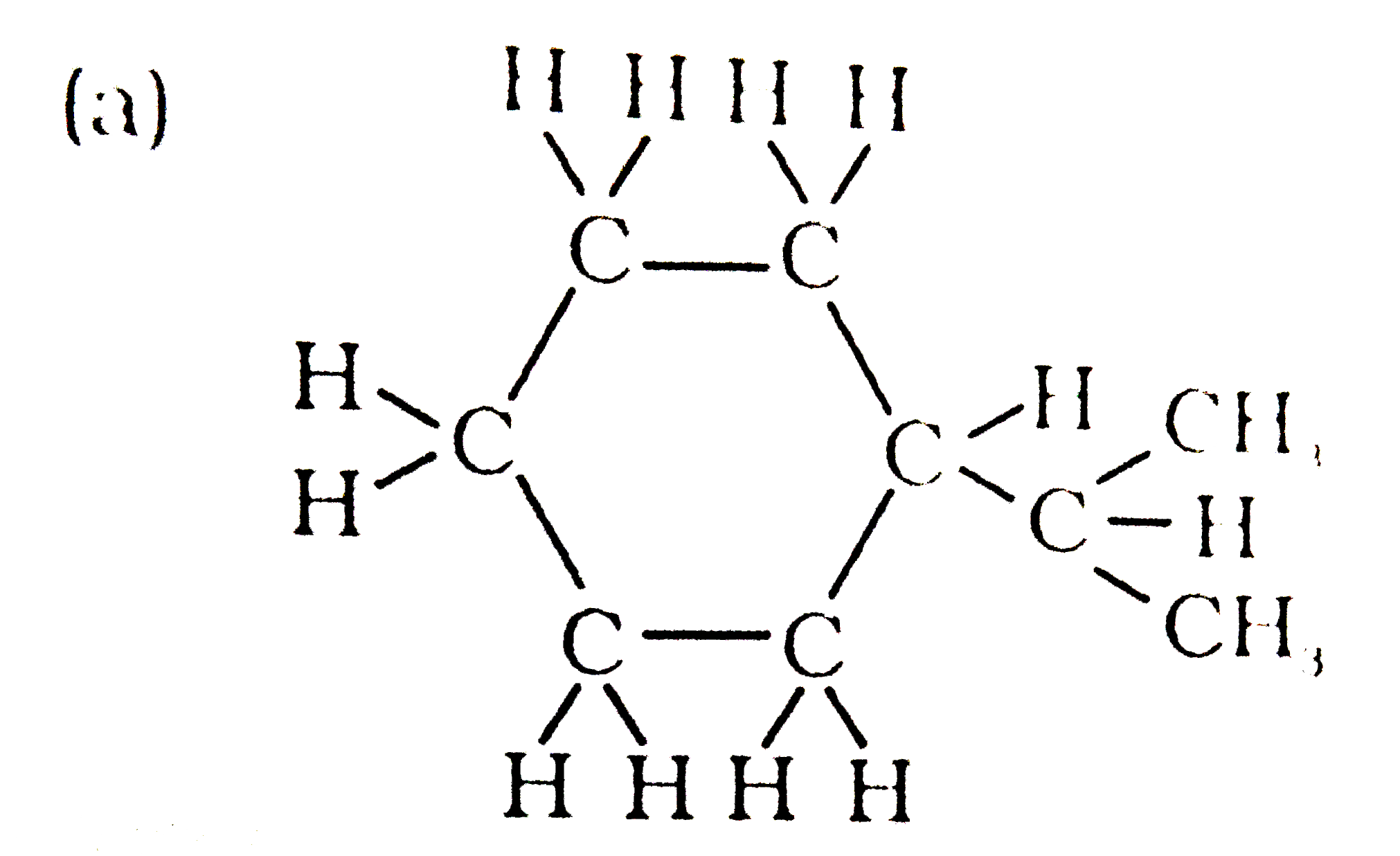
Expand each of the following bond-line f...

Expand each of the following bond-line formulas to show all the atoms including carbon and hydrogen

Text Solution

Verified by Experts


`H-underset(H)underset(|)overset(H)overset(|)C-underset(H)underset(|)overset(H)overset(|)C-underset(H)underset(|)overset(H)overset(|)C-underset(H)underset(|)overset(H)overset(|)C-underset(H)underset(|)overset(H)overset(|)C-underset(H)underset(|)overset(H)overset(|)C-underset(H)underset(|)overset(H)overset(|)C-underset(H)underset(|)overset(H)overset(|)C-H`
`H-CequivC-underset(H)underset(|)overset(H)overset(|)C-underset(OH)underset(|)overset(H)overset(|)C-underset(H)underset(|)overset(H)overset(|)C-H`
Promotional Banner

Topper's Solved these Questions

  • ORGANIC CHEMISTRY- SOME BASIC PRINCIPLES AND TECHNIQUES

    NCERT|Exercise EXERCISE|40 Videos
  • HYDROGEN

    NCERT|Exercise EXERCISE|36 Videos
  • REDOX REACTIONS

    NCERT|Exercise EXERCISE|30 Videos

Similar Questions

Explore conceptually related problems

Expand each of the following bond line formulae to show all the atoms including carbon and hydrogen. (i)

Expand each of the following bond-line formulas to show all the possible atoms including carbon and hydrogen. (i) Strategy: Each intersection of two or more lines and the end of a line represent a C atoms unless some other atom is written.

Expand each the following condensed formulae into their complete structural and bond line formulae:

Which of the following molecules shows intramolecular hydrogen bonding?

Expand each the following condensed formulae into their complete structural and bond line formulae: (a) CH_(3)CH_(2)COCH_(2)CH_(3) ,(b) CH_(3)CH=CH(CH_(2))_(3)CH_(3)

Which of the following species shows intramolecular hydrogen bonding ?

For each of the following condensed formulas, write the corresponding bond-line formula. (i) (CH_(3))_(2)CH(CH_(2))_(2)CH_(2)OH (ii) CH_(3)(CH_(2))_(4)CHICH_(2)CHO (iii) (CH_(3))_(2)CHCHCH_(3)(CH_(2))_(3)NO_(2) (iv) (CN)_(2)CHCH_(2)COCl Strategy: In a bond-line formula, carbon and hydrogen atoms (except those that are part of the functional group) are not shown. First outline the carbon skeleton in a zig-zag fashion and show only hetero atoms and H atoms bonded to them.

NCERT-ORGANIC CHEMISTRY- SOME BASIC PRINCIPLES AND TECHNIQUES-EXERCISE
  1. Expand each of the following bond-line formulas to show all the atoms ...

    Text Solution

    |

  2. Given the hybridistaiton state of each carbon in the following compoun...

    Text Solution

    |

  3. Indicate the sigma- and pi - bonds in the following molecules: I. C(...

    Text Solution

    |

  4. Write the bond line formula for the following compounds: I. Isopropy...

    Text Solution

    |

  5. Give the IUPAC names of the following compounds :

    Text Solution

    |

  6. Which of the following represents the corrcet IUPAC name for the compo...

    Text Solution

    |

  7. Draw the formulae for the first five numbers of each homologous series...

    Text Solution

    |

  8. Give condensed and bond line structural formulas and identify the func...

    Text Solution

    |

  9. Identify the functional groups in the following compounds

    Text Solution

    |

  10. Which of the two: O(2)NCH(2)CH(2)O^(–) or CH(3)CH(2)O^(–) is expecte...

    Text Solution

    |

  11. Explain why alkyl groups act as electron donors when attacted to a pi-...

    Text Solution

    |

  12. Draw the resonance structures for the following compounds. Show the el...

    Text Solution

    |

  13. What are electrophiles and nucleophiles ? Explain with examples.

    Text Solution

    |

  14. Identify the reagents shown in bold in the following equations as nucl...

    Text Solution

    |

  15. Classify the following reactions in one of the reaction type studied i...

    Text Solution

    |

  16. What is the relationship between the members of the following pairs of...

    Text Solution

    |

  17. For the following bond cleavages, use curved-arrow to show the electro...

    Text Solution

    |

  18. Explain the terms Inductive and Electromeric effects. Which electron d...

    Text Solution

    |

  19. Give a brief description of the principles of the following techniques...

    Text Solution

    |

  20. Describe the method, which can be used to separate two compounds with ...

    Text Solution

    |

  21. What is the difference between distillation, distillation under reduce...

    Text Solution

    |