

Home
Class 11
CHEMISTRY
Explain why alkyl groups act as electron...

Explain why alkyl groups act as electron donors when attacted to a `pi-system`.

Text Solution

Verified by Experts

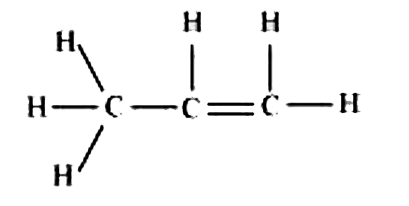
When an alkyl group is attached to a n system, it acts as an electron-donor group by the process of hyperconjugation. To understand this concept better, let us take the example of propene.

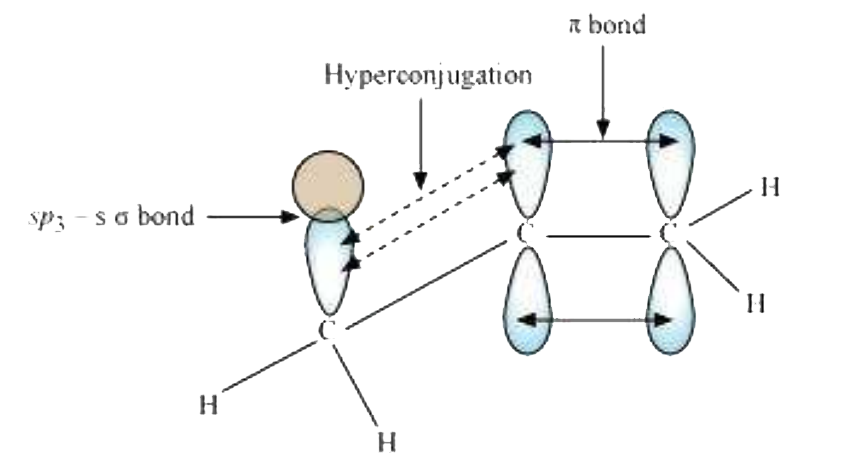
In hyperconjugation, the sigma electrons of the C–H bond of an alkyl group are delocalised. This group is directly attached to an atom of an unsaturated system. The delocalisation occurs because of a partial overlap of a `sp^(3)` –s sigma bond orbital with an empty p orbital of the π bond of an adjacent carbon atom.
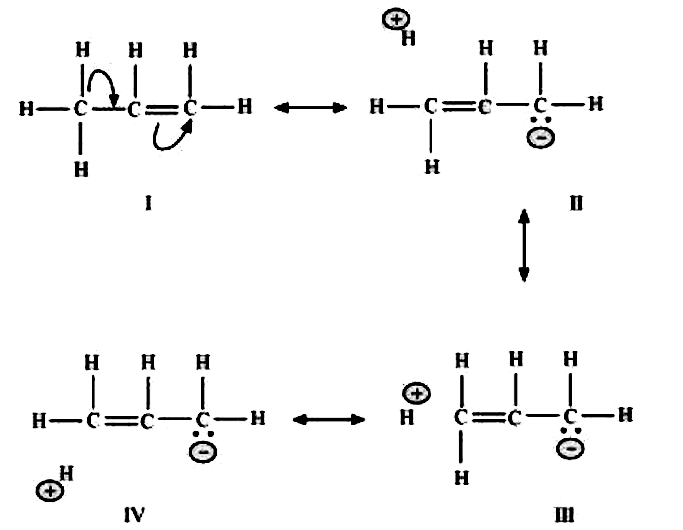
The process of hyperconjugation in propene is shown as follows:

This type of overlap leads to a delocalisation (also known as no-bond resonance) of the n electrons, making the molecule more stable.
Promotional Banner

Topper's Solved these Questions

  • ORGANIC CHEMISTRY- SOME BASIC PRINCIPLES AND TECHNIQUES

    NCERT|Exercise EXERCISE|40 Videos
  • HYDROGEN

    NCERT|Exercise EXERCISE|36 Videos
  • REDOX REACTIONS

    NCERT|Exercise EXERCISE|30 Videos

Similar Questions

Explore conceptually related problems

Explain why alky1 groups act as electron donors when attacted to a pi-system .

Which of the following alkyl groups exerts maximum hyperconjugation when bonded to an unsaturarted system?

Why do NH_(3) and H_(2)O act as electron pair donors?

Explain why is OH group in phenols more strongly held as compared to OH group in alcohols ?

NCERT-ORGANIC CHEMISTRY- SOME BASIC PRINCIPLES AND TECHNIQUES-EXERCISE
  1. Identify the functional groups in the following compounds

    Text Solution

    |

  2. Which of the two: O(2)NCH(2)CH(2)O^(–) or CH(3)CH(2)O^(–) is expecte...

    Text Solution

    |

  3. Explain why alkyl groups act as electron donors when attacted to a pi-...

    Text Solution

    |

  4. Draw the resonance structures for the following compounds. Show the el...

    Text Solution

    |

  5. What are electrophiles and nucleophiles ? Explain with examples.

    Text Solution

    |

  6. Identify the reagents shown in bold in the following equations as nucl...

    Text Solution

    |

  7. Classify the following reactions in one of the reaction type studied i...

    Text Solution

    |

  8. What is the relationship between the members of the following pairs of...

    Text Solution

    |

  9. For the following bond cleavages, use curved-arrow to show the electro...

    Text Solution

    |

  10. Explain the terms Inductive and Electromeric effects. Which electron d...

    Text Solution

    |

  11. Give a brief description of the principles of the following techniques...

    Text Solution

    |

  12. Describe the method, which can be used to separate two compounds with ...

    Text Solution

    |

  13. What is the difference between distillation, distillation under reduce...

    Text Solution

    |

  14. Discuss the chemistry of Lassaigne’s test.

    Text Solution

    |

  15. Differentiate between the principle of estimation of nitrogen in an or...

    Text Solution

    |

  16. Discuss the principle of estimation of halogens, sulphur and phosphoru...

    Text Solution

    |

  17. Explain the principle of paper chromatography.

    Text Solution

    |

  18. Why is nitric acid added to sodium extract before adding silver nitrat...

    Text Solution

    |

  19. Explain the reason for the fusion of an organic compound with metallic...

    Text Solution

    |

  20. Name a suitable technique of the components from a mixture of calcium ...

    Text Solution

    |